Jim
-
Posts
17,206 -
Joined
-
Last visited
Content Type
Profiles
Forums
Gallery
Everything posted by Jim
-
Indeed, here we go again. Let's not restart the "I think it's coming" discussion. It's coming! Now, let's be patient and wait for tangible information. Thanks.
-
Let's get back on topic shall we. Please discuss the UCS stand in a different topic. I think you can, but I must admit I am not 100% sure I will ask @Stash2Sixx For what it's worth, I haven't seen the sets yet.
-

Technic 2017 Set Discussion
Jim replied to CM4Sci's topic in LEGO Technic, Mindstorms, Model Team and Scale Modeling
I simply attached the drag racer/tumbler front wheels to the 42038. Check out more info in my review: This -
Bring 3D LEGO creations to Eurobricks
Jim replied to jlenglet's topic in Digital LEGO: Tools, Techniques, and Projects
Admin reading....check Will move this to the LDD forum to discuss further. -
Technic Pub
Jim replied to jantjeuh's topic in LEGO Technic, Mindstorms, Model Team and Scale Modeling
Hey guys, The pub is actually meant for non-LEGO conversations So by all means, create WIP topics for your MOCs. -
Potential Questions for LEGO Designers
Jim replied to Jim's topic in LEGO Technic, Mindstorms, Model Team and Scale Modeling
Back on topic please. You can continue in the 2017 discussion topic. -
Welcome to EB. This isn't the right topic for this. And I am not sure which topic is the right one, since I don't know the details.
-
Interesting question. However, they will most likely not be answering in too much detail. Will you consider....? "Yes, we might consider... We consider a lot of things" But I will try to get something out of 'em. Thanks.
-
Let's end this discussion here, shall we? We all need to accept that some of us do want to spend 600 euros while others don't. When I came back from the dark ages, around the time the previous (or should I still say current) UCS MF came out, I thought that 500 euros was way too much money. I have regretted it for a long time. However, back in the days I couldn't justify paying that much for a set. Things can change however. The most important thing is to let people decide for themselves and not decide for them. "I don't understand people forking out 600 for a set". It's fine that you don't understand, but we don't need endless debates about it. And you don't need to justify not getting it. You are not in court or something I'm not judging or taking sides by the way. Just a friendly reminder that we can focus on the sets instead of the debate about the price. Thanks....and carry on!
-
Technic 2017 Set Discussion
Jim replied to CM4Sci's topic in LEGO Technic, Mindstorms, Model Team and Scale Modeling
True that! Although the color scheme is better than the 42069. But that can actually be fixed! -
Hi, We are not keen on self-promotion. Especially when you don't even seem to know that there's a dedicated Technic and Mindstorms forum. But since it's Mindstorms, I will give you the benefit of the doubt
-
Technic 2017 Set Discussion
Jim replied to CM4Sci's topic in LEGO Technic, Mindstorms, Model Team and Scale Modeling
As with many Technic models before this one....at first sight I thought meehhhhh.....but I really like the features in this model. I will lose the threads in a split second though. It needs big wheels Reminds me: -
I will ask anyway
-
Nice!! Thanks
-
Potential Questions for LEGO Designers
Jim replied to Jim's topic in LEGO Technic, Mindstorms, Model Team and Scale Modeling
Sweet! Nice questions! -
That's what I figured. Wasn't sure. (My GF asked me this). Thanks.
-
Potential Questions for LEGO Designers
Jim replied to Jim's topic in LEGO Technic, Mindstorms, Model Team and Scale Modeling
LEGO Fan Media Days Interview TECHNIC 2016 EB: Size limits. Is there a danger that with growing size flagships, the technical limits of the parts are getting reached? LEGO: No. I mean, of course it’s engineering basically. So even on a smaller model, if you build it wrong, then you can also make it weak, you can also make it flex, and so on and so forth. When you see our latest flagship model now, the Bucket Wheel Excavator, you can see that there is an extensive use of the frame elements and it;s very much about creating a structural frame. So, it’s… how do you feel from building models? LEGO 2: Yeah of course it’s about cleverly re-designing what you have built previously and using as much as possible reinforcements of the structure. So for example if you just go with pythagorus triangles, it helps to stabilize the structure quite a lot surprisingly. Just repeating this one throughout the model gives you a rigid arm so if you have taken this one out you could probably just play on it and swing it without damaging the excavator. So we’re not at the limit yet. EB: But is there a limit? LEGO 3: How does you guys feel about the size of the models? Because this model didn’t get this big for any particular reason, it’s just because of the nature of the model it is a massively impressive machine in reality and we wanted to capture that, so it just ended up becoming this size. EB: So is that - do you not have a specific price point you have to hit? LEGO: Yeah, we want to make a variety of models for all possibilities all the way from the lowest price point all the way up to the highest price point. When we start to make a model, it might be that it becomes more expensive or less expensive as the designer creates it. So, for example, it could be that it becomes apparent that you need to get more functionality, or it becomes apparent that the model would become so much cooler if it’s smaller. That’s something that a lot of people overlook is that, you know, if you’ve got all of that cool functionality but it’s just this big, if you make it even a quarter of the size, you can end up with a lot of the same functionality and the same building experience but it’s just a lot cheaper and more accessible to people so we don’t - we obviously have a price point in mind when we brief the models to the designers but sometimes the designers can come back and say it would be better if it was more expensive or be better if it was cheaper. EB: Do you have more freedom over that than in some other teams? Because from what I hear other design teams it’s like - we know this set has to be this price point and then we’ll widdle it down and scrap it to this, and make sure it’s that price point. LEGO: You can swap things around if needed. And sometimes it makes much more sense to for example increase this one in size and shrink the other one because this needed a lot of functionality and it would be able you can be able to actually if if the digging was a lot smaller then… LEGO 2: Yeah, especially for this one if we talk about the build - if we make the buckets smaller then the whole model would scale smaller, but then it wouldn’t be as impressive, so the bucket wheel itself kind of sets the scale for the rest of the model and then the model just becomes that big. So we certainly didn’t set out with the intention that this would be the biggest Techinc model ever, it just ended up that way. It was always going to be the flagship. LEGO 3: It’s as well the question of the buckets that are used around the bucket wheel are basically redesign of the old one, and if we wanted to keep it in the same scale and afterwards be able to use it in the future for backhoes or whatever kind of diggers, it would make sense just to build it in this scale. LEGO 2: And also this little fellow (the included truck) had something to do with it as well, the uh - mining truck because as you know we have a mining truck on the market and we started playing around with this and what we found was that it was really quite fun to have this machine digging and then all of the elements going through the machine and then coming out where did they go? So we actually started using the little yellow truck as just as a fun catcher and we sort of went, well, actually it should be that scale. This is the right scale. So we thought ok then let’s try to make it in the same scale as the existing mine truck because that means that uh - this is a complete redesign of it actually - it’s just inspired by it, so it means that you can have this little truck and you can have this whole play scenario where you dig and you get all the elements coming through the machine and you have somewhere for them to go. And if you want to you can go and get your existing mine hauler and add it to the collection as well. It’s when this thing really kicks off, it’s really digging, it will fill this truck so fast that you’ll need another one straight into it, so it’s a very impressive machine. EB: How do you determine what new type of sets are being released the next year? LEGO: How do we decide what models we want? EB: Yeah, decide what type of truck or whatever. LEGO: I mean the designers themselves, they have a big influence on that. They build functions, they build things, or they see pictures. There’s twelve designers, that we have, and basically we have a wall and part of that is just to always find cool stuff to put on the wall. whether it’s the tech models or whether it’s things they see on the internet - trucks they see, photographs, whatever, yeah. We have a whole variety of different reasons for models. We want it to be broad, we want to have different types, and something that appeals to uh… LEGO 2: And not repeat ourselves every two years. LEGO 3: No. And that’s something that we’re really focusing on at the moment is in the past few years we’ve noticed that there’s been a repetition, very, very close, like every couple years we have a bulldozer or an excavator. Now we have a very strict sort of thinking that we want to make sure that we’re not repeating ourselves. So we want to try new things. And that might not mean that it doesn’t, for example, stop us from doing a bulldozer but if we do a bulldozer it should be very, very different from the one we did two or three years ago, and if possible, we should not do it for another two years or three years so it’s very much about giving variety. EB: Do designers always get to choose which model or what vehicle they want to work on? Or sometimes you hand it - ok, somebody needs to make this tractor and you’re going to be the one to do it LEGO: You can express your desires and afterwards it’s up to Andy and the rest of the management to assign the task basically but of course if you say from the beginning ok I don’t want to do this motorbike because I hate motorbikes and I’m never going to do a good motorbike then you’re probably not going to… LEGO 2: Yes, yes. EB: Ok. LEGO 3: No what I mean, what happens is in the process in the ideation phase when we come up with lots of models so lots of possibilities, the designers will build lots of sketch models, and they might build two or three different things, they might build a very small one and a very big model or whatever, but they build a variety of models, and it might be that they really want to take one of those - they fall in love with one of those models and they want that to be their next set, if you like. And of course we’ll try to accommodate that, we’ll let them go with that. But it might be that they build five models and they really like a model that someone else has done and they build something else so it really is down to, we want the designers to build the model they want to build because that’s, you gotta be happy it’s the next eleven months of their life or whatever so it’d be nice if they enjoy it. So I really want to get them to be happy with what they’re doing. LEGO 2: It of course also depends on the experience of the designers like when Niels started developing the Porsche I couldn’t probably say like ok, let me do the Porsche otherwise I’m leaving because I was there like two years and I wasn’t experienced enough to build something that big. LEGO 3: But for example the designer of this B-Model, the alternative build for the Bucket build excavator which again, biggest model ever, so the biggest alternate model ever I guess you could say, this is actually this designer’s first big model. And they’ve done a really amazing job at creating this machine. You know designing alternate models is a different set of challenges altogether. You get the luxury of having a set of volume that you have to build with - you don’t have to go looking for anything do you, but at the same time you have a set of elements that you have to build with, you don’t get any extras! So it’s a real challenge in itself and to see this model be created by a designer that’s previous highest price point was around 70 euros, so it was a really great stop up and that’s what I encourage with all the designers - they don’t get stuck with doing small models or big models or whatever, it’s having that ability to really have that variety, because they are different from the rest of the teams where they can move around from you know, from city to creator or minecraft or whatever, you know our designers are very specialist in what they do and so we need to be able to give them the variety in the process. EB: Are there any discontinued parts that you really miss being able to use? (11:12) LEGO 1: Hmm. That’s mostly like about color since sometimes you just find like yeah ok if we had the old like flexible steering rack and stuff like that it would be nice but these parts are probably never going to make it back because there was no reason. Like keeping them in technic because they were compatible with the system kind of building. LEGO: I think a lot of the elements I’ve designed over the years I’m obviously disappointed when they leave the system because that’s, but literally I think I’ve designed one that’s gone so I’m very proud of that because it’s… EB: Which one is that? LEGO: Oh, god, it’s the, umm, I don’t even know how to describe it, um, it was some component I made for Tiny Turbos when they first came out, and it’s one of the, what’s it called, fenders, spoilers, that’s what it was, and that was int he system until I think last year, and it may even still be hanging on in there, but I think every other element I designed is still in and that’s like my, that’s what I;m proud of that when you design an element and it’s something that everyone takes up and then continues to use, that really kind of emphasizes it. And I think as well, yeah — LEGO: Usually if you don’t use that element for like five years in any of the models then it’s probably not needed anymore. EB: Right. LEGO: The only time we delete an element is when it’s not used. So if the designers move on to something else and another way of building something, um, that… LEGO: And on the other hand you still have like evergreens that are here for all forty years from the beginning until now, and they will not leave. LEGO: And I think that, that’s the other thing as well, I mean to flip[ that question around a little bit, the next elements that we design are our favorite elements because those elements are the ones that give us new possibilities to build the cool stuff, whether it’s a more authentic bucket for this or an easier to build with piece or allow us to build authentic tractor tires or whatever it is, it’s always those elements. Or even one of our favorite elements, or one of the designer’s favorite elements I think, was eh this one, which was the smallest element I think we’ve designed in a long time, and yet the possibilities this element has given are phenomenal. EB: Well next question was about that, was where you get the ideas for new elements, and if they arise only from technical problems — you need to solve a problem so you make a new one — or you just get an idea. LEGO: Yeah it’s like, if you would like to enhance the visual appeal of LEGO technic then you will bring some styling elements like the wheel arch for the Porsche that we’ll probably use on other cars int he future and stuff like that, but of course we need to ensure it will give us more stable building possibilities as well improve the system which comes back to redesigning let’s say the gear shifting mechanism that we had for like twenty-five years that was in even numbers and right now it’s in odd, which we work in Technic. EB: So, so is that, would you say usually, you create a new part, for the most part, only when you have a problem? When you’re like, we need to introduce a new element to solve it. LEGO: Yeah, we, that’s the same with all design, improve based on problem-solving, but, it can be different levels of problem. It can be to make something easier to build, for example with the gear box it’s very much about making those gearboxes easier to build because our system is in odd, whereas the original design was in even numbers. So by completely redesigning that, and making it fit the odd system, it’s easier for us to build into models and that means we can use less elements, which we can go on and use somewhere else to make the model more interesting. It can give us new possibilities. So for example we built the half-circular curved gear. That means with this element, we can not only use it to make an authentic bucket wheel, we can use it for other things later as well. And then we have things that give us unique identity, like the wheel on the Porsche. That’s only ever going to be used in that set for specifically to only ever use as a Porsche rim. EB: Cool. Are parts always designed for a certain set or model that needs it, or are they sometimes designed and then you can pick from an unreleased parts catalog that somebody’s designed and nobody’s used yet? LEGO: I mean, uh, it’s a little bit different. We have designers that are creating possibilities for elements, even this year, next year, the year after. And some of those elements, then suddenly you go, oh actually that would be really cool to use for this model for this problem. But all of our elements are designed in a way that they will always function with all of the other pieces that we have. That’s part of our system in play, and that means that whenever we design a new gear rack, it won’t only work as a round piece here, it will work in every other building combination that you can possibly think of, and we have a department that makes sure that we do. But, it’s very much about finding the the elements that we’ll use multiple times, like I was saying a minute ago about like when I designed elements twelve years ago it’s like they’re still used today, that’s a really cool thing for a designer. And so, you know, what would be a good example — there’s a wheel hub that was designed, or started to be designed for this model, no, it started for the tractor originally! And it was started for the tractor because of the holding of the wheel fenders on the tractor, they turn with the wheels. And there was no way to build that possibility. And then, the designer of the car realized that he could then build brake calibers by having that same building possibility. So then the two of them they made sure that the element would work for both solutions, and then that’s our new hub. But that also gives plenty of opportunities for everything else. EB: Great, so, I don’t know if I understood you wrong, but are there element designers that are just designing element possibilities, that aren’t specifically — it’s not like somebody said I need an element for this model, the element designer just thinks — LEGO: It is both. EB: Oh it’s both. LEGO: We have element designers within our team, and our team of free element designers, and they’re designing models. So Marcus he’s one of them. He’s making this and he’s also designing the possibilities for this as well. And he may have elements that he’s designed, like every year he might design ten elements and we take two of them forward. So there’s always a back catalog of stuff for us to choose from. And we also have, we have interns working in the project that have been creating new mechanical possibilities for us. So he’s just spent an entire year coming up with what could be some cool new functions in LEGO Technic in two, three four five years time. So we have, always creating stuff, and when that gets used, differs. EB: Going into part coloring a big, why are certain new parts like the sliding brackets on 42043 - The Arox (the extension arm and on the outriggers as well) - so, why are those introduced in bright colors, red in this case? They could have easily been introduced in other colors like black or grey with minimal impact on the model and to fans, having them in bright colors might lower the usability over all. LEGO: I think that at that time it was because the Mercedes Arox originally comes with a red painted crane arm, so it was the decision that the outer shell would basically be red. LEGO: And also because the model would be quite boring if it was just black and grey, so the crane is red because that’s what most cranes are on trucks we found out from a quick internet poll. And because the outriggers is also a function then a lot of times functions are linked with color in the real world. So it’s an authentic detail in terms of aligning the functionality. LEGO: It doesn’t stop us from bringing it in different colors and if we need it. LEGO: So the next model you see it in maybe we change the color completely because it’s relevant to that model. EB: Cool. Why is there so much color coding. The examples given are the 3L axle with stop is brown, the new 16z clutch gear is red, the blue 3L pins, red 2L axles and others. LEGO: (20:16) Yeah I mean again it’s down to making sure that you can actually build the model because you can imagine with a LEGO technic model you have an amazing complexity of gearing and build and everything and if you make even the smallest of mistakes that might mean that your functionality won’t work in the end. And as designers in LEGO technic, it’s like, we really want to make sure in every possibility that everybody int he age range can have a go and you can build that model and have a great experience and also that the model works and functions as we intend it when you play with it. So we’ve learned from our consumer callback, consumer feedback that even having two grey cross-axles, if one of them is five modules and one of them is seven modules, and yeah, most people can tell that there’s a difference between them, but you’d be surprised as to how many calls that can generate in terms of people building it with the wrong one first and later not having the other one to finish the model. So what we do is, and this year you’ll see that we introduce the yellow and the red cross-axles to have even more to choose from, and it’s down to the designer really to choose whether they have the five module and seven module but in different colors so that you can tell the difference, or maybe they design the model so that they only have this seven module, so then they can be free to use what they like. So it’s very much, and I know it annoys some of the hardcore adult fans because it’s like it looks wrong, but for us, it’s very important that the building experience is a challenge and gives you this amazing functionality because that’s what we’re about, but at the same time you should have as much help as possible to finish the build. LEGO 2: Sometimes it’s as well crucial if you are building let’s say internal gearbox that gets locked in the model and afterwards it’s difficult to access it and you make a mistake and just swap one element for another and it doesn’t function then you would be very disappointed. Three hours later when your model is not working properly. LEGO: And of course it’s quite relevant as well, I mean I think there’s a good example on the Porsche actually, but um you can see that on the inside of the model, where it’s really complex, where there could be some confusion as to how you build the model, and also search time for elements as well: if you’re trying to find that, you know, we’ve only got two or three red two module cross axles in a box and all the rest of the volume is red, then it’s like, oh crap where are they, then we’ll put them in black. And you know, vice versa. And with this Porsche, there’s a lot of red two-module cross axles used during the build because they’re really easy to find in this large volume, but when you come right near the end you have two door-handles that are held on by two-module cross axles and they’re actually black, and that’s caused a bit of confusion people, oh why didn’t you just continue using red ones, well because it would’ve looked horrible, so in that case the designer has made a decision that he can use those there because all of the complex building is done and now he’s got to the point where it’s simply a cross-axle. So it’s the designer’s opportunity to find that balance really. LEGO 2: And it does as well depend on the size of the volume. If you have a model that is split into different numbered bags or you have everything in just a few bags and you open everything at the same time. LEGO: And that’s the same for beams as well, like we, it would be unbelievable how many calls we get that there’s a certain length of beam missing from a model, when it’s not missing, it;s just because they’ve used a different length, and when you see how much frustration that causes, you see why we try to make it as easy as possible, because there’s no such thing as being easy. If a model is easy to build, then that means that the kids will finish it faster and they have a tremendous sense of achievement: “I finished it before you.” So it means that you can never make anything too easy. We just want to make sure that there’s a challenge there and you get a great functionality out of it, but it’s not impossible to build and you’re frustrated because: “Damn I used the wrong part there.” EB: Yeah I wondered if for you as a designer, of course as you said adults can be very picky and a blue thing will stand out like an eyesore, but do you as a designer, do you even see that? Just your opinion aesthetically, would ideally I would love if that part wasn’t red or that wasn’t blue, or to you it still looks as a whole a cohesive thing? LEGO: Yeah exactly if it’s just a few minor things that are not in the right color as I would like them from the beginning, it’s better to reuse the one part in the same color and not introduce another one just for finishing it or. It pretty much depends on the models. LEGO 2: I mean if we take the tractor here, one of the earlier builds there were actually some blue pins here, and also along the line across the top here in this area here, there were some blue pins. And when the designer built that, they were quite sort of frustrated that it spoiled the black, because that’s where they wanted to have the black of the model. And what they did is they actually went back, and I think it was probably about a week and a half or two weeks, of just trying to build this corner and this corner again and again and again, to build it in a way that was buildable, but without the blue pin. Because the easiest way to do it, they could’ve just simply built with the blue pin, and it would’ve worked, and everyone would’ve been happy because it was buildable and structural, and everything else like that, but to them there was a blue dot there and I think somewhere over here there was a blue dot, and that was wrong, and so they spent that time just to get rid of those two blue pins. LEGO: Sometimes you completely revamp basically the assortment of the elements that you have there just to get the one on the outside in the right color and the right length basically. LEGO 2: I mean our designers are as passionate about this as our fans are. But they also have to balance the fact that everybody else has to be able to build from there model, and it has to be stable, and it has to be structural, but the sequence of how they build it needs to be considered as well so they’re trying to balance all of these things and still get rid of these blue pins. So it’s like, you know, it’s really, they really will go that extra mile to try to get it to look right. EB: Why are certain parts only available in a single color, like the pneumatic cylinders or linear actuators? And then, why do some sets have parts that ‘should be’ a different color but are not recolors - for instance, 42029 (Markus’s crane), would’ve been better if the angle 3 bumper connectors were red instead of grey? LEGO: It’s personal preference in this case. LEGO 2: But the question about the linear actuators and components like that, we have a design style obviously and these are very much aligned with the power functions, so that power functions family is all light grey dark grey with orange accents. So that’s pretty much why they’re there. And we have to remember that once we’ve designed that and chosen the color, it will be the same in every single model we ever make. So whether it’s used in this model which has a got a lot of grey and dark grey in it, or whether it’s used in the tractor, it’s really important that these things don’t stand out - like bright red in a bright green model, so you know we want to make sure that they kind of blend into the background because they’re facilitating the function, they’re not the design aesthetic as such. LEGO: And I think back to the pneumatics, it’s inherited color from the past. It’s always been yellow. LEGO 2: Now also with the pumps, all of the pumps are blue, so that you can easily decode and understand, is this a pump or is this a piston? So we’re trying to make it as easy as possible because I mean yeah, it’s just about optimizing it. EB: Is there any influence form the AFOl community with feedback on new parts people want to see in different colors, or any sort of design thing at all that you here something and work it in? LEGO: Very often. I still keep following the forums. I read it. LEGO 2: We basically have a great contact in terms of Milan because one of the things that Milan does is inspiring the rest of the team so we have this wall where we put up pictures of all sorts of things that are interesting to the designers. It could just be a crazy new lamp or a new truck or a new digger, it could be anything! But we have this inspiration wall. And then at the end of that inspiration wall there’s a cool technic model. And on that wall then Milan goes round and he finds the coolest technic models and they go on the wall. So from one week it might be a trucks, the next week it might be airplanes, bla bla bla, so it changes all the time and we sometimes use it as inspiration and sometimes we even use it to go the opposite direction, because what we want to do is always to surprise you guys and to inspire you guys with things you’ve never seen before. The last thing we want to do is to just build something that you’ve already built. So sometimes, and it might sound a bit arrogant, but sometimes we might use it as - we go in the opposite direction to what we see. So if you build something you want, then we might never see it. EB: I’m sure if you just put out what people wanted then they might say you just stole that design! LEGO: It happened to LEGO already. EB: I’ve seen it happen too. LEGO: Yeah on the whole, we, I wouldn’t say that we’re blinkered and we just do what we want, but we certainly try to look beyond, and we try to do things in a way that is beyond what people are thinking about. -
What exactly do you mean? TLG releasing one of the MOCs made by fans? Maybe I need to frontpage it.
-
Potential Questions for LEGO Designers
Jim replied to Jim's topic in LEGO Technic, Mindstorms, Model Team and Scale Modeling
Ahh yes, I can do that. Tomorrow! -
Ohh man, you guys are seriously doing this. Yes yes yes!
-
The Top-3 have received their well-deserved medals! Prize winner info will be relayed tomorrow.
-
Potential Questions for LEGO Designers
Jim replied to Jim's topic in LEGO Technic, Mindstorms, Model Team and Scale Modeling
Thanks guys. Keep 'em coming. I have another topic in Creator by the way. Maybe some of you are interested in that as well: -
Potential Questions for LEGO Designers
Jim replied to Jim's topic in LEGO Technic, Mindstorms, Model Team and Scale Modeling
Status update. I have received the answers to the questions we posed last year. I will post them in a separate topic. Before the 15th of May I need to come up with some new and interesting questions. I will try to make an inventory of all the questions posed in this topic to see if I can use some of them. Any new questions are more than welcome of course. -
Hi all, At the end of this month, I will be attending the LEGO Media Fan Days. I get to interview designers working on TECHNIC and Creator Expert. I wonder if there are any questions you like me to ask the Creator Expert designers? I need to send my list before the 15th of May so we have one week to come up with some interesting questions. INSTRUCTIONS I noticed that the Ferrari F40 has a different type of instruction booklet. It outlines the parts which need to be added to the model. The UCS Snowspeeder didn't use that approach. Why is that? And will we see the Ferrari type more often? BAGS The Tower Bridge doesn't use numbered bags. Is there a specific reason for that? Which factors are taken into consideration when packing parts in a bag? In other words; what's the logic behind the part distribution (for non numbered sets)? CREATOR EXPERT When is a set considered Expert within the Creator series?
-
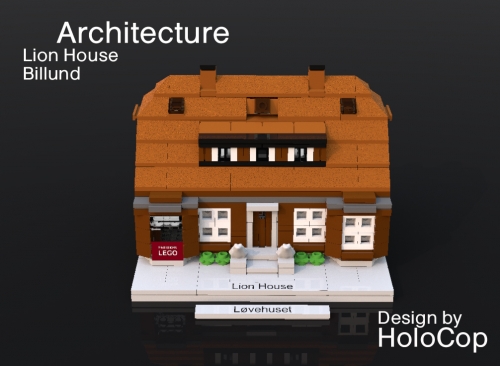
The Lion House in Billund is the place where everything LEGO-related began. It's the Kristiansen's family house and Ole Kirk Kristiansen started producing wooden toys here in 1932. Later he switched to the famous plastic bricks we all now. The house is still placed in the middle of Billund and is now called LEGO Idea house and is housing the Lego museum. @CopMike and @Holodoc have designed this wonderful LEGO Architecture rendition of the Lion House. Having built this model myself, I can honestly say it's very well done. Since we are not keen on self-promotion, I won't say it's on LEGO Ideas. It just wouldn't be appropriate. However, if you accidentally were to stumble upon it....please consider voting for it