

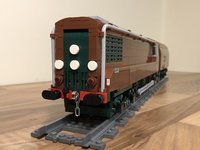
Hod Carrier
-
Posts
1,007 -
Joined
-
Last visited
Content Type
Profiles
Forums
Gallery
Everything posted by Hod Carrier
-
[OcTRAINber MOC] LMS Articulated Railcar (1938)
Hod Carrier replied to Hod Carrier's topic in LEGO Train Tech
@Asper You’re most welcome. I’m glad you enjoyed it and got a lot from it too. -
OcTRAINber 2022: The "Rebuilds & Retrofits" Challenge!
Hod Carrier replied to Daedalus304's topic in LEGO Train Tech
@Paperinik77pk I completely understand. Take a break, recover and get your mojo back. Strong with you The Force is. -
[OcTRAINber MOC] LMS Articulated Railcar (1938)
Hod Carrier replied to Hod Carrier's topic in LEGO Train Tech
@LEGO Train 12 Volts @zephyr1934 Thank you so much, gentlemen. You’re most generous with your praise. -
[OcTRAINber MOC] LMS Articulated Railcar (1938)
Hod Carrier replied to Hod Carrier's topic in LEGO Train Tech
@Duq That’s very generous of you to say. Thank you for the wonderful feedback. I’ve really got to thank BMR for giving me the push to build this railcar, as without this theme I probably wouldn’t have tackled it. -
[OcTRAINber MOC] LMS Articulated Railcar (1938)
Hod Carrier replied to Hod Carrier's topic in LEGO Train Tech
@bogieman That's very kind of you to say, Dave. Thank you so much. -
OcTRAINber 2022: The "Rebuilds & Retrofits" Challenge!
Hod Carrier replied to Daedalus304's topic in LEGO Train Tech
I've seen some builds on here that haven't yet appeared in the relevant competition entry thread on the BMR Flickr page. Don't forget to add them before the deadline or all your hard work will have been in vain as they won't get judged. I'm think of @Paperinik77pk and @Ashi Valkoinen in particular, but there may be others I don't know about. -
Sorry, how many versions...? I thought I counted three. The excellence just keeps on coming. These are all strong contenders.
-
[OcTRAINber MOC] LMS Articulated Railcar (1938)
Hod Carrier replied to Hod Carrier's topic in LEGO Train Tech
@Ts__ Thank you for your very generous praise. I always find myself getting immersed in the story of the prototype and like to share what I have learned as well as sharing any techniques that I've used. The techniques I've used in these models may be familiar to many builders, but I have learned so much by seeing the techniques other people have shared and I always like to think that there might be someone still gaining experience who will find it helpful to see how I've achieved certain aspects of my builds. I know exactly what you mean about it being almost a full-time job. OcTRAINber always absorbs a lot of my time at this time of year, but I think that this year has put a really heavy demand on entrants. The need to design not one but two models to competition standard, even if only digitally, has meant that we've all had to work so much harder than in previous years. @Shiva Thank you. @XG BC I did!! I really did!! Thank you so much. -
[OcTRAINber MOC] LMS Articulated Railcar (1938)
Hod Carrier replied to Hod Carrier's topic in LEGO Train Tech
I am pleased to present my entry for OcTRAINber 2022 in the "Other Locomotive" category. My model is of the LMS Articulated Railcar in both its original and rebuilt forms. In 1938, Britain's London Midland & Scottish Railway (LMS) unveiled a radical new diesel railcar built at its Derby carriage works. Three coaches long, the railcar was intended to be an experimental train to help the company assess the relative operational costs of diesel against steam operation as well as to gauge the use of railcars on secondary routes. During the inter-war years most of the major rail companies in Britain were experimenting with diesel railcars. Most of these were single coach trains such as the GWR diesel railcars with the option of adding a trailer coach if the need for more accommodation ever arose. However, this LMS streamlined 3 car articulated railcar was quite unlike anything before, being a multi-car multi-engine fully self-contained train. Painted in bright red and cream with a silver roof, the shape put a lot of people in mind of the record-breaking German "Flying Hamburger" diesel train, mainly due to the streamlined cabs and lower bodyside fairings which gave it a futuristic appearance. The train was powered by six 125hp Leyland diesel engines, two per car, each powering one axle each through a hydraulic transmission. Weighing just 74 tons the train was intended to reach 75mph but actually hit 82mph on an early test run. After initial tests the train was allocated to the Oxford to Cambridge route where it ran a limited passenger service before being moved to the London St Pancras to Nottingham route. Early experience showed that the train suffered with overheating due to the lower paneling restricting the airflow to the radiators. Remedies were sought, but in the end the lower panels were simply removed. The outbreak of the Second World War saw the operation of the railways change to address the national need and many modernisation programs were simply shelved. This railcar was no exception. It was withdrawn from service at the outbreak of war and stored for the duration of hostilities. With the end of hostilities in 1945, the railways were in a poor state and the railway companies not in any position to restart any experimental schemes that had been underway prior to the war. The main priority was rebuilding and re-establishing a peacetime economy. Nationalisation and the creation of British Railways followed soon after in order to deal with the backlog of maintenance and to make good bomb damage to the infrastructure and losses in locomotives and rolling stock. It would seem that the newly nationalised railway had no interest in developing the LMS railcar any further, but it still remained as an asset. It was decided to convert the railcar for use as an overhead line maintenance train on the Manchester South Junction & Altrincham route, which had been electrified before the war. The advantage of using a diesel railcar rather than a steam hauled maintenance train for this purpose should be obvious. It would seem that the railcar saw little use as a maintenance train and was moved from depot to depot before finally ending up at Longsight in Manchester. Here it fell into a state of dereliction and was finally disposed of in 1967. My own interest in this train is down to various reasons. What first drew my attention was simply due to the way it looked. Along with the original AEC railcars built for the GWR it looks outstanding, especially when compared to other railcars of the era. But as my job is to drive this train's modern descendants, it impressed me with its modern technology. It contains features that are still familiar to me in my work, such as a door interlock circuit that prevents the train being driven away with the doors open as well as stopping them from being opened while the train is on the move, and automatic engine shutdown in the event of low oil or coolant. As a consequence of all these factors I had bookmarked this train in my mind as a possible future build. I like to pick unusual trains that maybe people have not heard of before and to bring them to wider attention, and this was a perfect candidate. Knowing what happened to the train once it re-emerged after the war made it perfect for this year's theme and gave me the push to try and build it. And here is the fruit of my labours. The two versions of the railcar side-by-side contrasting the stylish looks of the passenger railcar with the extremely practical features of the maintenance train. The original version of the railcar is distinguished by its curvy body profile and streamlined cabs. In order for this train to be suitable for the contest I would have to work out how to recreate these features. The vast majority of my LEGO train builds to date have been conventional in their design and build, but this was going to push me quite a long way out of my comfort zone. A lot of time was spent on trying to come up with a form of parts that would work but, after quite a lot of trial and error, I arrived at a shape that I was happy with. I had never really used "Clip SNOT" techniques to such a degree so it was a bit of a voyage into the unknown. The coach bodies are built of a number of sub-assemblies that are attached to the chassis. This version of the railcar also uses a form of close-coupling to improve the look and movement of the model. It was a bit of a "bend to fit" solution, not having been envisaged for use on an articulated model like this one and not being entirely suitable for such use, but overall it works well enough. The coupling gap has had to be extended a fraction to permit the train to take R40 curves, but it can manage these successfully. Where possible, the model has full interiors. Although I wanted to use the LEGO Train Motor to provide drive, I was unhappy about using one in the conventional manner. These make for very large bogies, especially on a 7-wide model, and I was not prepared to compromise on the looks of the train. Consequently, I mounted the motor on its side inside the car body and used a conventional Technic-style bogie to take the power down to the wheels. Although there are not a huge number of sources for the original version of the railcar, the design of the second version of the railcar was hampered by an almost total absence of information. Whenever I found any mention of this train, reference was always made back to a single magazine article from December 1949. When I finally tracked the article down, I discovered that both the explanation and accompanying photos did not provide me with very much to go on. Although I could see the basic form of the rebuilt train the details remained incredibly sketchy. Even a trip to the British Library to see an original copy of the article provided very little additional information. Layout of equipment, door and window arrangements and even the livery that the train wore would have to be guessed at. I decided that I could either worry about this or just press on and try to make the best of what I had. Naturally I chose the latter. I have taken the decision to use dark green lined with tan on the basis that the photos showed a lined livery, and this is the colour scheme that passenger railcars at the time would have carried. Other discernable features were the rollers over each cab to protect them from cables being run out (or in), battery boxes and the ladders that were stowed underneath the solebar on each car. I have also included other detailing below the floor, but all of it is conjectural on the basis that I have no pictorial sources for them. The structure of the rebuilt railcar differs from the original version in that it uses fewer "Clip SNOT" techniques and a few more conventional ones. Although some techniques are common to both, the two builds are individual and quite different. Although the railcar lost its centre car during the rebuild, it gained a wire wagon. This was based on the chassis of a former Midland Railway coach which would have originally been built sometime around the end of the Victorian era. As with the rest of the rebuilt railcar, there is very little information to go on with this design, so I have simply opted for what I think it could have looked like and just given it three cable drum stands. This model contains a couple of bonus features that reflect real details of the actual train which are worth a look. As part of the rebuild process, the bodywork was cut back from the inner ends of the cars to give a couple of open working platforms which could be extended if needed to aid access to parts of the overhead line under maintenance. This part of the train was equipped side panels that could be extended as well as an elevated section of roof. On the real train these would have been hand-cranked, but for the model the elevated section uses a scissor jack driven by a Technic M Motor linked to a linear actuator inside the car. Two months ago, way back at the start of the contest, I joked that I was going to come out swinging this year and really embrace the "quality over quantity" message after just playing for laughs in the previous edition of OcTRAINber. I thought it might have been hubris to have said as much and wondered whether or not my mouth was signing cheques that my abilities couldn't match. To come up with these two builds I have really had to work hard and push myself to try and master new techniques in pursuit of accuracy. It's been hard work and not always very enjoyable at times and I have come very close to hurling one or other of these builds across the room in frustration. But I'm glad that I pushed through and persisted with them, because I now have two very satisfying models that I can sit back and enjoy. Although I consider them to be finished from the perspective of the contest, I am still looking at them as works in progress. There are one or two issues that are still outstanding, either from a structural or operational perspective. However, the overall look of the two should remain unchanged and, in that respect, I am happy and proud to be able to present them. More photos and narrative can be found in my Flickr OcTRAINber album. -
[ocTRAINber MOC] St. Boniface Golf Club Foot Bridge
Hod Carrier replied to Supplement_Creatif's topic in LEGO Train Tech
When I got married, we had our reception at a local golf course. If my own experience is anything to go by, I would blame the photographer for putting the happy couple in harm's way on the bridge. Looks like the guy in the golf cart is doing an Alonso and should probably be moderating his speed a bit. Great way to present your build. You've really brought it to life in a very creative way. -
It's the attention to details that elevates your builds. You just never stop improving. Fantastic progress and two fabulous builds to show at the end of it. I'm really enjoying seeing your progress.
-
[OcTRAINber MOC] LMS Articulated Railcar (1938)
Hod Carrier replied to Hod Carrier's topic in LEGO Train Tech
@Shiva Thank you for the positive feedback. Time is running out fast and I'm pushing hard to get everything finished in time to get my submission in on time, but I can see the end is in sight and I'm still just about on target. Work has been progressing with the rebuilt railcar in its guise as a maintenance train, but it is generating a growing "snagging list" of minor build problems that I probably won't have time to deal with before the deadline. I have completed one car and am well on the way to finishing the second. Although the rebuild was purely for practical purposes rather than aesthetics, I have retained as much of the body profile as I reasonably can from the original version. Even though it's no longer much of "a looker", I quite like the way that it carries the dark green livery. It may be only a maintenance train, but I think it looks quite classy. I've also been making good progress on the power coach. Unlike the original version I have used a Technic motor for power rather than the train motor. Partly this is because this version doesn't need such a high turn of speed, but mostly because that's all that will fit. Hmm. Not sure what this is all about (ahem). I've still got to push myself to make sure that everything gets done in time. The power coach still needs finishing off and the wire wagon built, but neither of these things should take too long. The "snagging list" that I mentioned is something that I shall have to simply park and come back to later due to the time constraints. There's some minor flexing to be dealt with and there something weird about the way the roof sections fit onto the body that means that in some places it sits flat but in others it shows a gap. I've checked all the clearances for the parts and they look fine, but there's something going on that I really haven't got the time to investigate fully. As a result, I'm just building this version "as is". -
[OcTRAINber MOC] LMS Articulated Railcar (1938)
Hod Carrier replied to Hod Carrier's topic in LEGO Train Tech
Thank you so much, @zephyr1934. I'm definitely enjoying having it sat on my coffee table. I know that my use of the train motor is a bit unusual, but I really couldn't see any other way. It would be fine for a loco which generally have much larger bogies, but for a railcar it would just have been way too big. That said, I wanted the model to have a decent turn of speed as befits a passenger train. The only alternative would have been to gear-up some manner of Technic motor, but that would have been more complex and at least as space-hungry as the solution I picked. ---------------------------------------------------------------------------------------------------------------- With the original version of the LMS railcar taking all the limelight, and time fast running out, it's finally time to turn my building ray on the second version. Just to recap, the railcar was rebuilt into a maintenance vehicle for overhead power lines around Manchester and spent the remainder of its life in that area. The rebuild saw the train lose the centre coach and gain some new features that rendered it almost completely unrecognisable from its original form. The design of this version is very different from the original and is, if anything, a bit more conventional. Rather than having a chassis with the body assemblies clipped onto it, this design uses a "bath-tub" chassis made up of bricks and plates which gives it a huge amount of strength and rigidity. Where things get a little less normal is with the roof. The desire to keep the roof to a certain width meant that I could not simply build it flat, but rather had to use quite a lot of brackets with plates and tiles at right angles to each other to get the required width. This is a quick look at the underside of the roof which gives an idea of how it's been done. There is a slight structural weakness which I know how to address, but the proximity of the deadline means that I probably will have to come back and deal with it after the close of the contest as I really don't think I'll get the necessary parts in time. I don't think it will cause too many issues when mated to the bodyshell, but time will tell. Speaking of the bodyshell, I have decided not to bother trying to make an interior. There are so few sources of information that it's not even possible to tell which car served what function, but I think that will be OK given the lack of windows. The front of the maintenance train tapers down to 6-wide and contains plenty of windows to help the crew position the train accurately when it was in use. It's quite a plain and functional design. The black cylindrical part is the roller that would carry the cables for the overhead power lines up and over the cab so as not to cause any damage to the train. As can be seen, there's still plenty of work to do before this model is complete, but it's coming together very nicely. I am still awaiting the final few parts to arrive through the post, including the all-important ladders which are coming from overseas. I trust that they will get here in time, but I am starting to feel the tension a little bit. There were one or two areas where I felt I was making some compromises in the design, particularly with regard to strength, but it's actually holding together quite nicely. I hope this can continue, as I won't have enough time to make any changes to the design if I'm to hit the deadline. -
[OcTRAINber MOC] LMS Articulated Railcar (1938)
Hod Carrier replied to Hod Carrier's topic in LEGO Train Tech
@Toastie Sir, you are too kind with your praise. Thank you so much for your kind words. I do feel as though I'm on a journey with LEGO and am still gaining experience. Certainly my knowledge has increased over the years I've been doing this, following the examples of others more experienced and skilled than me and applying the techniques they have shared to my own designs. Familiarity with the palette of parts and the introduction of new items has made things possible that before were hard to achieve. As I think you know, my approach is to design virtually first and then in bricks once I'm happy with how things look. But, as you say, there are no sky hooks or magic super-strength 1 stud connections, and I'm always thinking about how to realise it in real brick, so strength and stability is always at the front of my mind. The problem is that Stud.io et al do not always highlight where you've made a mistake because they permit the use of magic gravity-defying parts and so on. In the case of this particular build, I felt as though I was pushing the boat out further than the limits of my experience by using techniques on a scale that I have never attempted before. Consequently, I was unsure how strong the overall structure would be, whether there would be any weak connections or whether the overall weight of the cars would be too much for the structure and cause distortions and, as mentioned above, how well the close-coupling between the cars will work. There were a few areas that needed improvement that only came to light by snapping parts together. I may have spotted them prior to building if I'd had my customary "tiffling time", but the constraints of the competition do not permit me that luxury and so I have to find them the hard way. I called my Mum on the phone last night for a chat and had the railcar sat on a length of track on the coffee table and just kept on looking at it while we chatted away. Being able to sit back and enjoy the completed build is immensely satisfying. I just have to work out how and where to photograph it so that I can share it with you and everyone else. -
[OcTRAINber MOC] LMS Articulated Railcar (1938)
Hod Carrier replied to Hod Carrier's topic in LEGO Train Tech
It's been a little while since posting any updates on my progress. Partly this is due to being busy with real-life but also because I've been up to my eyeballs with two large builds. As a result, I haven't really had any time to keep you all abreast of changes. The build of the original version of the railcar has been progressing. Due to the time constraints imposed by the contest deadline I did not have my customary "tiffling time" to make sure that the design was good before progressing to the build. Instead, alterations have been needed to be made as the build went along which meant that I could only make progress in fits and starts. Luckily the number of changes that needed to be made were small and primarily structural rather than cosmetic in nature, but it did mean that I could only progress so far and then have to stop and wait while new parts arrived. In the meantime, I was able to continue with the design of the second version of the railcar and to order the parts I need. The alterations made were to strengthen the bogies, reinforce the centre of the cars around the door opening and to change the close-coupling design to make it easier to access from below should rubber bands ever need to be changed. Otherwise, the appearance of the railcar is almost completely unchanged from the design renders posted so far. So how does it all go together? Well, as outlined previously, the idea is that the cars are made up of various sub-assemblies clipped to a chassis. The main assemblies are the lower panels, the upper panels, the passenger doors and the roof. This is the centre car broken down into its various sub-assemblies. The upper and lower panels are clipped on to attachment points while the doors and roof are fixed conventionally. With all the parts assembled, this is what the centre car looks like. I think it looks quite good and shows off the curved profile quite well, plus it is remarkably sturdy with all parts assembled, which has been a very nice outcome. Looking through the car end it's possible to get an appreciation of the profile as well as showing the close-coupling. I've also completed the end cars too, including the motor coach. With the roof off it's possible to see the technical arrangements inside. I wanted to use a train motor for this build in order to give it a good turn of speed but, being a 7-wide design, I didn't feel it appropriate to use it in the normal way. The problem is that it is rather a large lump and would result in the bogie being waaaaay too big. So as a solution I have placed the motor inside the body instead and have it driving a conventional Technic bogie to get the power down to the wheels. Roof on and this is how it looks. I think it's turned out very nicely and shows a very good likeness to the renders. I always worry a little with Stud.io that it allows for tolerances that real bricks do not, so I was very careful to try and make sure that I didn't take too many liberties with them. However, I was still a bit nervous about how well this part of the build would go. A small strengthening issue aside, I was pleased to see how well it came out. I will confess to having used a small amount of coloured vinyl to carry the shape of the livery around the front of the train, but I didn't really see any alternatives. LMS lettering, numbering and crests are courtesy of my old nemesis, waterslide transfers. So, what's next? Apart from having to build a whole other version of this railcar, I will still need to test run this model to ensure that it works as I hope it will. The close-coupling is a source of worry, as I'm unsure how well it will work. Remember, this wasn't something that I thought would be usable for articulated vehicles like this. However, a quick test suggests that it will (just) squeak around R40s without derailment. Another challenge will be to try and work out how and where I'm going to photograph this beastie, as it's quite a bit bigger than the majority of my builds. But for now, I think I'll just have a cuppa, sit back and enjoy looking at it. -
[MOC] [WIP] Doom train for Spooktober 2022
Hod Carrier replied to Darkkostas25's topic in LEGO Train Tech
I’m loving the direction you’re taking with this. The Hellish Clown tender is very creative and the casket coaches are extremely well done. So does this loco burn coal, wood, oil or the souls of the damned? -
This is already looking like a very tasty build. I wasn't aware of any European "cab forward" locos before now. I understand your dilemma about the wheel arrangement. It would look wrong in curves if the loco is pivoting on it's bogies rather than the drivers, but then you have problems with the lower body panels because it wouldn't permit adequate articulation. Do you spoil the lines of the loco by having part of the streamlining attached to the bogies so that they can articulate more freely or compromise on the way the loco moves by not having flanged drivers? I will be interested to see how you tackle this.
-
[ocTRAINber MOC] St. Boniface Golf Club Foot Bridge
Hod Carrier replied to Supplement_Creatif's topic in LEGO Train Tech
Welcome to the contest. I think you'll score highly on the "change factor" with an entry like this, but even so you've knocked-out a very nice looking flat car which will only help to improve your chances of a good result. Don't forget to add your WIP story to the BMR Flickr pages, as this is a Flickr based contest. -
[OcTRAINber MOC] LMS Articulated Railcar (1938)
Hod Carrier replied to Hod Carrier's topic in LEGO Train Tech
@Darkkostas25 Thank you. I had to work hard to get the shape as I wanted it, but I think the efforts have paid off. I'm hoping to have a complete car ready to show very soon. @zephyr1934 That's exactly the approach I'm taking. -
[MOC] [WIP] Doom train for Spooktober 2022
Hod Carrier replied to Darkkostas25's topic in LEGO Train Tech
Yikes!! That skull is to die for. I like the way it leads into the streamlining. I think that it would definitely freak out any passengers waiting at the station. It would be just perfect for the Necropolis Railway. How about a coffin...? Too weird...? -
Oh hello. Looks like we've got some serious competition. That looks like a very interesting concept. I'm assuming you're already a lot further along than your introduction suggests.
-
[OcTRAINber MOC] LMS Articulated Railcar (1938)
Hod Carrier replied to Hod Carrier's topic in LEGO Train Tech
While I wait for parts to arrive so that I can continue with the build of the original version of the railcar, it's time I devoted some attention to it's second incarnation. Time is marching on, and I can't afford to be lazy. As you may recall, in 1949 the LMS railcar re-emerged in a totally new guise as a maintenance vehicle for the repair and upkeep of the overhead power lines on the line between Manchester and Altrincham. In order to be useful for this purpose, the railcar underwent a radical rebuild with new cabs, new roof, new interior arrangement and one less car. The problem is that, apart from a single short article that appeared in the journal Railways in December 1949, this transformation appears to have gone totally undocumented. Not only that, but in the time between it's conversion and disposal in 1967 it seems to have attracted virtually no attention whatsoever. As far as I am aware, the only images of this train that exist are the three poor quality black and white images that accompany this article. To date, these are the only images that I have discovered. This causes something of a problem when trying to create a model of it. The photos do give an impression of the overall look, but it's very hard to make out any details, even for fairly major things like doors and windows. The description of the train says that one car was converted to a mobile workshop while the other provided mess facilities for the crew, but it's not even possible to say which car was which. I can't even be certain what colour the train was. All I know is that the two cars were different and then had to base my design decisions around hints and suggestions that I can discern from the poor images. I'm just glad that the article held in the British Library was of better quality than it's online reproduction. So anyway, with the excuses out of the way, this is what I have come up with. This render show approximately the same aspect as the main photo in the article which means that you can compare them for yourselves. It's a little hard to see the window positioning, but then that's also the case with the photo of the real train. I've guessed at the livery being dark green as that was the colour for passenger railcars at around the same time. The railcar was accompanied by a wire wagon, that was itself a repurposed redundant vehicle. This must have been quite a survivor even at this time, as it was converted from a Midland Railway 6-wheel 30 foot coach, a type that was being built around the turn of the 20th century. I've been able to get good source material for the chassis and running gear, but everything above chassis level is an educated guess. In the photo, the wire wagon is at the rear of the railcar and, therefore, the image of it is incredibly poor. Plus, the vehicle is covered with a wagon sheet which hides everything. However, from the shape of the wagon sheet it is possible to tell that it had low sides and a central sheet hoop but, on the downside, it hides everything else. I have opted to model three cable drum stands, but in truth I could be way off. Other details that I've had to guess at include parts of the railcar itself. In the article photo, there appears to be a recessed feature towards the far end of the second car but no clue as to what it might be. It could simply have been an open door, but the feature appears to extend all the way to the roofline. It's possible that it is vents and exhaust for the onboard generator. I have opted to model it as a ladder for access to the roof to match a similar one at the centre of the railcar. I may yet change my mind about this. Given that the photo shows only one side of the railcar, I have opted to make my model symmetrical. It's not necessarily likely, especially for internal user stock like this, but without any visual sources I have no way of knowing. At least replicating what I can tell from the side that it featured saves me the trouble of having to imagine what it looks like on the other side. I suppose that one good thing about not having any visual sources is that no-one can tell me that I've got the design wrong. LOL!! -
[OcTRAINber MOC] LMS Articulated Railcar (1938)
Hod Carrier replied to Hod Carrier's topic in LEGO Train Tech
@zephyr1934 @Toastie Thank you, gentlemen. There's still a long way to go but I'm pleased with how things are progressing so far. It's a British Great Pound. I think my spill chequer got involved without me realising and messed things up. -
Ooo, yes!! I do like those rather a lot.
-
[OcTRAINber MOC] LMS Articulated Railcar (1938)
Hod Carrier replied to Hod Carrier's topic in LEGO Train Tech
@Daiman @zephyr1934 Thank you for the amazing feedback. I certainly feel as though I'm pushing myself with this build, and so far it's going as well as I could have hoped. @Toastie I have made some alterations and upgraded the bands to the white LEGO bands, as well as making them easier to access for servicing. Mind you, at about 1GBP a go they'll need to last a looooooong time to be better value than the ordinary garden variety rubber bands. It's been a little while since I updated folks on the progress of my build, so I thought I should correct that oversight. A couple of weeks ago I took a trip up to London to visit the British Library. This is an amazing institution that holds all manner of weird and wonderful items, including copies of pretty much every book, magazine and journal available in the UK going back many many years. This is really the only place where I could expect to see original copies of the primary sources used in the online articles I had been reading and would give me the best chance to get more details that could help me complete my builds. My expectation was tempered a little in the knowledge that probably the majority of detail and the best of the images had already been reproduced online. I wasn't anticipating a massive revelation. And so it proved. There were no huge surprises to be had, but I did manage to meet one of my targets, which was to see if the photos in the original article concerning the rebuild of the railcar were better than the online reproductions. Railways: December 1949 This image does show details that the online reproduction does not, but it is still very vague. However, I can at least now read what it says down the side of the cars which I couldn't before, so I think I can call that a win. I've also been making progress with building the original version of the railcar. Chassis and interiors for the non-motor end car and the centre car have been completed. The centre car is what is referred to in the UK as a composite coach in that it contains both 1st and 3rd class open saloons. This is the 3rd class area with the toilet cubicle and a small luggage rack opposite. The posh end. I've had to use some creative techniques to fit some semblance of seating around the various chassis structures. I've used trans-clear parts to try and minimise the visual impact of this. I've also built the roofs. There's some colour variation in the parts, but that can be explained away as weathering. The shaping of the transition between the roof and the bodysides is just as I'd hoped and the structure remains strong. Construction has been slower than I would have liked. The problem is that having a deadline by which I need to have completed not one but two builds means that I have not had my usual tinkering time to review the design and make sure that everything goes together as it should. As a consequence, I have been having to make alterations as I go, which means ordering parts and waiting for deliveries before I can move on to the next stage. I also still have the design of the second version of the railcar to complete, parts to order and the build to commence. Juggling these two projects along with work and other real-life commitments means that the pressure is starting to build. Four weeks should be enough time, but it might be a bit close.