
Search the Community
Showing results for tags 'vacuum engine'.
Found 2 results
-
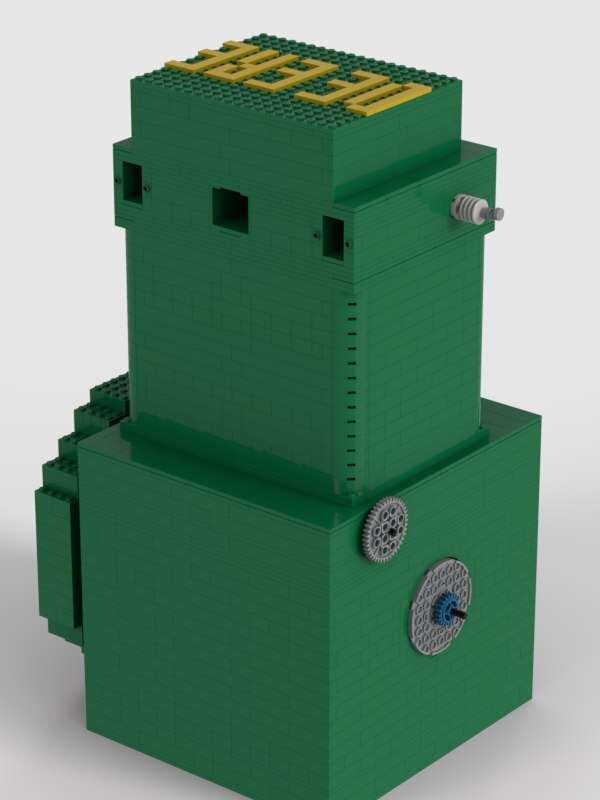
 Here is a scale model engine I made, inspired by Digitaldan's 1:1 scale engine. Before I get into the LEGO version I made, let me tell a few things about the original: The John Deere Model A was a row crop tractor built from 1934 to 1952 in three generations: Unstyled, Styled, and Late Styled. It was a direct competitor to the Farmall F-20 and later the Farmall H. The engine was a transverse mounted inline 2 with a 5.5" bore x 6.5" stroke, for a total displacement of 309 ci (5.1 Liters!). Governed speed was 975 RPM. These engines were notorious for being extremely loud, and vibrated a lot with terrible power delivery. In my opinion, the only reason John Deere stayed in business was because their tractors were cheap to run. In 1934 a model A on steel wheels sold for $1,025. The comparable Farmall F-20 on steel sold for $900-$1,000 in 1934. The difference was that because of the high compression ratio, the Deere could run on may different fuels. The F-20 started on gas and switched to kerosene when warm. My model has 8x8 square pistons and a 10 stud stroke for a total displacement of 655 cc. The crankshaft is built out of 6x6 round bricks and incorporates engine1ear's caged bearing system. I built the model in Studio 2.0, and it consists of 12 separate modules: The block, crankshaft, cylinder casting, camshaft, head assembly (including valves), flywheel, 2 pistons, and 4 pushrods. All these modules add up to a grand total of: 2366 parts! https://www.tractordata.com/farm-tractors/000/0/2/25-john-deere-a.html Why only two cylinders?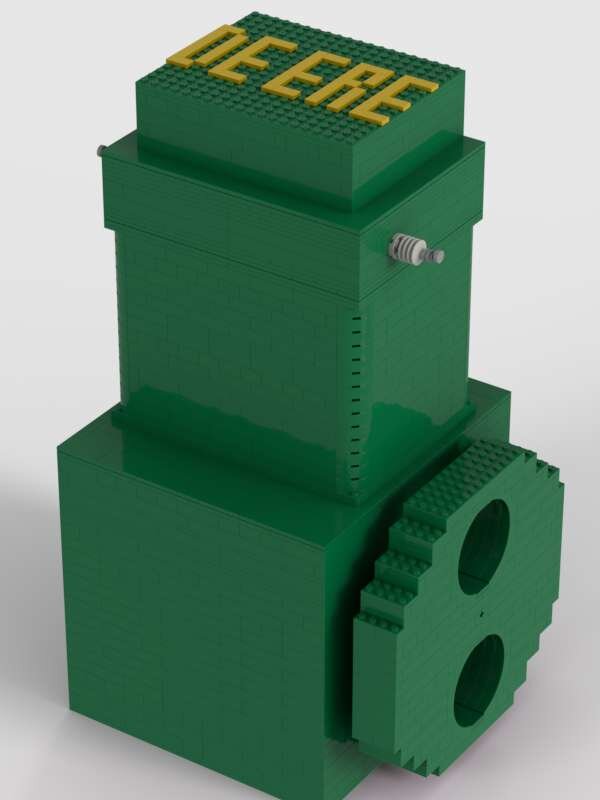
-
I like OHV vacuum engines as much as the next guy, but they have more than their fare share of issues. Of course I mean the intake valve. It needs to have a hard enough spring to not get sucked open by the vacuum, but has to have the right rocker ratio and valve clearance for the engine to run well. The first work-around I've seen is to use butterfly pistons to break the seal and take in fresh air, but these also have problems. One is the piston itself. It tends to get caught on the seams between brick layers. On top of this, it only really works well with 4x4 or 6x4 pistons, and crankarms with a 2 stud radius. With these issues in mind, I went ahead and made my own fix to these problems. My new engine design is basically a classic SVS engine with a head. It uses a modified SVS valve on the side of the block to let in fresh air as the piston goes down. Then, the slide valve closes, and the poppet valve in the head opens for the power stroke. Because it uses two kinds of valves, my working name for it is Tandem Valve System, or TVS. It has all the benefits of SVS engines: It works with essentially any bore or stroke size, gets decent RPM's and torque, can be turbocharged or supercharged, and can even run on positive pressure, unlike other OHV engines. It also gets around some SVS limitations, like the manifold. The TVS engine also has the OHV benefits of realism, good sound, and the ability to make it into a four stroke. This engine ended up not even needing a flywheel, but I still used one anyway. That's not all folks! I mentioned on another thread how my vacuum engines have Water Injection, where water is pumped through the intake for extra lubrication and cooling to enhance the performance. My new TVS engine has a CARBURETOR to deliver a mist of water to the intake manifold to achieve the same effect. Here's how it works: I use a pneumatic pump submerged in water to get the water into a hose. In the carb, the pneumatic hose squirts water into the "venturi", into a minifigure spear mounted in a half-pin, which functions as the jet. The blast of water makes a fine mist, and the "richness" can be adjusted by moving the jet needle in or out. Then, intake vacuum draws the mist into the cylinders for lubrication. The carburetor also has a single butterfly valve made from a 4x3 plate which functions as the choke. When the choke is closed, it blocks some airflow and slows the engine down, while enrichening the mist. it all works quite well, and surprisingly makes a noticeable difference to running the engine without the carburetor. Now lets talk specifics: This particular engine is an Inline 2 with 6x6 pistons and a 3 stud stroke radius, for a displacement of 184.32cc, or 11.24 cubic inches. During a dyno test, it made 28 Studpower, or 0.0028 Horsepower. During the test, it made 0.03125 ft/lb of torque at 500 RPM, but peak torque when stalled came out as 0.0625 ft/lb, and a maximum speed of 2200 RPM (Not simultaneously). I think this engine design has alot of potential, and seeing as this is only the second prototype, there will definitely be a few issues to sort out. I hope you guys like it! Here is a link to where I have pictures posted on Bricksafe: https://bricksafe.com/pages/LegoLord1880/vvt-vacuum-engine/technic-starter-motor-prototype/kohler-k241-vacuum-engine-model/3-valve-vacuum-engine/tvs-vacuum-engine I also hope to have a video of the engine running and the carburetor in action soon :]