


Brickthus
-
Posts
707 -
Joined
-
Last visited
Content Type
Profiles
Forums
Gallery
Everything posted by Brickthus
-
I like it that they can be used on a wall, such as a backdrop at shows. But I hope they didn't have to glue or screw anything to build what they are showing in the video! Would like it if both pieces were available in the same colour though! TLG often uses contrasting colours to help kids pick the right piece, especially in the Education kits. The integral rack made me think of the Snowdon Mountain Railway. A steam loco built around the gear block would be interesting. Mark
-

[WIP] Lego monorails. [Custom Rail Systems (CRS)]
Brickthus replied to Trekkie99's topic in LEGO Train Tech
New ideas are the most exciting thing. The question is whether you have a good number of pieces to have a go! A 24M curve needs about 115 pieces. I figured that the original 6990 set had a layout size in mind, plus a possible alignment with the 32x32 size of crater plates. The new system can go a bit smaller but the increased maximum speed with PF or PU might look strange on a tighter curve. The maximum speed I've tested was 0.95m/s but that was with the earlier belt drives and wider curves. The current speed is a good compromise between being a bit quicker but also having enough torque to ascend the hills. For the hills, I think the SNOT is more complex in Brickheads and statues, such as the Puppy kit 11384 that I'm building now. I'm waiting for the underneath round tile #3567 to be made in dark bley. There might be a more convenient way to set the spacing as I've threaded parts onto the tubes, which works better at the bottom than the top at the moment. That would be as simple as a 1:1 diagram in the instructions. But the 10-brick rise in 64M was a good target to hit because it facilitates more compact layouts. And added idea is that a real curve is more gentle either size of an apex, so perhaps I should bias the 2x3 sections nearer to the ends of the 28M curve. Mark -
[WIP] Lego monorails. [Custom Rail Systems (CRS)]
Brickthus replied to Trekkie99's topic in LEGO Train Tech
🙂OK, here's the technical development of the curves. My curves started with these prototypes in 2012, with the default being a 5-plate sandwich comprising a top layer of 2-wide tiles, layers 1&3 of 2x2 plates and layers 2&4 of 1x2 plates. (these might be larger higher up the thread) In the original, the 2x2s were all square and the 1x2s all oblong. All track pieces keep layers 2, 3 & 4 for 1 stud at each end for a 1x2 brick with 2 holes, using 2 black pegs to connect the next piece. That means layers 2&4 have a 1x1 plate at each end and layer 3 has a 1x2 plate at each end, inset 1 stud from the ends. It takes 19 2x2 modules to make a 1/8 curve of 48M radius, which is the minimum radius without unreasonable stress. This still left some people complaining! Along with 48M, wider curves would stay in place at 58M (23 modules), 68M (27 modules) or 78M (31 modules), so this could form a quad-track round a corner. 58M and 68M also form a double-track helix to gain height. This is complemented by straight spans of 64M to enter and leave the helix. The helix pic shows a different colour of 1x2 bricks with holes. So when people complained on my previous Space Monorail project on LEGO Ideas, I set about solving the tighter-curve problem. The early updates (April 2018) were variants using the 2x3 coupling plates, firstly a 19M radius based on pointwork experiments Then more overlap of the coupling plates to go tighter, as small as 12M radius. But, even having used bogie trains from an early stage, the problems are the evenness and rigidity of the curves and making a train go round them. It was at this time that the LEGO roller-coater track began to appear, so a fairly tight radius was useful for smaller sets. However, an early motorised vehicle I saw was not as compact as a monorail one. The real objective in systemising the track was to be able to recreate the previous monorail sets in function and scale. Then a breakthrough in May 2018 was using the 1x2 plates with rounded ends. With an even pattern of square and round 2x2 modules this made a 19M radius. Using a 2x3 module allowed a 12M radius. These are the minimum stress-free radii for the system. These use black 1x2 plates with rounded ends alternating with red or dark grey oblong 1x2s. So the key after finding the minimum was to find useful sizes for a layout and to make trains go round them. For the Blacktron layout, exhibited in 2025, 24M and 34M make good double track: The 24M curve uses a regular pattern of square and round modules. The 34M curve uses a regular pattern of 2x4 oblong and 2x2 round modules; the 2x2 squares at the end form a 2x4 oblong with the next piece. All of these smaller radius curves are made as 90 degree curves, compared to the 45 degree curves of the previous 48M and larger radii. A bespoke double bend with smaller angles is possible but it is easiest to put the joint where a connection to the next piece can be supported easily. Having made and tested curves in a good range, this opened the possibility of making a 28M radius to replicate the radius in the original sets. As a development from the 24M curve, the 28M curve adds a pair of 2x2 modules (11 square + 10 round), then makes the 4th and 8th modules 2x3. So in this system we have oblong modules of 2x2, 2x3, 2x4 or as long as necessary, and a round module of 2x2. The round module comprises round plates on layers 1 and 3, a round tile on layer 5 and two of the four 1x2 plates on layers 2 and 4, connecting to adjacent oblong modules, have rounded ends. These modules are interleaved to make useful patterns for whatever radius or track formation is needed. A hill (see my previous post) uses sections of 24M radius curve at either end, with the track on its side, using some SNOT pieces. Clip plates and tubing hold the shape, still stress-free and with similar profile to the original hills, rising by 10 bricks in 64M length. Built as a single piece and the middle stanchion uses coupling plates and is attached permanently. Of course all these curves use quite a few pieces so part orders in the hundreds are to be expected. My first order was for 5000 2x2 tiles, 10000 2x2 plates AND 20000 1x2 plates! That would make 45 metres of the wider curves. I have since ordered 2x2 round plates and 1x2 plates with rounded ends by the thousand. But the trend in LEGO sets for adults is for more smaller pieces, so this fits well enough! The reward of a completed curve comes in about 20 minutes. I can make 2 in that time. I'll save the trains development for another post! 😄 Mark -
What would you want from a new Lego monorail system?
Brickthus replied to Trekkie99's topic in LEGO Train Tech
OK, sorry! -
[WIP] Lego monorails. [Custom Rail Systems (CRS)]
Brickthus replied to Trekkie99's topic in LEGO Train Tech
My latest project has a few more details. Yes, it is a system of 1-wheel bogies with carriages suspended between them. I've used those since 2014 https://www.brickshelf.com/cgi-bin/gallery.php?i=6276761 - Traction was upgraded from half-bushes with tyres to Creator wheels. - Small Technic pieces make up the bogie with the wheel on axle and 2 pivot points, Vertical rigid axle mounts in the middle allow more structure to make more support to attach the motor car. - Lots of 1x2x0.5 ++ joints, 4 1x2 toggle joints and 2 1x3 toggle joints with central round hole, then a 2x2x2 bracket at either end (sub with 2 1x2 bricks with cross hole for the cab). The monorail system is finally ready to replicate set 6990 as the next Classic Space revival set, following on from 10497 and 10355! - The use of small, available pieces for track, trains and canopies mean it could be sustained from PaB online far beyond the shelf life of a set. https://ideas.lego.com/product-ideas/3b2e5ca7-13c5-4dbe-8c4d-cb9d22b40f93 The motor drives from a train motor have to reach the two bogies at either end. This needs 2 chain drives and a variable-angle bevel drive, making the best of the double-bevel gears! - The first chain drive is 16:16 from the motor to a point above the pivot point. - The variable-angle bevel drive is 12:20 across the pivot point, supported above and below. - The second chain drive is 12:24 down to the wheel axle. - Driving 2 wheels means there is enough traction to climb hills. A 2-motor train (easier with PF) can pull more wagons with the maxim that half the wheels in a train are powered. It was ingenious of you to run on the 12V conductor rails with a radius of 40M, less than the 48M of the standard "wall of 2s" with oblong 1x2 plates but with no stress. But now curves using the 1x2s with rounded ends can go as tight at 19M radius. My previous post of the Blacktron layout used 24M and 34M radii, which make good double-track. Now the 28M radius of 6990 is replicated for the project so that all track pieces can do what the originals do. No need for start/stop rails though, as it's PF/PU compatible. - Straights can be any length but most are 16M, 32M, 48M, or 64M to enter or leave a helix. - Hills rise 10 bricks in 64M like the original. Built as 1 piece with attached middle stanchion for rigidity. Stanchions use vertical axles for strength. - The upgraded 6990 station has train-over-train, which was a feature of 6399 Airport Shuttle. So the question now is whether there are 10000 people in the world who would like 6990 to be revived! Many have their doubts but it depends on whether the community grabs hold of the idea. Out of 850 supporters I've had 400 people save the project so far so there is some real depth of interest. I don't know how to make it go viral though. It's all over Facebook and LinkedIn, and even Bluesky, but is there anywhere else that LEGO Monorail enthusiasts hang out? Mark -
What would you want from a new Lego monorail system?
Brickthus replied to Trekkie99's topic in LEGO Train Tech
Well the LEGO innovation portal came and went! It has taken another 8 years but at last my new monorail is ready to replicate set 6990, which seems an appropriate revival set to follow 10497 and 10355. https://ideas.lego.com/product-ideas/3b2e5ca7-13c5-4dbe-8c4d-cb9d22b40f93 I've proven the system with tight, stress-free curves at shows over the last 2 years. It runs a bit faster than the original at maximum speed and longer 2-motor trains can pull more wagons. This year I developed similar stress-free hills and small-piece canopies. Everything uses small, available pieces and the same electric pieces as a train set, so the parts outlay for TLG would be very little. It would be sustainable from PaB online so there is no need for extra track packs and this is as low as the obsolescence can go. I hope to be exhibiting it again on October 10-11 in Swindon, UK. Mark -
Then this one may interest you, a small-piece remake of 6990 Futuron Monorail. https://ideas.lego.com/product-ideas/3b2e5ca7-13c5-4dbe-8c4d-cb9d22b40f93 TLG said they would never make more of the original system so the idea is that this new system, proven at exhibitions, is sustainable from PaB online, including the track, trains and canopies. Bring back LEGO Monorail for ever! For future shows I might incorporate a couple of 21362 Mineral Collection for Space mining operations. Last year I used some yellow/blue 5-wide balls from 21358 Minifigure Vending Machine for a pneumatic robot to manipulate.
-
Futuron Monorail set 6990 is a "Holy Grail" set for many people, the definitive first set in a system that spawned the Airport Shuttle 6399 and Unitron 6991 sets as well as two track packs. Over the last 14 years I have been developing a new monorail system. It branched from the Hidaka monorail, which models the Osaka monorail, in 2012; mine has a few important differences. - A plate sandwich for the track, allowing a 64M straight span, instead of using deeper bricks. This used my experience of building a railway fiddle yard with a station on top. - Trains with bogies, powered by a standard train motor, PF/PU compatible, instead of multi-wheel rigid chassis vehicles. While there is a LEGO train set, it could support this with the same electrical pieces. The trains were designed for tighter curves from the start. - Tight curves with no stress, using plates with rounded ends. Minimum radius ~20M but 24M, the original 28M and 34M are useful sizes; 24M/34M make good double track. - Hills using a similar technique to the curves. For the last 2 years I have been proving the system by exhibiting it in the UK in the Blacktron livery, using models and parts from 6x 10355 Blacktron Renegade; it runs well all day so the system is mature enough. This shows a short train on the inner track and a longer, 2-motor train on the outer track. The larger structures are built with Technic panels. This year I have developed the trans-blue canopies and hill tracks to enable a remake of 6990 as a set on LEGO Ideas. Whilst TLG had stated that they would not make more of the original monorail system, my design deliberately uses small, available pieces, enabling the new system to be sustained from Pick-a-Brick online far beyond the shelf life of a set. That means there is plenty of time to break track length records and build large layouts. It also gives it the maximum opportunity to allay TLG's concerns (there is very little outlay in parts development, even less than the roller-coaster track sets) and enable a remake of 6990 to be the next Classic Space revival set, following 10497 and 10355. This is close to the original box picture of 6990. I have deliberately recreated all the functions: - The power plant canopies are a bit larger, using available octagonal plates as the 10x10 with cut-out was obsolete. - The station canopy is doubled and adopts the larger size. - Both canopies are made from small pieces, including available trans-blue pieces. - The power plant and station both move like the originals, perhaps with slight improvement. - The station now has two levels, train-over-train, which is a feature adopted from 6399 Airport Shuttle (useful at exhibitions too). - The train has flashing lights in a different place, using pulleys with filters. - The train carries an original container but could carry a wider one. - I opted for SNOT lettering rather than stickers for the "9V" sides on the battery car; those panels are easily removable for battery changes. I expect that TLG would make a few changes anyway, but I hope for a few things: - Futuron livery torsos. - A few recolours, perhaps the cab covers and a 1x1 round plate with hole in trans-blue. Computer roof bricks and radar dish revival in white. If you would like a return of the LEGO Monorail system then please would you support the product on LEGO Ideas: https://ideas.lego.com/product-ideas/3b2e5ca7-13c5-4dbe-8c4d-cb9d22b40f93 ❤️ More pictures accompany the project. Whether or not a future monorail set would be a remake of 6990, 6399 or 6991, can we show TLG that there is plenty of support for monorail? I intend to build more; I have Futuron and Blacktron already but plan to build Classic Space and M-Tron. A City-based one may follow. Please see at least 4 monorail videos at https://www.youtube.com/@brickthus/videos Development pictures at https://www.brickshelf.com/cgi-bin/gallery.php?f=517847 Best wishes, Mark (aka Brickthus)
-
LEGO Sci-Fi Ongoing - Rumors, Speculation, and Discussion
Brickthus replied to Lyichir's topic in LEGO Sci-Fi
Thanks, you have understood the idea of it. After doing some obsolescence studies at work 25 years ago, ringing up suppliers and asking "can I still get these parts?", and then seeing how the selection of pieces on Pick-a-Brick online varies, with many parts specific to sets being discontinued after that set ends its shelf life, I sought to use pieces that were most common. This was already a feature of the track curves, with the taller Hidaka design and my own plate sandwich design being based on 2x2 sections. The next trick was to recreate the tighter curves like the original 6990 track. In my previous "Space Monorail" project I had jus the wider curved and there was the complaint of "brick stress" using the "wall of 2s" technique. The solution for me was to use the 1x2 plates with rounded ends but it's not as simple as that because if you use only those the track will lose form completely; it would have to be formed around something and would then change shape as trains ran around it, applying forces as they did so. So the knack was to alternate the oblong and rounded-end 1x2 plates in the right pattern to achieve various curvatures without stress. As it happens, the 1x2 plates with rounded ends are relatively new but we see them in so many sets that they have quickly become a core piece, available in many colours and hence most likely to be continuously available on PaB online. That was key to choosing them. Along with some round plates and tiles with similar good availability, this means the curves as well as straights are made form always-available parts. That meant track extension is almost sorted, with no need for a "track pack" set because LEGO Ideas sets have to be just one set. So production requirements for the track should be OK; it's just a matter of how long it takes to build each curve, but adult sets have more smaller pieces and the reward of a completed pair of curves can arrive in 20 minutes. I could say the same for the canopies; the Technic joints and smaller pieces are common and the trans-blue pieces are those that have been continuously available in trans-blue despite that colour being less-common than other trans colours. There's a bit of trickery owing to the relative sizes and clutch power of a 1x1 plate with or without hole in the various Technic joint holes; I was careful to stick to "legal moves" but it means using some 2M rod pieces where I have 1x1s with holes either side of a joint with 2 axles. The train using the electric pieces from a train set makes sense as those can support each other, even if the system develops. It's a good train motor and should continue for a while yet, even if the plug changes again! The other train parts are mostly common. Small Technic pieces and the available canopy, which I hope might be varied in colour; it was in trans-yellow for Blacktron Renegade 10355 but I had to get trans-clear ones for others as a trans-blue one does not exist. I understand that there is a nominal quota of 4 recolours of pieces for a LEGO Ideas set. Another one I'd like is a trans-blue 1x1 round plate with hole. And I know TLG would vary the design anyway; I just wanted to make it as easy for them as possible with the principle of small, available pieces. 20 minutes for a pair of curves (2x 115 pieces for the smallest) is probably a good enough reward for adult builders, compared to some other kits that I have found very tedious! Then the modularity and varying which bit is built next can help. Even 6990 builds two almost-identical containers at different points in the instructions, just with different tools inside. The track for the set is 4 curves 28M, 2 hills 64M, 1 straight 48M, 1 straight 32M, 1 straight 16M and the lower track for the station, for which I used a 24M curve and a special-length straight of 36M as that is now in the first test of my next exhibition layout; the special length helps align the Train-over-Train of the station with the double-track formation of 24M and 34M curves for the show. I had to stick to the original 6990 amount of track except for the extension suggestion but it is a very customisable system as well as fitting a grid easily. I certainly don't expect a kit of 20000 1x2 plates, 10000 2x2 plates and 5000 2x2 tiles, which is what I bought originally! 😂 That would make 45 metres of curved track. So in the obsolescence strategy I was already hedging by making a "lifetime buy"! I have since added 1x2 plates with rounded ends 1000 at a time for a reasonable number of curved pieces. It may be a little while before I exhibit a larger layout but 6ft x 2'6" is enough work for now, including some public interaction. We're hoping to show at the Great Western Brick Show at the STEAM Museum in Swindon, UK on 10th-11th October. I know there is also a tedium risk with the canopies, building 4 lots of 2x sections of trans-blue pieces to fit the frame. But it's less tedious and quicker to the reward than some sets I've built! The fiddly bit might be the trains. 4 loops of chain. I have experimented with belt drives but those are not as good. The bogies use quite a few small pieces but the design is necessary to get round the tight curves. Someone remarked that the video showed the train going a bit too fast! That has to be a good thing. A bit spare for a longer train, or for when the batteries weaken. But the sustainability of the small pieces is the key to longevity and viability as a system. One can only hope for no more obsolescence but planning helps. Mark -
LEGO Sci-Fi Ongoing - Rumors, Speculation, and Discussion
Brickthus replied to Lyichir's topic in LEGO Sci-Fi
A Futuron Monorail Icons set would have to be up to date, using available pieces rather than the large bespoke pieces of the 1990s. I have been developing a new system for 14 years and it is finally ready to recreate set 6990. Viola! The track, train and canopies are all made from small, available pieces, 3000 for the set. The largest are the available stanchions and a standard train motor. PF/PU compatible, PU in the set, using the same electrical pieces as a train set. I use a PF LiPo battery for exhibitions. An earlier train ran 3km on one charge of the battery. The small pieces mean it can be supported from Pick-a-Brick online, far beyond the shelf life of a set. Track records may tumble! Please log into LEGO Ideas and support the project https://ideas.lego.com/product-ideas/3b2e5ca7-13c5-4dbe-8c4d-cb9d22b40f93 ❤️ Thanks, Mark -
[WIP] Lego monorails. [Custom Rail Systems (CRS)]
Brickthus replied to Trekkie99's topic in LEGO Train Tech
This is our Blacktron monorail layout, shown at STEAM 2025 and NSC 2026 in the UK. Now 3x5 plates, 2'6" x 4'2". I used 6x 10355 Blacktron Renegade sets for the livery, with Technic panels for the larger structures. The sharp curves work well with no stress, thanks to some 1x2 plates with rounded ends. Radii 24M and 34M. The train motor works well as the motive power. The PF LiPo battery lasts up to 1.5 hours in either a single motor or double motor train. 3 batteries per train is sustainable for the show. I now have hills working too, similar to the original geometry of 6990. Mark -
Questions about pneumatics
Brickthus replied to pekka111's topic in LEGO Technic, Mindstorms, Model Team and Scale Modeling
The newer switches are a bit stiffer than the oldest ones with studs. The longer cylinders help to provide more leverage for pneumatic automation. A single cylinder can push up to 5 switches and the new type of switches with the nozzles on the bottom are easier to build as a compact bank. This robot uses 7 cylinders and 17 valves (some in banks of 3 or 4 as a back-pack) in a 14-step sequence to sign "JOY" in semaphore: I tailored the length of the levers to align the cylinder travel with the valve lever range. A #2 joint plus a hole with 2 axles plus a #1 joint is the right length. Mark -
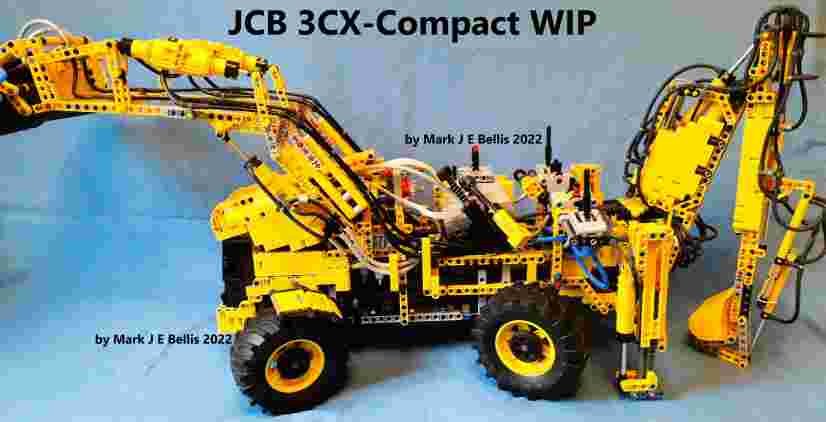
A proper 30-function JCB Backhoe would be lovely, a worthy development of 8862 and 8455. Since the LEGO Ideas parts limit is now 5000 pieces, I hope Technic could reach that with a functional non-car flagship set. Avoid Control+ nonsense and do it properly with pneumatics, including 3-function loader, 6-function backhoe, multiple compressors and servo steering. This should suffice, if I had another 500 hours to finish it: The loader and backhoe controls are laid out like the joysticks of the real JCB 3CX-Compact, so it would be possible for the user to drive them like the real thing. I took another 40 hours in 2023 to improve the servos for the steering as they need a good range of variable movement to do the proportions. Those need to be implemented in the next build. Drive works well enough from a single L-motor, with dual compressors from two right-angle motors taken from 51515, built as the "engine". I expect the 2-switch battery unit would be best for the compressors but a 2-port City hub could work with the train handset to do just the drive and steering remotely, leaving the digging functions as hands-on. TLG has not yet exploited the train handset's capability to rotate the dials, where it would be easy to set them up for drive and steering of an RC vehicle. And, best of all, the LEGO company must now have a deal with JCB, since one of the pull-back vehicles in January's range has their name on it. Mark
-
I'd love to see the SPIKE Essentials 2-port hub used in Technic, provided that the firmware was updated to use the train remote handset. This could control a car without needing a phone. It would be the equivalent of the City hub but with the Technic attachment method and a LiPo battery. The 3x3x5 motors would be useful too; those are the smallest but not in high-street sets yet. If there is to be a tower crane, based on the jib modules of 42146, then let it be one that builds itself by rising and inserting modules into its main tower. That would be a decent flagship. A LEGO mobile crane has the difficulty that having more than 3 telescopic parts to the jib makes it too wide for the scale and too heavy to lift with LEGO actuators. There is a real crane that extends the idea of 42146 with a very long diagonal telescopic jib and twin cables to support the extension that is made from frame modules. Lichfield Station Crane December 2023 Mark
-
D11 42131 troubleshooting
Brickthus replied to Micky505's topic in LEGO Technic, Mindstorms, Model Team and Scale Modeling
I agree on "worst". Having had the same problem with the 42131 front blade calibration and having reinstalled the app, I had more success when I repeated the individual function tests until each one rotated its function in both directions during the respective test, ignoring the times when they moved incorrectly. It seemed to be random but maybe it records the movements that were made during each test and takes those forward to the calibration stage. You could remove the ladder and wind the gears manually through the clutch to give it an offset. Then do it every so often when it falls out of calibration. Have owners of 42146 crane found that to be any better? I imagine a command to wind in fully would be subjective, based on how the strings wind on each spool. Or are all its 6 functions variable, without specific distance calibration? If that were so, it might lead to avoidance of Control+ sets with linear actuators but greater ease for sets without that combination. Mark -
Given the "Earth Green" leaf pieces from 10289 Bird of Paradise, and the fact that is is retiring, it would be nice to see an E-type Jag in British Racing Green to keep up Technic panels and other pieces in that colour. A manual gearbox would be a nice change but I expect the Yamaha pieces would be employed in the next supercar as justification for their existence; 4 new complex pieces is quite an outlay. Mark
-
D11 42131 troubleshooting
Brickthus replied to Micky505's topic in LEGO Technic, Mindstorms, Model Team and Scale Modeling
The motors are identical and independent. The differential is only a drive to the engine. The drive motors have to turn in opposite directions to go forward or backwards; this can only be done by a command of that sort from the hub. At step 198 I found that the tests were inconsistent in what they did to drive the motors. Test 1 drove the gear both ways sometimes and only one way at other times. Test 4 drove that drive motor in the reverse direction to what was prescribed, yet it would not fit into the model in a flipped orientation. I tested the drive motors with a battery unit and both are correctly wired, so it's either a bad hub or bad software. I'm persevering with the build in the hope that it was bad test software and that, when it calibrates (needing the model to be finished in order to hit all the end stops at the right times) it will work OK. This all puts more nails in the coffin of confidence in PU hubs and software. Mark -
[MOC] CityAirbus Air Taxi
Brickthus replied to Brickthus's topic in LEGO Technic, Mindstorms, Model Team and Scale Modeling
Hi Philipp, Unfortunately I'm not really into writing instructions. In the expired LEGO Ideas project there are a few more pictures and a video. I'll give you a basic list of key pieces: - 1x PF L-motor, 1x PF LiPo battery unit in the tail - 2x regular linear actuator (11M compressed size) - 2x set of gear selector pieces with white 3m axle extender, 3M selector, red lever and pair of red 16-tooth gears. Mounted one set each side near the front. The outputs of those drive the up/down and forward/back functions. - 4x small turntable, though this version chose not to tilt the rotors as the real CityAirbus uses just differential speeds for manoeuvring. - A couple of universal joints behind the front piece, to take the motor power up to the rotor drives, 45 degree angle on each one. 4x trans-clear 15M liftarms for the "invisible" lift effect. - Lots of axle joint #3, which were ordered from Bricks & Pieces. The rest came from sets but I have bought quite a few aircraft and sets with black and white panels. The latest sets have smaller panels for better shaping. Most of the rest you can see from the pictures. Mark -
I agree that Technic has changed but it depends what structure we assume for the range of sets. If supercars and big Control+ models are each their own series then Technic sets up to £200 still include good flagship-worthy sets that have at most 1 or 2 motors with a simpler battery unit. 42145 helicopter and 42128 tow truck are two of the best. Plenty of play value. 42144 is similar to 8851 of old as a multi-pneumatic set and 42157 has more pneumatic parts for a similar number of functions. I do agree that the occasional clutch-power issues are a disappointment. I had 42158 Mars Rover corner-wheel bogies fall off because the clutch power of the 4M axles with end stop was insufficient in the black lobed gears. I substituted 5M axles with end stop and added half-bushes on top, which TLG should have don themselves. If that had given us another 4 white half bushes in the set then that would have been most welcome. TLG ought to know the value of reliability because to cost of unreliability is high. The change to studless was a big change. I miss the beam-and-plate chassises for vehicles because they were sturdier than studless ones are; the recent 3x19 frame helps but it took TLG a while to develop one! I would be happy with a studded chassis and studless additions but those years were brief. We do get occasional studded beams but more in other ranges of sets like the Batman Tumbler; the supply of those pieces is rather inconsistent. I may bemoan the reduction in basic instructions that used to be in the front section of the 3-digit Technic set booklets, as well as the lack of ideas books. Those were most informative but I suppose one has only to look them up on Peeron in the modern age. Kids need those pointers to learn the basics well; there is a trade between basic information that all should learn and the mass self-specialisation of filter-feeding that we all do on social media and search engines. I don't think AFOLs can completely fill in the gaps left by the end of ideas books; we try our best but we don't have the same "lead you through" objectives. The phone-dependency is the thing I dislike the most. Yes, it fits with the "every kid has a phone" trend and may help LEGO to stay ahead of the competition but it doesn't reach older fans quite so well. Then there is the cost of the parts; I simply won't pay RRP for any Control+ set because I won't get the value out of the hubs. However, if I see one at 33% off (after waiting a while) then I may be tempted. The bespokeness of the app for each set model is a bugbear because it takes a lot of dedication to bother getting MOC controls up to the same standard. I had in mind that the template of the Bulldozer 42131 (2 tracks, 1 power motor and 1 selection motor) might be good for other models too but it all depends on calibration. So when it comes to the new crane I would wait and see if 33% off ever happens. The GBP price would have to start with a '3'. Otherwise it'll be a parts order if I ever feel the need for some girder frames. With the advent of phone-dependency, what Technic lacked was the simple motor-and-battery setup, particularly when the Osprey 42113 was such as disaster, that being the only set with the simple battery unit at the time. The motor-and-battery setup is the essential step up from pull-back motors before anyone thinks about programmability. There is an abundance of pull-back motor sets but surely kids can't use more than 2 in a model? The sets with 2 (like the Mustang) are quite impressive but the pull-back motor torque tails off so quickly. TLG really missed a trick with the Top Gear car 42009; it should have had a city hub and train handset to be at least £10 cheaper. The tactile feedback of the handset is better than a phone screen. I would like it very much if TLG put the 2-port SPIKE Essentials hub and the 3x3x5 motor into Technic sets and allowed that hub to use the handset with the official firmware (not needing Pybricks or other hacks). I do like some of the new pieces but it's obvious which ones are versatile and which ones are not. The #17 and #18 panels have been the most aerodynamic, bettered only by the propeller blades from Education set 45400 (I cannot recommend that set too highly as an addition to your Technic hobby). It is the oblong panels and curved edge ones that I have found most useful in larger numbers, especially for making Technic-enhanced Space-themed models. The new 3x19 frame is great; I have already raided several sets for them, including the second copies of sets I liked enough to buy two. The girder frames are interesting but more dedicated to cranes. There are still some possible small pieces missing, such as a cross block with an additional 1M axle extension, either on one end or the side. We also need a new 2/6 pneumatic cylinder to complement the others, as well as brackets to assist in overlapping 2 or more to improve reach and the length/displacement ratio. More thin liftarms would be good, including an "O+O" to save using weapon-barrels; also a "minim" as a round hole with thin cross hole at right angles i.e. half the current 2-round-hole and single cross-hole cross-block pieces and able to make either of them with two. Thin liftarms with a cross hole on one end and a round hole on the other end would be good too. As I build frequently with Technic, I semi-sort for quick parts finding, using large freezer bags in small plastic crates. Bags of 2M pegs, 3M pegs and axles in one box, bags of smaller pieces 1x2, 1x3, 2x2, 2x3+, cross-blocks, thin liftarms and cogs in a second box, beams per length in a third box and right-angles, other angles, panels and frames in a fourth box. Those four boxes live on shelves and are easy enough to carry to where I'm sitting when I watch TV. I usually have a medium set box, opened as a tray, for sub-assemblies and project-specific parts in other bags. Overall I'm glad to still find a significant number of Technic sets to buy, build, enjoy, learn from and turn into MOCs. I buy approximately the number of sets that come out each year but, across the range, it will be two of one and none of another according to taste and usefulness of pieces, focusing on their destinations in MOCs. Mark
-
If 8480 was the flagship set then, should a new Space Shuttle be at the same price point or a supercar price point now? The functions you suggest would put it at least as high as the CAT Bulldozer. Whilst the rocket motor light-up function could be achieved with three 2x3 light bricks (such as those in Pac-man 10323), the motorised functions could be done by having two free-run functions substituted for the bulldozer's tracks and one 4-way selection function and one power function from the other two motors of one hub. The free-run functions would have to include the satellite because on the end of an arm it would be too far from the base to use mechanical transmissions. The arm might start with what the Mars Rover arm does and then expand to as many realistic remotely-driven degrees of freedom as possible. We haven't seen the 3x3x5 motor in Technic sets yet; that is currently the smallest motor. I don't know if the licence to use the patented micro-motor concept ran out in the 1990s, or when the inventor died, but the smallest possible motor unit now would be 3x3x3 rather than 2x2x2. Does that put a new shuttle on a larger scale, say 1.5x like 10497 is to 497/928? On its own that could make the cost 3.375x 8480. Unfortunately that would also be over the 3000-piece limit for LEGO Ideas, otherwise it would be tempting to have a go at that. The limit is not just for practicalities of sales but also for the challenge of creation, as you can see with my JCB; it has suffered from the typical runaway complexity of engineers who like to do things properly, though the objective of pushing out what the bricks will do is always good, giving new set ideas a Unique Selling Point. Speaking of which, I will soon have a LEGO arcade machine to publish, with secret novel mechanisms! Mark
-
I've had a go but after about 300 hours of work it needs a chassis rebuild: Pic Folder: https://www.brickshelf.com/cgi-bin/gallery.cgi?f=585534 Dual pneumatic servo steering, 6-function Backhoe, 3 function front loader. Engine repurposed as motorised multi-cylinder compressors. Would be up to 30 functions in total, showing enough value from expected £430 price tag. The aim is to avoid phone-dependency by having drive and steering controlled from a City hub, using the train remote handset, with the compressors driven from a battery unit with switches. The digger functions would be hands-on pneumatic controls. The design sets up the single front and twin rear joysticks in the prototypical positions. At least for the rebuild there are some new parts now, such as the 3x19 frame. The frames for the backhoe sideways slide function have used composites from thin liftarms up to now. Mark
-
I find set 76405 a "dolls' house on wheels". It's an HP playset, not a set aimed at train fans. At 1:32 it is too large for L-gauge track; as experienced train fans we could shrink it to 1:38 or re-gauge it but... All 6 large drivers are flanged. We need them flangeless at this size in order to negotiate curves and points. In the points in particular the flanges would catch on the check rails, leading to derailment. The preferred solution at this scale, especially with 4 bogie wheels at the front, is to carry the loco body and blind drivers on the front bogie and the front of the tender, which might have 2 train motors, like this: Note: I could improve my loco with some BBB XXL blind drivers and upgrade to use fewer studs on top but this was built and exhibited in 2004. Another thing with 76405 is that the front bogie wheels should be smaller than the tender wheels, so BBB medium wheels would be better. Obviously a "not another new piece" limit for TLG. It would take 4 train motors to pull a 4-carriage train on L-gauge track at 1:38, including a maximum straight hill of 1 in 30 and R104 curved hill of 1 in 40. 4 train motors is OK with 9V, or with Power Functions using 2 sets of a LiPo battery and IR receiver on the same channel - 2 in the tender, 2 in the 1st coach. Powered-Up would need 4 hubs at 1 train motor each to handle the 1.3 Amp total current required. Synchronising 2 PU hubs on 1 channel is not easy; doing it with 4 hubs would see too many calls to customer services so it's no wonder TLG avoided making the L-gauge train. This fits with their policy of not supporting LEGO model railways. By contrast I find the winding handle of 76405 a humiliation for TLG, admitting their PU electric system is not up to the job of powering a proper train built at the scale of the track (as it represents "standard gauge" of 4'8.5"). The carriage in the set is too short to scale; it should be 8x as long as it is wide. My 1:38 UK Mk1 carriages use an 8x64 base. I'm not too worried on the "red vs dark red" thing. The HP book describes the Hogwarts Express as "a scarlet snake".. The darker red is only a factor of the LMS livery run by the WCRC train company. Some dark red pieces have broken for others, not quite as bad as brown, but we know red has a wide range of pieces and little tendency to break, so it's a safe bet. So 76405 does not have much appeal for me, not even the larger wheels. Hence the huge price tag is not justifiable for the value I might get out of it. I hope the HP fans enjoy it but I worry for TLG missing the train market like this. Mark
-
Your Best Technic Bargains
Brickthus replied to Kumbbl's topic in LEGO Technic, Mindstorms, Model Team and Scale Modeling
42144 Material Handler is currently at £80 (RRP £105) at Smyths UK Mark -
Amen to that, but it's not easy at that scale. I have a WIP JCB, potentially 30 functions, of which at least 12 would be pneumatic. After 250 hours it needs 250 more but it is heading for 1:8 scale flagship super-digger £450 territory! I have to decide whether variable pneumatic servo steering and pneumatic hydrostatic drive are feasible. Both functions aim to follow the prototype but need technical performance that I'm not sure the pieces can provide. Remote control would be drive and steering only, using a City hub, but the digging actions would be hands-on with compressors using the AA battery unit. Mark
-
42144 - Material Handler
Brickthus replied to Ngoc Nguyen's topic in LEGO Technic, Mindstorms, Model Team and Scale Modeling
The price of 42144 at Smyths UK dropped from RRP £105 to £80 so I bought a couple of them. Not sure if it would ever go lower but that would be welcome. If £30 of RRP were for the 7 pneumatic pieces then that would be £23 of the £80 and £57 for the rest is 6.9p/p. The set has fewer panels than most but £80 for 8 functions seems OK. Mark