

Cumulonimbus
-
Posts
682 -
Joined
-
Last visited
Content Type
Profiles
Forums
Gallery
Everything posted by Cumulonimbus
-
MOC methodology
Cumulonimbus replied to niknarjc's topic in LEGO Technic, Mindstorms, Model Team and Scale Modeling
That is a good question, I would say that although the design process can be very similar, designing real machines is much more challenging, especially if that machine will be series produced: In real life you have (almost) limitless design freedom which makes it much more difficult to make good choices: materials and production processes, logistics, budget, market needs, patents, legislation, and many more aspect all have to be taken into account and can have a profound effect on the final design. In this perspective, the fact that you are bound to Lego parts (if you are a purist) really restrict the possibilities and in most cases this is a good thing, since you can focus on the looks or the functions without having to worry about all the other stuff. On the other hand, if you simply look at the construction, the Lego parts do have considerable limitations. The huge design freedom in real life also means that there are many more options to solve any given problem. But you do need much more knowledge to be able to make good a decision in this ocean of possibilities. I have a theory that experienced Lego builders have a “database” in their heads of Lego parts with their possible uses and a list of best practices how these parts can be combined to solve common problems, such as bracing a structure. This database is either consciously or subconsciously used constantly go back and forth between the possibilities of a part and the design problem at hand. That is the reason why it is important, as mentioned above, to keep looking how co-AFOLs and TLG designers solve design problems with these parts, so you can keep adding to your personal database. This is exactly why I love Lego, especially Technic. The constant “tension” between the restriction of the parts and the desire to build more complex/life like/compact, and the Eureka moment and the euphoric feeling when all piece of the puzzle fall together. And of course trial and error is a huge part of any learning curve. Happy building! EDIT and PS: The human mind seems to be at its most creative when faced with restrictions. The company I work for challenges us to come up with 20 different solutions for a critical design problem. The first 5 or 6 are easy, but after those it’s very hard to come up with novel solutions. However, once triggered, your mind really can come up with 20 solutions and the last one are often the most innovative. -
MOC methodology
Cumulonimbus replied to niknarjc's topic in LEGO Technic, Mindstorms, Model Team and Scale Modeling
As an industrial designer by profession, my MOC process is structured as a any other design process I undertake and consists of distinct phases: - Ideation phase: exploring the possibilities of a MOC or MOD idea. I often sketch on paper for this, because it is the quickest way to “write down” thoughts and possibilities. I have dozens of pieces of papers laying around with half ideas and inspirational drawings which once will make it into a MOC/MOD (I hope). In this phase, I also search for reference material, such as photo's, technical drawings and videos of the real thing and think about what level of realism I would want and which aspect I would be happy to compromise. - Proof of concept: a quick test of a working principle, mechanism geometry and/or proportions. Here, I always resort to bricks to get a feeling for friction and play in a mechanism and rigidity in a (sub)structure. I often build several solutions for the same problem simultaneously and compare then before choosing one or a combination of several. - Concept phase: after selecting the best ideas and solutions for sub-problems, I start combining them in a concept. In this phase I use LDD extensively because there are no part-limitations and it is easy to copy-paste parts of a build to make iterations. The end result of this phase is a complete, functional, real life build, but often not in the correct colours yet and most of the time with a lot of room for improvement. - The final step is a complete rebuild, were I reduce the number of parts, improve and simplify the structure, choose a color scheme (which sometimes requires ordering new parts). I go back and forth between LDD and real bricks here. A final note: In my experience there are two approaches to design a Technic creation: inside-out or outside-in. For the first, I start with a mechanism I want to build, for example 3-axis airplane controls, and once I have a concept which is feasible, I design the rest of the vehicle around it. Here the scale of the vehicle is determined by some critical components which can’t be reduced is size of complexity (like a helicopter swashplate). The second approach is outside-in, where the looks and scale of the model is leading for the structure and mechanisms inside. This is often how I MOD official sets: I want to keep the appearance of a TLG set, but radically change mechanisms or structures beneath. -
Nice review, thank you. I agree with Thirdwigg that the flexible parts are needed to create some play needed for compressing the suspension. (EDIT: you can even see it flexing at this point in your excelent movie of the rear suspension) Jim, I 'm currious how compact the crane on the Arocs can be folded up? Can it be folded compactly behind the cabin like in the 8258 or maybe on top like some real trucks? Or does the crane always have to rest in bed in "transport mode" as was the case with the 8110?
-
In hindsight, my previous posts were fueled by real world frustrations and were more aggressive than intended. This really isn't my style in normal circumstances, my apologies for this.
-
Don’t act so patronizing. I wasn’t lecturing and once again your assumptions are wrong. I’m a mechanical engineer as well and I too aim for the highest level of realism in my MODs and MOCs as any AFOL. Additionally, I’m definitely not a fan of RC or PF. In fact both the strive for mechanical realism and the removal of PF and RC elements are my biggest motivations for MODding official sets. And of course bricks can be tools for prototyping or proof of principle test, in fact I have experienced this first hand in my daytime work. I have even operated construction vehicles such as a Volvo L90G front-end loader. All this is simply not relevant to this thread you have started. I simply fail to see the value of topics which ask for list: which is the best, worst, ugliest, prettiest, biggest, smallest, most expensive or most complex set? The same goes for asking the biggest ‘error’ TLG made, which flagship they should make, etc. These lists simply don’t add value to anything, there is nothing to learn except that everyone has their own preferences and that TLG can’t make all its sets +2000 piece flagship sets. Apparently I really have missed the point, because I still don’t understand your question of your OT and your motivations behind it. I’m convinced that many AFOLs here feel the same way.
-
I'm sorry, but why do we need another topic like this? What is the point? A test how good AFOLs are at spotting "inaccuracies" as you call it? TLG needs to consider a lot of requirements and considerations when designing a set and a model is per definition always a simplification of the real deal. So what if some official TLG front-end loaders have the proper suspension and others don't? Don't like it? MOD or MOC it, as so many have. Your post is so incredibly vague that there is nothing to learn and it's impossible to draw a conclusion. Your opening assumption even isn't correct: there are many front end loaders with a single rigid frames and four wheel steering. My apologies if this sound harsh, but I would like to see more constructive topics and less pointless complaining in thin air. Why don't you start with a concrete example of an official set you are a bit disappointed about, then put in some work and propose solutions how that set can be improved? That would be very interesting to read.
-
[WIP] Ultimate 42009
Cumulonimbus replied to grum64's topic in LEGO Technic, Mindstorms, Model Team and Scale Modeling
Aha, that was the topic I was looking for. Thank you for the link, you explained clearly how you manage these amazing feats. I really admire how you're not limited by the circumstances, I'm not sure I would be that strong. Many happy builds! -
[WIP] Ultimate 42009
Cumulonimbus replied to grum64's topic in LEGO Technic, Mindstorms, Model Team and Scale Modeling
Nice work, I really admire your perseverance. You might have explained already, but I'm curious how you approach a complex build like this. Do you use extra tools (Lego or otherwise) to keep parts in place while assembling? The challenge of mounting a complex subassembly such as the 42009 boom, assembling a gearbox, weaving a cable through a model or even put bushings on an axle seems quite big without the use of hands. Respect. -
Serious piracy problem and its consequences
Cumulonimbus replied to Sariel's topic in General LEGO Discussion
First of all, I would like to say that I really appreciate your work: Your MOCs, reviews and books are always an inspiration and help me in my development as an AFOL. Thank you for that. Second, piracy sucks but, unfortunately, it appears to be a sign of our times. The availability of information which has been created by the internet, makes it very easy for lazy people the make a quick profit on someone else's hard work. I guess that most pirates are very short sighted about any consequences and are detached from the work of the original creator. It can also be done very anonymously and I can imagine they feel very safe in their own room. Face to face most of them wouldn't be so arrogant (I hope). As discussed before in relation to stealing/selling MOCs, all creative efforts, professional or other, seem to suffer from this. I work as a designer/engineer for a manufacturer of agricultural equipment and every single creative step forward has to be protected with patents, copyrights and similar measures, backed up with a internal legal department. And even then, once and a while, competitors really push and even cross the boundaries of what is allowed and legal. I'm not sure that you could get legal support from TLG, since these infringements are not really affecting their finances, brand image, patents or copyrights. My best guess is to try to get support from your publisher, since they are directly involved. Personally, I have bought all your books as paperbacks and loved every one of them. We all operate in very small niche here and I'm very thankful your books even exist. Do you have an idea what the ratio is between the sales of the physical books and the digital ones? Would you and the publisher lose any revenues if it would no longer be available as an e-book? Anyway, keep up the good work! I wish you all the best. -
Yes, I read about that. But I'm working on a 42042 inspired MOC crawler crane and it is relatively easy to achieve similar functionality in a space of 15x7x25 studs. The 42042 has a body of about 21x7x32 (quick estimate), so what is it hiding?
-
Maybe a silly question, but why is it so big? I mean, the body is very bulky (wide and long), but I don't see why the designers would need so much room. Apparently, the body is considerably bigger than the one from the 8043, but It has less motors, (I think) a simpler gearbox and fewer functions. Could it be a question of equilibrium? Did the battery box needed to be a certain distance from the turntable to keep the arm and grabber in balance? But then the solution of the 8288 to achieve the same effect was a bit more elegant
-
[HELP] Motorcycle Tire Size
Cumulonimbus replied to Milan's topic in LEGO Technic, Mindstorms, Model Team and Scale Modeling
One of my 8420 bikes has flattened patches on the tires, which I find supprising because the rubber compound is quite hard. I guess that storing the tires under load, for example in a displayed model, could lead to this effect. Does anybody else have had this issue with these (or other) tires? -
Has anybody seen this RC MOD of the 42036: .Although it need small supporting wheels, it reminds me of this non-lego RC bike
-
I recognise your troubles. Once it became clear to me that emerging from my dark ages wouldn't be limited to just one set, I promised myself to restrict myself to just one Lego theme: Technic. The temptation of big Creator sets as the Sopwith planes, the VW Beetle, T1 camper and MINI Cooper was very big, but I resisted the urge because I know myself too well: Once I buy one, my collecting drift will lead me to buy more. My wallet wouldn't thank me for that.
-
Crawler Crane
Cumulonimbus replied to gvo25's topic in LEGO Technic, Mindstorms, Model Team and Scale Modeling
That is a goodlooking crawler crane, nice work. You mentioned it is fully PF, but I'm curious about the controls. Is it RC or is there a "gearbox" inside? -
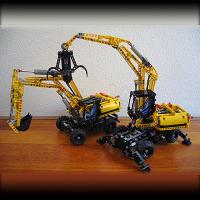
I have converted the 42006 into a wheeled excavator. To achieve this, I rebuild the last section of the boom to be able to control the bucket with a mini-LA. Unfortunately, I don't have instructions.
-
Dark Bluish Grey, the color of the dark grey parts in recent sets. The name was created to be able to make the distinction between it and the older types of grey. Edit: LBG is of course Light Bluish Grey, similar story as for DBG
-
I really like the looks of your MOD, clever use of the transparant cylinder block as well. Good job! I am curious how it would look if you switched the two red panels in the front, it might look similar to the preliminary version of the 42039, which is never a bad thing.
-
Very nice work! But I wonder about one thing though: As the new rail is meant to be used with the new gear rack, what are the options to mount a gear that will interact with the rack? I mean, there are no holes or mounting points on the top of the end of the rail to brace the gear. (I hope you understand what I mean).
-
Not sure about the height of my version yet, I'm planning a jib similar to the 8288 A-model which will add quite a bit of height as well. Normally my MOCs and MODs are stripped of PF and RC functions, because I prefer manual power and control for various reasons. This time however, I wanted to keep the battery box as a counterweight, and therefore I kept the PF motor as well. But if you look for a fully PF and RC crane, I have to disappoint you. I will make a separate topic for this MOD/MOC in due time.
-
42040 Fire Plane
Cumulonimbus replied to timtimgo87's topic in LEGO Technic, Mindstorms, Model Team and Scale Modeling
Where? I only see it in light grey on top of the tail and on the support structure of the floats. -
This mock-up gives an impression of my plans with the 42042:
-
I think the trolley will be able to move and probably will be motorized as well: With the available gearbox parts, the B-model could have four motorised functions: drive, lift, rotate and move trolley. The A-model has two strings, in the B-model one will be used for lifting and the other could be for moving the trolley back and forth. Not sure about the extendible tracks though, I think the picture on the back is just indicating driving.
-
42040 Fire Plane
Cumulonimbus replied to timtimgo87's topic in LEGO Technic, Mindstorms, Model Team and Scale Modeling
Do you guys think the colour scheme is orange and white or red and white? The earliest sources talked about red, but orange would look cool as well. -
I understand what you're saying but consider the following: - A large scale version of the 8288 (which brought me back from my dark ages) has been on my MOC list for years and I have developed some ideas and wishes in the meantime. Although the 42042 might not satisfy all my wishes, it has sparked the MOC plans again. - There's always something to learn from building official sets. - Gathering the required parts for any MOC is time consuming, especially with the current TLG (temporary) ban on ordering parts directly from them. In addition, the easiest way to get the new part in this sets is to buy it. - It's Lego, anybody can build the stuff they like It probably doesn't sound like it, but I really like the 2H sets and admire the designers for the efforts they have made in the 2015 Technic line-up. Really nice models, parts and colors, kudos!