


powerwindows83
-
Posts
36 -
Joined
-
Last visited
Content Type
Profiles
Forums
Gallery
Everything posted by powerwindows83
-
maybe if you put two in a row somehow? also if the axle itself isnt a design issue but the visibility of it is, could you cover the entire exposed length with red axle sleeves to cover everything but the worm gear(s)? just an attempt at keeping to vanilla lego
-
any plans to make it RC? it looks dense so i imagine not but still great work so far! also can we get a pic of the underside? im curious how you did the suspension setup because proper live axles are a tough thing to pull off
-
Hi all! Is there any chain that's stronger than the rather pitiful technic links? I've been wanting LEGO to make sturdy chain links using the large treads forever now, and if they do have something like that I'm unaware of it. But is there a stronger chain available from LEGO, or should I just resort to buying and cutting up some tread links? I'm picturing something pretty similar in size to the chains found in K'NEX roller coaster sets. Thanks in advance for the guidance and/or bad news! :P I'm working on a somewhat realistic boxer engine for an MOC. I thought it would be interesting to have XL motors where the camshafts would be and have the timing belt (technic chain) actually drive the thing, but of course the old links are far too weak to handle one motor, much less two. I'd like to use the large tread links since they're plenty strong enough, but the tread face is five studs wide and would 1) be obviously unrealistic, and 2) take up most of the space in the engine bay. If I have to I'll use two chains next to each other and hope that holds, but if I can I'd like to keep it as narrow as possible. Cheers!
-
High speed gearbox
powerwindows83 replied to F41RF4X's topic in LEGO Technic, Mindstorms, Model Team and Scale Modeling
allanp that transmission design doesnt shift properly using a servo due to the allowed dead zone around a target position. depending on how the levers are oriented it gets stuck between gears, ie. it stays in 3rd too long shifting into 2nd thus the whole system locks hard momentarily mid shift. i tried putting a spring "clutch" between the buggy motors and the gearbox to give it a cushion, but it didnt have any effect. honestly i would stick to either two separate 2 speed boxes, or 1 steeply geared 2 speed while throttling the motors. i like to make fast cars (now with a buwizz unit) and i really dislike "sand" and bent gear teeth, so i put a lot of effort into making transmissions take a heck of a beating at high speed :) -
i had the bearings fail in one of the little gears in my mountain bike derailleur and the gear came out. it turned out that the bearing ID/ODs were exactly the same as the 2 stud technic sleeves. i cut one to length (roughly 1.5 studs) and with a shot of oil it worked perfectly. a year or so later the chain caught a stick and the entire mechanism crumpled under the force i was putting on it, so i can confirm it worked at least that long
-
The gear type motor would require a grease lubrication to keep noise down, but it wouldn't require a large volume of air. The purpose of the gear train in this case would be to dampen the visible effects of the compressibility of air over true hydraulics; the slowing of the output is just an added benefit. If there were no gear train the operation would be rougher, but it would only use as much air as you put into it, plus leakage. It would be a much simpler and smaller design than the axial piston type, but it would be harder to implement it in a build. I agree it would take a lot of new parts and special engineering. But: (1) I think, even if for some reason it were never to be included in a kit, it would have just unique enough a function to be worth such a price (75 seems a bit high, but that's not important until manufacture costs are determined :P) and worth lego's time to engineer. The existing lego motors come in all shapes and sizes, especially the robotic ones, and I imagine an axial piston motor would fit into a PF M- or L-motor case with a modified 45* front piece so it wouldn't be too terribly radical-looking. And (2) lego parts are already designed with incredible precision, so that's definitely not going to be an issue for them. With respect to fitting the components into a 3-s diam. circle, I think that would work pretty well. Their 1-s width piston plunger and seals would be perfect for this application. The gear train already exists, and they can use the small technic ball joint components to make the swash plate and pistons interact since they're also 1-s wide. The only thing in this motor that would really need to be heavily engineered is the valve system for the pistons, but I'm sure lego's up to the task. It's an interesting idea. It just can't be 3D printed and work effectively, and most people don't have the ability to mold things at home, so no prototype can be built right now.
-
there isnt a reasonably sized MOC anywhere that can house that comfortably, and they usually require a very large volume of external air. also unless you use a tube pinching design (which i dont personally like) youre losing a ton of efficiency in the amount of friction the switches make.
-
Hello all! I don't know if this is in the right place or not, but it's quite an outlandish topic so I'm gonna assume this is right! The pneumatics system has gone through many part additions and changes over the decades. One component that never showed up is the hydraulic motor. Now, I'm aware that hydraulics and pneumatics are very different things, but the operational differences would fade in higher speed applications. What I mean by that is if there were to be a very high speed (due to the differences in how air and liquid drive these motors) gear type or axial piston type motor for example, and you coupled them to the existing planetary gear trains found inside most PF motors, the results in theory would be fairly decent torque and roughly normal lego motor speed inside of a roughly lego motor-sized housing. So why haven't they done this? And how come no one else has done it on the internet so far as I've seen? I know you can make rotary motion using pistons in an "engine" application, but that method has some obvious limitations barring it from actual use in an MOC usually due to size and/or switching inefficiency. Let me know what you all think of this as an idea, and fill me in if you know why this wouldn't work in practice if it doesn't!
-
parts wear (motorized technic builds)
powerwindows83 replied to powerwindows83's topic in General LEGO Discussion
ive always wanted to make a fast lego rc car, but the wear is just ridiculous bc technics werent made to do that really... im still gonna try, but it looks like the only sure-fire way to make a fast drivetrain that wont explode is motors directly attached to the wheels, but thats not "real" like a conventional 3-diff awd drivetrain or a 1-diff 2wd... i guess what im indirectly asking is whats the best way to make a preferably awd drivetrain that will stand the test of time in terms of wear? -
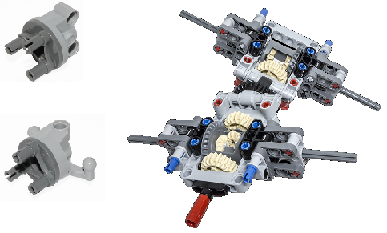
Hello all! There's a thread called "parts wear" which deals with such things as discoloration of bricks over time and tire deformation, but that's not quite what I was looking for. This one, as the title suggests, is geared towards motorized technic creations... Many people who build complex technic things and love their motors know that ABS plastic on plastic doesn't make for the best bearing in the world, often resulting in extensive deformation and/or failure of parts, or the creation of "dust" from a once-useful axle under load. Fast mechanisms, even under little to no load, also like to disintegrate very quickly... What building techniques (or even slightly non-vanilla tricks) do others use to keep their models going, or at least keep the parts usable once the model comes apart? Happy Building! I got some wheel hubs (left) a few weeks ago because they look like they can handle heavy vehicles much better than standard axle-in-pinhole hub designs (right). I don't know if there's any real advantage to using them, but it seems like the greater surface area plus a drop of oil or something would make them far better at holding up in the long run versus just an axle in a hole
-
hi guys! ive seen many different designs for stepper mechanisms on youtube (...https://www.youtube.com/watch?v=w1Nj-5ISZow...) primarily to be used for shifting transmissions remotely, but none quite achieve what i'm looking for. all of them use a cam attached to a motor that will advance the mechanism by an increment every time the cam executes one revolution. to control these types, the user would have to listen for the click or look for the effects (ie vehicle speed change) to know to stop driving the motor, which if messed up could lead to overshooting the desired number of shifts or possibly breaking something depending on the design. so my question: has anyone developed a stepper mechanism that advances one increment based off of the motor being accelerated as opposed to rotation count? like if i wanted to shift up i would run the motor, and the motor would increment the mechanism but then keep spinning freely until i tell it to stop, at which point it would 'reset' itself mechanically and be ready to shift again when i want? i doubt just throwing a slipper clutch at one would work because of the high force it takes to actuate such mechanisms, and that wouldnt work in most designs since the force of stopping the cam is the same as shifting, therefore a slipper clutch wouldnt do anything or it would prevent the mechanism from ever shifting. any ideas for this?