Link to MOCPages: http://www.moc-pages.../moc.php/426649
VIDEO FOUND HERE:
Hello, this is my first post on Eurobricks. Anyway, here I present my custom supercar RHM (Rage Hobbit Motors) Wutzwerg.
Note: this model is on Lego Ideas, the link for which is here: https://ideas.lego.com/projects/136011. I'm not really expecting the model to get either the necessary votes or to get turned into a set, but hey, I like to be surprised.
Propulsion: 1 x L motor
Steering: Front wheel with 1 x Servo motor and working steering wheel
Drive Type: RWD
Transmission: 4-speed sequential synchronized V2
Weight: 1.3 kg (2.87 lbs)
Length: 41.5 cm (16.3 in, 52 studs)
Width: 18 cm (7 in, 22.5 studs)
Height: 10 cm (3.9 in, 12.5 studs)
Power source: 7.4v 8878 Li-Po rechargeable battery box
Estimated part count: 1800 pieces
Suspension: All-wheel dual-wishbone independent
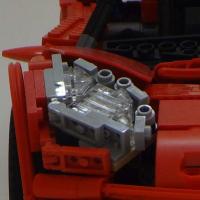
Opening hood, doors, and engine
V10 piston engine connected to drivetrain through transmission
Build time: ~60 days
Short Description
This is my first vehicle to be built without a real subject vehicle in mind. It has less of a focus on performance than my other vehicles, with only a single L motor for propulsion. It also has front-wheel steering with a working steering wheel, a new version of my 4-speed sequential synchronized transmission (link here: http://www.moc-pages.../moc.php/422999), and a motorized rear wing.
Introduction
For this car I was trying something a little bit different. I had just designed a new version of my 4-speed sequential synchronized transmission (link here: http://www.moc-pages.../moc.php/422999) and I wanted to use it in a car, but I also wanted to build something a little less performance-oriented than usual and thus fit in more functions.
This time, there is no original vehicle; make what comparisons you will, this car is entirely a product of my imagination. I think.
Drive Train
Part of my plan for this vehicle was to eliminate one of my customary 2 drive motors, leaving only a single L motor for propulsion. This freed up space for another M motor, as well as allowing room for the V10 piston engine. The V10 piston engine located behind the front seats, and was connected to the drive system through the transmission; as such, it varied with whatever gear the transmission was engaged into. Because of space restrictions, I had to replace the usual cylinder brackets with a custom rig, after spending a solid hour determining the exact geometry of the original brackets.
The transmission used in this vehicle works off of the same principle as my previous 4-speed sequential synchronized transmission; this transmission is also a dual-sequential transmission. What this means is that the transmission actually contains TWO separate transmissions which are shifted in such a way as to produce 4 distinct speeds. What differentiated this transmission from the previous versions is that the switches were not hinged: instead, they moved back and forth in a straight line. This can be seen and understood better from the video above, and you can expect instructions sometime sort of soon-ish. The transmission itself was shifted by an M motor geared 10:1.
Because of the lessened power from using a lone L motor, the motor had a gear reduction of 1.25:1 before being fed into the transmission, and then another reduction of 2:1 before the differential at the rear wheels. The car wasn’t fast, but it did pretty well for a single motor.
Steering and Other Motorized Functions
Steering was simple as usual - with a Servo motor and rack-and-pinion system - but this time I added a working steering wheel. That’s just about all there is to say for the steering system.
The final M motor was for the rear wing. This was no fancy job, just a linear clutch and lever mechanism to raise the rear wing, but again space restrictions made the implementation of this system difficult. The rear aesthetics were somewhat compromised to make room for the rear wing & mechanism.
Aesthetics
With this being the first time I’ve ever come up with my own large-scale car, I didn’t really know where to start, and all the online comments saying “Making your own car is SO hard!” were not particularly encouraging. The front was actually the first area to be built (because of the awkward and inconvenient position of the battery box) and the rest of the car was built using the front as a reference point.
Obviously, I can’t give my own unbiased opinion on the car’s aesthetics - many hours spent designing it have probably compromised my opinion as well - but I think the aesthetics turned out pretty well. Please, give me your honest opinions in the comments section!
Reflections
Not bad, I think, for a first attempt at making my own vehicle. Space was a little bit cramped because of the scale I chose to build it in, but everything mostly fit together in the end. It functioned really quite well: the transmission, rear wing, steering, and propulsion systems all worked without malfunctioning even once in the final vehicle, despite considerable use. That may be a first for me.
Despite having fun crafting my own vehicle, I can’t see this as being something I’ll repeat frequently. That’s not to say I’ll never do it again, but I do enjoy recreating existing cars, and of course brand familiarity with my viewers gives people something to compare to.
Enjoy the pictures!





 That's actually because the output driving ring is slightly damaged from use in a previous model.