Search the Community
Showing results for tags 'ural'.
Found 2 results
-
 Hey everyone! First of all Happy New Year to everybody! Here's my last MOC of 2019, a URAL 4320 4x4 Trial Truck. It features: -working steering with servo motor and adjustable working steering wheel -4x4 drive with 2 differentials powered by 2 x power functions XL motors, and fed by 2 x 2.0 pf receivers and 2 x lithium battery boxes -opening doors -working lights A couple pictures of the model, more on here: https://www.bricksafe.com/pages/Teo_LEGO_Technic/ural-truck My main goal with this project was to make a robust trial truck with tons of ground clearance and tons of torque and solid steering, while not having anything be at risk of breaking. For this reason I have an XL on each axle, as a 5 x 7 frame with a differential can hold the full torque of one XL without damage to the gears. Extra torque was achieved by using the Unimog portal axles. The truck can stand Sariel's wall test, i.e. when the wheels lock up on a grippy terrain no gears break anywhere. The steering is also precise, with no intermediate gears between the servo motor and the rack and pinion system. It too can handle the full power of the servo without any danger of breakage. The suspension too is robust and meant to operate as smoothly as possible. Putting the battery boxes low down on the sides helps it be as difficult to topple over as possible, bearing in mind how high it is off the ground. My secondary goal was to emulate the rugged look of Ural trucks, which only look as good as they should when every little curve and angle is modelled like the real thing. This includes the curvature of the front grill, the form of the bonnet, the angled headlight frames, and the subtly angles and tilted front windshield. I'm fairly satisfied with the result, and overall it's a truck I'm pretty happy with. Nothing super fancy, no gearbox, just a solid chassis and a good-looking body. Hope you guys enjoyed it!!
 -
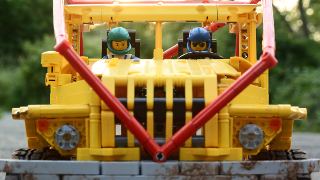
 Hello. Today I want to introduce my competition truck for this year's Czech LEGO truck trial competition. Original Vehicle: My MOC is based on Ural 4x4 that was raced by a Polish team of Ostaszevski 4x4 Team for a few years. The truck participated regularly in European cross-country rallies and truck trial competitions (according to photos). I did not find any technical data of the vehicle, just photos. But you can see different evolutions of the vehicle: changing frond end from Ural 375 to newer Ural 4320, changing color of a roll cage, changing wheels and, of course, adding scars to the vehicle. An interesting feature is the roll cage, which is attached at the front by a pivot pin. This makes it possible to twist the chassis frame of the vehicle without breaking the roll cage (this can be seen on czech Praga V3S trial specs). Even more interesting is that the racing team moved the front axle ahead in compare with serial Ural truck. This improved the weight balance between front and rear axles and at the same time increased the approach angle. I chose this this vehicle as a base for two reasons: 1) I built Ural 4320 6x6 when I started participating in Czech LEGO truck trial competition four years ago. And this year I wanted to prove myself that I improved my building skill and I wanted to create a nicer model. 2) The Ural Team Ostaszevski is the most interesting competition 4x4 truck I've ever seen. Especially on desert photos it looks like Mad Max kind of truck. MOC: Scale of the model is 1:12.5 (1 stud = 10 cm). Dimensions: width 26 studs, length 57 studs, wheelbase 38 studs. Weight: 1600 g. I think all basic proportions are accurate to one stud (sometimes half). Only the front bumper is wider than it should be (required by our competition technical rules) and wheel rims have a larger diameter. But tire circumference is all right. Even the longitudinal beams of the chassis frame correspond to the original. There are two PF Large motors that drive all four wheels through the 16:16, 20:12, 20:12, 24:8 gearing. There are no differentials in the drivetrain, but the rear axle drive is able to disengage. This is controlled by a pneumatic piston, but due to the wrong design of the disconnection it does not work anymore (actually worked when it was new). The PF Medium motor is used to steer the front axle. Due to steering geometry, Ackermann's steering is achieved (the inner wheel turns more). And steering wheel is connected so it rotates while steering. Other equipment required by competition rules: manual winch, front and rear tow hooks, seat belts and attaching points for number plates. Drive ability: I tried to get the most accurate imitation of the original truck with cost of worse off-roading ability at competitions. For example: approach and departure angle could be better, the cab is heavy and those tires do not have a best offroad thread. But it is better than I expected. The axles are not sprung (the axle does not have any travel), but I use the torsionally soft chassis frame. Just like the mentioned Praga V3S truck. That was probably the most difficult for me. Design two longitudinal beams, just soft in torsion, stiff to bend and not break apart while twisting. This was done and chassis flex is quite nice. Also the wheel travel looks natural (not as a turntable on one of the axles, the rest stays stiff). I also like that the entire drivetrain is hidden in the chassis frame. Only the steering motor protrudes under the bonnet. It is compact and the chassis itself reminds a chassis of real truck. The chassis, the cab and the flat bed are independent modules as in a real truck design. The thing Porsche 42056 was promising, but did not match that. To be honest, it has some technical issues: 1) Gearwheels mounted to L motors (16tooth) wind up long grass in between them. 2) As already mentioned, disconnecting of real axle drive has stopped working. 3) In the last section of the second race, the front axle U-joint has cracked. 4) I do not believe the 24 tooth gearwheels in front wheel hubs. But they have not broken on the Ural yet. Anyway, the biggest weakness during competitions is the driver for sure :D Car control: I believed you noticed there is not a single battery box on the truck. That is correct. In our trial competition rules is drive-by-wire allowed. We know it looks lame, but there are main reasons for that: 1) Weight reduction - Batteries are part of your controller and car doesn’t have to carry them. 2) Control precision - LEGO offers only IR remote control (so far) and that is useless outside on direct sunlight. 3rd party receivers were forbidden until last season (100% pure LEGO), but sBrick is allowed since this year. Still, no one use it because it not as precise as old 9V BBox and because of weight. 3) Pneumatic control - we can use pneumatic hoses for diff locking, gear shifting or suspension adjusting. You can do that remotely as well, but it will cost you lost of additional weight and no one would do that anymore. And don’t think we tow out cars by cable. That is forbidden, of course and our official is strict about that. --- For more photos look here: https://www.zonerama.com/Link/Album/4391387 To see where it got that dirty, look at video of 2nd race: https://www.youtube.com/watch?v=g9Gnw0XoFHU --- I use Zonerama instead of Flickr and I am not able to insert pictures.