Search the Community
Showing results for tags 'Ancient'.
Found 9 results
-
The Tylisians of Lampsacus. by Mark of Falworth, on Flickr Legio IV Abydus "The Northern Legion" by Mark of Falworth, on Flickr I'm really liking these guys! More on Facebook and Flickr!
-
The Conquest of Lampsacus by Mark of Falworth, on Flickr The Conquest of Lampsacus by Mark of Falworth, on Flickr The Conquest of Lampsacus by Mark of Falworth, on Flickr Enjoy!
-
War has come... by Mark of Falworth, on Flickr My latest creation featuring some new parts I got yesterday! Gotta love those dark red brick bricks!
-
Now moving way back in time. This ship was in use in the period from 800 BC-300 BC. The archaic and the classic periods in Greece. This was the time of Homer (not Simpson), Pythagoras (a2+b2=c2) , Thales (Waterworld), Sappho (Woman into women), The battle of Marathon (yes this is where the name is from), The battle of Thermopylae (“THIS IS SPARTA”), The Peloponnesian war, The rise of Macedon (That great Alexander fella)… Penteconter front by Anders Thuesen, on Flickr This vessel was rowed by fifty oarsmen. These were free citizens and the use of oared ships is said to have a strong link to the Greek (Athenian) Democracy. The Penteconter would later evolve in to the more well-known Bireme and Trireme. Penteconter side by Anders Thuesen, on Flickr This was a very fast design Yep both the ship itself and the designing of the LDD file. Penteconter back by Anders Thuesen, on Flickr
-
Then out spake brave Horatius, The Captain of the gate: “To every man upon this earth Death cometh soon or late. And how can man die better Than facing fearful odds For the ashes of his fathers And the temples of his gods, From Horatius at the Bridge by Thomas Babington, Lord Macaulay (1800–1859) In around 506 BC a large Etruscan army lead by Lars Poresna, King of Clusium, marched on Rome. Among their number was Rome’s recently deposed King, Tarquinius Superbus, who hoped that, following a successful campaign, he would be returned to the city’s throne. Having recently engaged an army of Tarquin’s in an indecisive battle at Aricia, the Romans were expecting an invasion and hastily attempted to construct a fort on the Janiculum, a hill on the western side of the Tiber. However, owing to inadequate scouting, the troops stationed at the fort were surprised and overcome by the Eutruscan force, which proceeded to occupy the hill. From the Janiculum, Porsena’s army launched an attack and advanced on Pons Sublicius. The Roman forces were now in disarray and the future of the newly formed republic looked bleak. However, just as all seemed lost, a soldier named Horatius Cocles, accompanied by two others, namely Titus Herminius Aquilinus and Spurius Lartius (which, intriguingly, are Etruscan names) stepped forward to defend the bridge, using its narrow width to reduce the effectiveness of the large enemy force that bore down upon them. There they fought while to their rear the citizens of Rome gathered and, using but hand axes, began to chop down the bridge. Herminius and Spurius retreated as the bridge was almost destroyed, but Horatius fought on until the bridge had fallen, leaping into the river in full armour and swimming its width while coming under enemy fire. The attack was thus repulsed and Porsena forced into an unsuccessful siege of the city. That, at least, is how the story goes according to Rome’s poets and historians. There have however always been questions about the story’s veracity and even Livy, whose history was as much about promoting Augustus Caesar’s legitimacy as it was about recording past events, casts doubt over some of its claims. It’s likely that Porsena succeeded in capturing Rome, for a short period at least (though there is no evidence to suggest that Tarquin’s throne was ever restored), and that Horatius’ exploits were later invented as a means of masking past defeats and promoting the idea of Rome’s inherent superiority. The Romans were, after all, skilled in the art of propaganda, a modern Latin word with ancient roots. Whatever the truth, I think it makes for a fun little MOC. You may notice that I’ve avoided using the familiar Roman Minifigure helmets and armour. This is because during this period the Roman Army was still fighting in the Greco-Etruscan style, where the phalanx was the master of the battlefield. This is over a hundred years before Rome comes into conflict with the Samnites and subsequently adopts the maniple system and around 400 years before Marius implements his reforms. The army was therefore vastly different in appearance and style to the one most people are familiar with. This is why I’ve gone for the Corinthian helmets, Hoplon shields and bronze and Linothorax type armour. All photos can be seen by going to my Flickr account. Anyway, many thanks for viewing, your C&C is very welcome. MW
-
Often it can be difficult to decide what I want to build. The Collectible Minifigures theme has brought many interesting historical minifigures. Last year I have built a large Greek layout for the Spartan from series 2: http://www.eurobrick...89#entry1533491 After I had finished the Greek layout I thought a lot about what I should build next. Should I build a Roman layout for the Roman minifigures? Or should build an Egyptian layout for the pharaoh? Or a 1700's layout with a lot of minifigures with white wigs? I would like to build it all. That's how I got the idea to build this MOC: Ancient Egypt: Ancient Greece: Ancient Rome: In the background: Colosseum The Viking Age The Middle Ages: The Renaissance In the background: St. Peter's Basilica in Rome: The Late Renaissance: In the background: Rosenborg Castle: The Age of Enlightenment In the background: Fredensborg Palace: The Industrial Revolution In the background: Westminster Palace: Modern Time: The back of the MOC is a world map:
-
 OK, at this point, a small series of sets covering the Ancient World is essentially inevitable... All the molds have already been made, and it is just a matter of time now... So here is an ambitious new attempt to make a series of sets through Cuusoo. I designed a series of 8 of them, ranging all the way from $30 to $300, including different sets for Greece, Rome, the Lighthouse of Alexandria, Stonehenge, the Hanging Gardens of Babylon, and the Nexus of Bifrost. Please have a look, I'd love to hear everyone's feedback, and then you can come to vote on all of them for free at LEGO Cuusoo! And I will incorporate everyone's suggestions as soon as I can! Thanks Again! =D therealindy (Archaeology, Ancient, History, Greece, Greek, Rome, Roman, Alexandria, Egypt, Celtic, Stonehenge, Garden, Babylon, Viking, Bifrost, Wonders of the World)
 -
Since I was at holiday in Athens in the summer of 2010 it have been my dream to build an ancient Greek LEGO layout. But my mother and I did also have many other building projects. Therefore it was not possible to start before January 2012. It took 10 month to build the layout. It’s our largest MOC. The area of the layout is 2.3 x 2.8 meter. The layout shows a typical Greek town from around year 400 BC. The name of the town is Legopolis. Symmetry, harmony and geometry were importation values in the Ancient Greece. Therefore it have been our goal to build a town in that style. 14-17. February 2013 the layout was exhibited at LEGO World in Copenhagen. http://www.flickr.com/photos/66344850@N06/sets/72157632900664334/ More pictures: http://www.brickshel...ry.cgi?f=522053
-
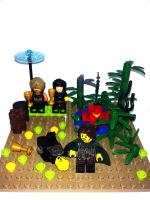
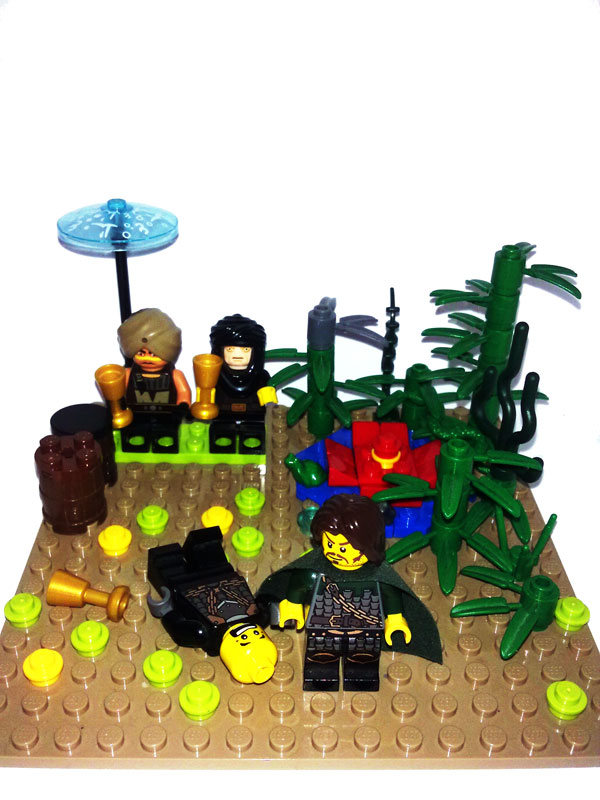
I am glad to introduce a series of my works devoted to Odyssey's travels. #1. Odyssey and Lotus Eaters. #2. Nobody is a guest in Polyphem's cave. #3. Odyssey and Circe. #3.1 Odyssey and Circe. Pediment: Batrachomyomachia