


grindinggears
-
Posts
96 -
Joined
-
Last visited
Content Type
Profiles
Forums
Gallery
Everything posted by grindinggears
-
(Maybe we should distinct between the first appearance of studless parts and the first completely studless set ) Back on topic: Happy birthday studless building! Let's hope we see 17 long liftarms on your 17th birthday
-
That is awesome. "Ferrari tanks - lose the war with style!"
-
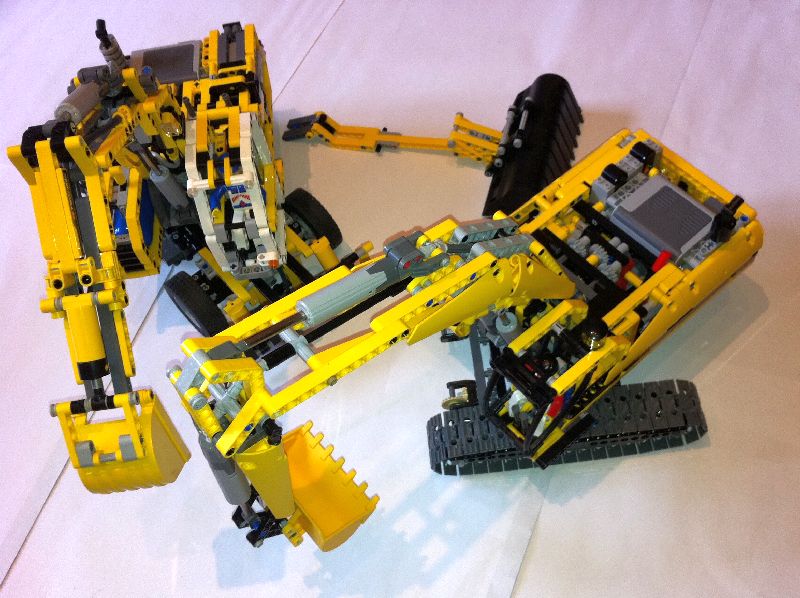
As a late christmas gift and reward for finishing my own one I bought the official 8043 excavator. It really is the number one official model of ALL TIME!!! Here it is in comparison to my own excavator: I spent some hours playing and tinkering around with it. I implemented the mods of Out Of Sight and later switched to the bucket mod of Jurgen's Ultimate 8043. Many thanks to both of you, it operates really smooth now! More pictures are available on my Flickr channel In the next days I will disassemble both excavators and start working on a hydraulic system. Of course I will post pictures of the naked gearbox.
-
Awesome review and a very good idea to show the mechanisms with gifs! If I had not bought the 8069 already I would do so NOW
-
Thanks for all the comments! @ Sariel and Jurgen Sorry, I didn't know that insane is a positive word and I didn't want to judge the model by myself. I wanted to express that my concept of powering the model's functions is really different from what I think would be a normal solution. Naturally you would put one motor to each function. The problem for me was when thinking about an excavator: I only have three motors and I wanted the model to drive too. So I had to find a new and more complex solution. By calling the gearbox insane I mean that the whole concept is pretty awkward. I am not too proud of my MOC as I see enough things that I could have done better and I don't want to judge it with the words I use. @ Zblj Well, the video really got long. I am new to editing videos so I was kind of unexperienced in filming and putting the material together. I will make the next video shorter. Can you give me an advice for the still frames (I mean those where there is text on a black background): How long should I make them? Currently they are 4-5 sec which might be too long.
-
Hi there I want to present my latest model to you. Making a video for it was a first to me but it even is HD and I hope you will like it! This my most complex MOC so far. I have done the first sketches half a year ago but there have been many difficulties and distractions interrupting the building process. Now I am glad to have finished the model and all the photographing and video editing (this is a first for me) work. The model is a wheeled excavator. It is powered by only 3 motors, 2 LAs and some pneumatic stuff because my parts collection is not too big (yet). This setup needed a really unique way of transferring power to realize all the nine functions that a real wheeled excavator has (including dozer blade, outriggers but no two-section-boom). This is made possible by a complex gearbox that transferres the drive of a single XL-Motor to four different functions independently. These functions (compressor, boom LA, dipper LA, slewing) are toggled by gear levers which provide precise control over the model. The undercarriage houses two motors driving and steering the model remotely. The compressor fills an airtank supplying the bucket tilt, the rear outriggers and the dozer blade with pressure. The whole model is pretty small for its number of functions and there is absolutely NO space left to add anything more. Controlling the machine works quite well although it uses a mix of LA-driven and pneumatically actuated motion for the digging arm. In the video below you can see it digging white beans. You can see all the pictures in my Brickshelf gallery(once moderated) or on my blog. The should be embedded below. If it doesn’t work, there is a copy on vimeo. You can read the full blogpost on my blog in English or in German! I will be glad to hear your critiques and comments! GrindingGears
-
My greatest respect, furius, my mind is officially blown! I never thought that it would be possible to pack power functions components so dense. When modding my 8069 I also tried to fit a few motors inside the cabin but didn't succeed in placing the bb inside the model without destroying the looks. I still don't get it how one can place 13 power function parts in this tiny model
-
Thanks for all the praise! Makes me want to do another building video in the next time... @ Doug72 Good solution for that problem. I don't know why it didn't occur to me when the model was built Moving down the seat made it lean back a bit more and thus lowering the grey connector by more than one stud. Hence the space here was slightly less than two studs. Above the seat I couldn't place a connector because it would interfere with the technic figure's head.
-
Lego Hydraulics
grindinggears replied to grindinggears's topic in LEGO Technic, Mindstorms, Model Team and Scale Modeling
Sorry for not posting here in the last days, I was at the wedding of a friend of mine and didn't have the time to post here. BUT I have made some thinking about how a hydraulic unit with compressor and valves could be built and how to make it watertight (or oiltight ) I will build a mock-up model of such a device in the next week, maybe you have a suggestion for me if there is a hull or tank piece by lego that fits the following specifications: - made of one piece so it's watertight - has a rectangular shape and is about 10 to 14 studs high Maybe some bionicle boxes will fit that. Otherwise I have to use a non-Lego tank On the 28th of January I got Timo's reply about his mobile crane and how the hydraulics were working. First the biggest news: He is still working on the model! So we have a good chance of seeing it in motion sometimes in future I have put the whole message from him in the attachment if anyone speaking german wants to read it in original. He gave me the following hints: The plugs of the pneumatic cylinders are too narrow to provide a sufficient working speed with water. Hence he widened them to 1.2 mm using a drill. Too bad for the purist in me Considering rust: The new cylinders (maybe he meant the past 2003 cylinders by saying new?) do not corrode. He used silicone grease to tighten the cylinders. Instead of the original Lego hoses he used slightly narrower ones which didn't pop off ever. To improve the outrigger performance he supported the counter cylinders with rubberbands which give additonal pressure when extracting the outriggers. As a liquid he used a mixture of distilled water and alcohol. The alcohol was used to decrease the surface tension of the water. I'm not an expert in that field but I suppose the surface tension of the water would otherwise have caused additional resistance when running threw the narrow hoses. So his solution (number 2) is not just a CAD idea but a real one which eventually works and has undergone some heavy sophistication. That's it for Timo's hydraulics. He also wrote something about the progress of the rest of the model (see the attached text for more info). Maybe I should post these infos somewhere else (doesn't really belong to hydraulics)... Finally I want to reply to the recent posts here in the thread: @ efferman For suspension the solution number 2 might work really good. Think of a vehicle with pendular suspension on all axles. Now attach hydraulic pictons on each side of every axle and connect all pistons on the left side to each other and also connect all on the right side together. If the left front wheel now goes up because of an obstacle the rear left wheel goes down because both are connected via hydraulics. Thus you eliminate the risque of tipping the vehicle over to the side. @ allanp That release valve idea is purely genius! I have incorporated it into my design. @ Out of Sight Thank you very much for the inspiration, yes you were the first to mention hydraulics :thumbup: You could be right that the seals of the pneumatic cylinders will be a big problem for the lego version as noone wants to have a model that sparks oil all over the floor @ Tobbe Your idea of moving the counter cylinders with LAs might be not really right out. Think about an attachment for an excavator, e.g. a claw, that needs power and accuracy but is so far away from the engine housing that driving an axle through three moving joints to eventually move the claw is too complicated. Here you can use a LA inside the engine housing moving a counter hydraulic piston that transferres its motion via hoses to the claw! The prices of professional RC-hydraulics are far beyond my budget So that's it for this post. Maybe it's my longest post ever? We have many ideas and concerns now so we should start building something and see how far we can get! konversation.txt -
This is absolutely true. I have started a new thread about Lego hydraulics and I hope we will finally find a good solution for combining the advantages of pneumatics and LAs without having to destroy pieces. The link is here: http://www.eurobricks.com/forum/index.php?showtopic=51439
-
***This thread continues the discussion about creating a hydraulic system by using the official pneumatics parts*** To take a look at what has been said before please take a look at this thread about benjiii712's excavator. The discussion about hydraulics starts on page 2. http://www.eurobricks.com/forum/index.php?showtopic=51310&view=findpost&p=911899 In this post I want to sum up what has been said about the two most discussed solutions: Number 1: Using a motorized compressor to power a system of valves and pistons like we know it from pneumatics The main problem is: How do we get the liquid (water or non-aggressive oil) into the compressor) and how do we get it back there when it leaves the valves? AllanP has pointed out a way to solve that: Using a big watertight reservoir, eg. a boat hull, and filling it with the liquid. The compressor can be placed within the liquid while the attached motor remains clean. The valves are placed directly above the reservoir, thus the liquid ejecting when changing direction gets back into the reservoir. Read his post here: http://www.eurobricks.com/forum/index.php?showtopic=51310&view=findpost&p=912981 Number 2: Using pneumatic pistons to power pneumatic pistons Brickshelf user Timo has used this solution for the steering and outriggers of his massive mobile crane Liebherr LTM1500. For a detailed description of this technique you can read this post by me: So join the discussion: Wouldn't it be incredibly awesome to have a hydraulics system that matches the advantages of the pneumatic system (load-balancing, easy to attach via hoses) with those of the LAs (precision, stays in place) ? And we need some people who are keen enough to risk their Lego parts for the sake of advanced Lego science
-
Thank you very much Milan! This guy (Timo Kessler) has made some good thoughts on using pneumatic as hydraulic pistons. He uses a much simpler approach then the reservoir+compressor+valves idea of allanp and me. I'm so glad to have German as my mothertongue, so I could understand how he did the hydraulics in his mobile crane. First take a look at this picture: You see six pneumatic pistons packed tighly together, underneath there are another six cylinders. Only the lower ends are attached to the hoses. His carrier includes three different steering angles. So everything is three times here, don't worry it's not as complicated as it may look! The upper cylinders are moved by a heavily down-geared motor. They are connected to one of the steering cylinders at the bottom. Both cylinders and the hose are filled with water. So when the motor pushes the upper cylinder in, the lower cylinder will extract at the same rate. Thus you can control the extent of the cylinder precisely and you don't have any backlash in the system because water is not compressable. This is a really simple solution that might not be what we need to control a large-scale excavator but it might be an interesting option for many other applications, for example: steering of suspended axles without the need to route a second axle through your model attachments for excavators like grabber, or claws Generally it comes in handy everytime you have to transfer precise movement to a hard to reach location. I will contact Timo to ask him whether this solution has worked good for him and if he experienced rust issues. btw: his mobile crane looks AWESOME and features a mind-blowing sophistication, I hope there is a video somewhere...
-
Filling a pneumatic system with oil or water(rust?) sounds exciting. Is there anyone out there who wants to try that with a few of his parts? The crucial part of that idea is: How do we get the compressor to soak the liquid? Maybe we can place the compressor piece in a watertight enclosure that's filled with oil or water. And then you have to get the rotary motion of a motor in there without leakink liquid. And we even have to get the oil back from the valves which also increases the overall complexity. So imho it can be done. But it would require so many non-Lego parts that it might be more wise to leave hydraulic systems to other RC toys.
-
Anyway, welcome to eurobricks, benjiii! Your creation is really sophisticated and functions quite well. Also it's one of the few Lego excavators that have a 2-section-boom. This is great work and the fact that you are only 14 years old makes it even more impressive! It's good to see someone from Germany here in the Technics forum Of course I know efferman but still we have imo a massive lack of technic moccers from Germany here at eurobricks. What's the reason for that? I really don't know. I'm looking forward to see more videos of your excavator grindinggears
-
8070 Supercar
grindinggears replied to BrickWild's topic in LEGO Technic, Mindstorms, Model Team and Scale Modeling
The fourth part seems to be very useful. Compare it to barman's custom piece in this thread (second element). It's almost the same! I don't have the 8070 myself but I'm sure that this part will be used for the outputs of the differential at the rear axle intead of U-Joints. In 8070 this solution makes the rear axle 2 studs narrower compared to one using U-Joints. Someone should should test these parts for rigidity and if they perform well, we can use these parts for compact axles that are driven and steered! Limiting factors are the flimsy CV-Joints and the non-sufficient length of this new piece. Anyway, I think this part is an awesome addition to the current line-up -
Hi there, I recently bought the 8069 Backhoe and had enough time to think of some little modifications. The 8069 is a marvellous set, especially the rear part contains an unbelievable amount of gears and still feels robust. The Design is very nice and makes the Lego version imho look even better than its realworld counterparts (especially the big front wheels and the wide cabin). The number of functions is insane and thus it has a great playability. Still there are some short-comings which I tried to solve by some modifications. 1. The turning radius is too big I simply replaced the 3/4 pin by the 1/2 pin which maximises the steering lock without letting the front wheels touch anything. 2. Flimsy bucket tilt mechanism I didn't find a good geometry for the many cranks that are used. I tried replacing the lower crank with one that is only 2 studs long and replaced the grey liftarm with this one. It was a lot stronger but didn't have a sufficient reach. To reduce the backlash in the bucket mount I replaced the 3 long liftarm: Maybe someone of you can find a good solution! I think what we need is a major redesign which doesn't use cranks. 3. Big backlash of the rear hoe No, I don't have an easy solution for this. Inserting a 24t gear here would need a major redesign of the rear part. But at least there is a simple way to make the reach of the backhoe bigger: Remove the outriggers! You don't really need them because stability isn't a serious issue here. And it makes the playability a lot bigger. 4. Seat I moved the seat down by one stud to fit a technic figure in the cabin. Thus I needed an 11 studs long axle to connect the steering knob and the gears. As you know there is only a 12 long axle and thus the steering knob got elevated by one stud. That's it for my thoughts of making the Backhoe better. I also recorded the building process with my camera and made a stop-motion video of it. It's not high quality and the music might sound weird at the first glance(the full song is ) but please keep in mind that this is my first video.
-
It would be soooo cool to have parts for planetary gears!
-
Hi legolijntje I don't know if I understand you correctly but if you want to pass the lower motor's power to the top without affecting the upper motor I suggest you to use 16 tooth gears and this 16 tooth clutch gear to put on the axle of the upper motor. It has no crossholes so it can spin freely.
-
This is irony! A few days after the 16 Tooth gear has lost its holes that AFAIK noone put to good use... You come out with an idea that utilizes them I agree to aeh5040, a more sophisticated screw drive would be a nice application. Maybe one can enlarge the axle in the middle by placing rims on it and then wrap the flex axles around it to not let the gears touch ground.
-
Maybe this site containing the gear ratios can help you to build your own version http://www.greatdreams.com/numbers/jerry/antmec/antmec.htm but they are so confusing This will certainly take a while to understand. This site contains some nice documentation af the AM too: http://www.math.sunysb.edu/~tony/whatsnew/column/antikytheraI-0400/kyth1.html Maybe we can contact the original builder Andrew Carol. If he could give us pictures of every gear stage, making your own Antikythera Mechanism would be a lot easier then. I was in Greece a few years ago and also saw that mechanism in the national museum of Athens. I was astonished to see that Greece (or Babylonian) engineers designed so precise gears. But now I fully understand what a masterpiece of Astronomy, Mathematics and Engineering this thing is because of this video. Thank you Andrew! Edit: What a coincidence! I just found Andrew Carols' documentation of that mechanism: http://acarol.woz.org/antikythera_mechanism.html There is also the Difference Computer of Babbage on his homepage And maybe we should head over to this thread at reddit.com to praise Carol's creation.
-
That is so cool! Looking at this replica made me think about creating my own version. To do the rope programming I could mount liftarms on the drive axle with these two elements: 1, 2 Then I can put some pins inside the liftarms, spin the rope around them and thus programm my own moving sequence. To not let the weight just fall down in a few moments I will gear it up and thus separate the rope of the weight and the driven axle. This will give me some driving power for a long run without building such a high "tower on wheels". Maybe there is an ambassador that could suggest the idea of making such a heron-robot to LEGO for their education line. It would give children a good entrance to Mindstorms as it is low-cost and more robust. Well, it's getting somewhat offtopic, I will open a new thread if I really build my own rope-robot.
-
Wow, this is an epic creation. What a luck that it got such a professional video! Greek engineers (well, mavbe they were in fact Babylonian) were so much ahead of their time and it's a real pity that much of their findings didn't advance in the following 2000 years or even got lost. There is another technical device from that time which I find very remarkable: The first programmable ROBOT! It was used in theatre and used rope looped around an axle to follow certain paths which could be programmed before a play. This thing was invented by Heron (10-70 AD) who was a pure genius and designed many other mind-blowing mechanisms. That robot is driven by weights which go down over a period of time and drag a rope that is looped around the axles of the left and right wheel of the robot. The programming works as following: The engineer spins the rope around the axle to let the device drive forward. To let it drive backwards he sticks a pin into the axle, spins the rope around it and thus reverses the direction of the axle. Controlling both axles independently gave him the possibillity to turn the robot. That is such a big amount of ingenuity, it totally amazes me. What do you think about this device? Was it really a robot? And why has it been so long(2000 years!) until robotics made some better progress? There is a nice article about that thing in German. Click here to read it. And here is an automatically translated English version of it.
-
Hi, I've got the 8466 myself and think it is a little overhyped. There are many features and it's big but IMO there is nothing really genius to it. The most important parts of this set are in my opinion the big powerpuller-wheels. They are essential part of many huge MOCs and I would keep the set just for these wheels, which cost a little fortune on bricklink: http://www.bricklink.com/search.asp?itemID=47657 On the other hand you would get a nice sum if you sell it on bricklink as the price for a used 8466 is at about 150$ minimum. http://www.bricklink.com/catalogPG.asp?S=8466-1 So keep it if you have some big MOCs in mind or sell it if you want some newer sets I hope I could help you
-
Beach Buggy
grindinggears replied to grindinggears's topic in LEGO Technic, Mindstorms, Model Team and Scale Modeling
Yes it's really robust and I enjoyed letting it fall down a bit. The sound of the tires is pretty cool then 8-) I actually designed it for these "little" wheels but it looked really out of proportion and I didn't have the 8297 wheels. So I chose my good old 8466ers and I was amazed how big the steering lock actually can be although the steered axle is even 2 studs narrower than the rear axle. I was using the new differential inside this frame and transferred the torque without any further reduction to the wheels. This was of course a mistake and I have learned my lesson from that and I will use more gear reduction in every future model with big wheels, the standard Lego parts for suspension and transferring the motion to the wheels are simply unsuitable for anything than flat ground. @Milan I already made an attempt of hub reduction a bit earlier in my first Trialtruck: and I just didn't use it to reduce building time of the Beach Buggy. BTW: more pictures of the Buggy are available in the gallery on my blog -
It has been some time since my last model so here is one that I finished some time (exactly one year) ago. It's a Beach Buggy with huge tires: I wanted to use a very simple design with only few gears which is similar to the 8297 Offroader. Having finished the drivetrain and the basic chassis I had some time to do bodywork and some interior. The Buggy uses one PF M-Motor for steering and one XL-Motor for powering the rear axle. Both are remote controlled and the battery box is easily exchangeable. One major problem was the torque at the differential which broke two 12-tooth gears and weared out the differential. Still it was a nice build and I am quite happy with the result. I'd really like to hear your opinion so feel free to comment! You can find additional information on my BLOG and there is also a German version You can find the yet to be moderated Brickshelf gallery here grindinggears