Robert Cailliau
-
Posts
80 -
Joined
-
Last visited
Content Type
Profiles
Forums
Gallery
Everything posted by Robert Cailliau
-
Hi Peter, During a more awake moment I looked at your analysis: If you come through one of the red switches onto the loop A-A-B-B you can only turn there in one sense: anti-clockwise. Replacing A-A with C-C lets you go back to the main layout but it will not let you travel on the loop in the other sense, unless the main layout is APR, so C-C does not make it APR. D-D also does not make the loop APR, but if the main layout is APR then it will make the loop APR. If the main layout is not APR, e.g. if you can travel from the loop into the main layout but then you cannot get back onto the loop, then adding D-D does not help, because starting from a point on the loop hanging off D-D you can travel the loop only in the clockwise direction or get off onto the main layout, but then you can't get back. However, unless I missed a phrase, you did not specifically say the main layout is APR. But I assume that it is what you intended. I agree with that one. It is a description of a "trap": you can get in but not out. And I can't think of another type of sub-track that would cause non-APR. I think you have covered it. (though I will not even attempt to prove that!) So, if we look at a layout and we find a trapping loop of your description, then the layout is non-APR. However, neither of your remedies (C-C or D-D) will help, unless you can first prove that the main layout is APR. In other words, if you find a trap then it is certain that you have a non-APR layout, but then trying to make it APR is not so easy. This is typically one of these mathematics cases where it is easier to reason in one sense and difficult in the other. Changing tack slightly: the algorithm I found was actually quite easy to find, I do in no way pretend it was an achievement. Anyone with a bit of curiosity would have found it. And implementing the program was even easier (thank heavens for LiveCode...). It is quite "brute force" to "multiply" an nxn matrix by itself n times. The astounding discovery was that the specific implementation that I happened to use needs ever only 2 multiplications, but that was a totally different subject, nothing to do with APR at all. And that made me think of the discussions I had with the first mathematician: suppose you let the train go, and you make a note of each forward-facing switch you pass (e.g. one of the green ones). Then if you come to such a switch again, you deliberately set it the other way before going over it the second time, and keep going. Eventually you will come back to some of the same switches, in the same direction. Your count of different switches you travelled over cannot be greater than the total number of switches. But if you keep coming back to the same one over and over again, then you must be in a trap, and this is certainly so if there are switches that you travelled over but never set because you never approached them in the right direction. I'm getting woolly (it's 22:48 here), but I do remember the mathematician attempting something like that, starting from the idea that it was not necessary to explore more than the total number of switches (of course). Hmmm... Time for bed I think.
-
Thanks! But it has many faults; it's only a proof of concept. For 3D modelling I'm using Cinema 4D which I bought a long time ago. I have not upgraded from version 11, because it is now too expensive for an inidividual. It does movies though (hence the 4D: 3 space+1time dimension). I'll look into MOI.
-
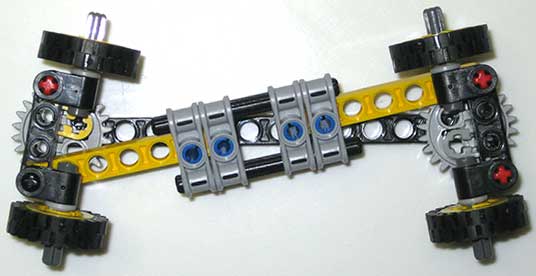
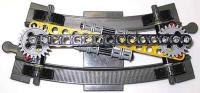
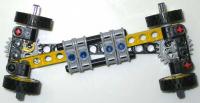
Hmmm... Another of my posts somehow did not make it: Peter, yes you may have a valid set of points there (no pun intended); I'll study it carefully. How did you make those beautiful drawings? zg0, I made an attempt, not very good, of linked bogies: (and that puts me at the limit of my media) The link itself is heavy because the axles are needed to adjust the length, which is not a whole number of units. Also, kinematically this is only an approximation, but it works better than unlinked bogies. There is very little friction. The gears are there only to get the 4-unit beams onto their middle. I did not bother with hooks etc. but it rolls fine. Not yet made it go over a bridge though.
-
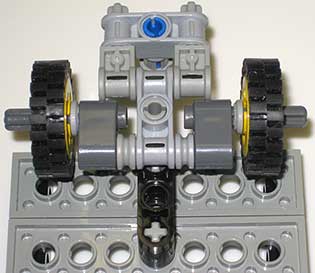
Thanks! You are right. It does goes over a bridge, but only just and with a lot of friction. I had not noticed that the centre of a bridge is wider. This is done so that the loco's wheels firmly engage with the racks on both sides. Interesting point, and shows again how much thought goes into these products. But the wider middle of bridges makes the whole thing more complex if rubber tyres are used, because they don't roll very well there.. I got to 4.5 units wide by using axles with a "head" and adding a quarter bushing(*) at each side: The axles with heads stick out a bit; I did not have shorter ones. Ideally the front and back bogie could be linked in such a way that as ont of them turns, it also forces the other one to turn. I'm not sure I will find the time to try that. (*) Quarter bushings do not exist, but can readily be made by cutting a half bushing carefully in two with a fine jigsaw. I'll make a page for my site for parts that do not exist but would be desirable for AFOLs.
-
The gizmodo article is interesting, unfortunately it is indeed old. It would be interesting to have a catalog of parts like the ones at Peeron or the Bricklink, which also has the dates of start and end of production of each part, if they are known. Then the question of the number of parts would be easy to answer. Somehow also we need a standard way of naming parts and naming elements of parts (e.g. knobs or studs? Holes, depressions, hollows?) and a set of part numbers that is not dependent on the colours. Too little time, too many parts. More questions: Is there an "official" way of talking to Lego? I can understand they would not be willing to talk about future plans, but there are no secrets about sets that exist and have been sold. I.e. is there some on-line resource where Lego publishes a colour table, a dimensions table, whatever, perhaps maintained with the help of adult fans. I could not find anything. But then, as I argued on the Duplo train page, there have been errors in the past, be they small, and maybe Lego rather stays mute on any of these matters and leaves the publishing of this type of resource entirely to the fans. Some parts live "forever" but some do not. Anyone having an RCX brick can no longer use it unless he has kept an old computer alive as well. I have two RCX bricks and have a machine specially for that. Why are certain combinations avoided in the connector series? Connectors for axles have gripping holes (bushing like) and sliding holes (bearing like). There are various combinations, some with gripping and bearing at right angles, some parallel. There is no part (to my knowledge) that has two gripping holes at right angles, or two sliding holes at right angles. Why do I always use loads of double length black pin connectors in building Technics stuff, but very seldom need the triple length ones, but I have loads of triple length ones. Am I not using the right techniques? (Is there a "building techniques" resource? Have not searched for one). I watched the Memory Lane movie. Strangely, I did not remember many sets at all. I bought some Lego for my daughter (I was then 30), and then there was a very long gap, until a few years ago (when I was 60...) and picked it up as an AFOL for a very strange reason indeed. So I did not see much in the 30-year gap. My parents gave us some Lego when we were kids, but not very much, and those bricks actually warped and stopped sticking together, so they must have been from before the ABS plastic times. I wonder if I can still find them. There was an interesting evolution in axles: first there were only lengths that were multiples of 2. Length 3 did not exist. I had to saw axles to get some. Then suddenly they appeared. Then somewhat later the odd lenghts became grey instead of black. I have 3 and 5 in black, but 7 (which came last) only in grey.
-
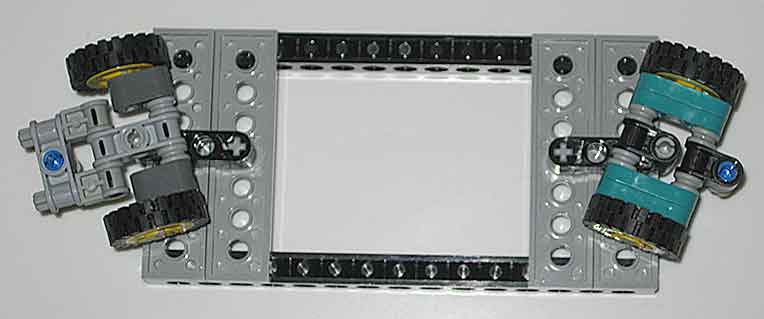
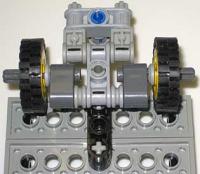
And to zg0: It does go over switches etc. It lets itself be pulled very well (friction reduced by turning bogies and independent wheels), but it does not stand pushing (because the bogies turn). There are two different designs for the bogies, I had only two lf the pieces used in the left one. Frustratingly, the assembly could be more compact if certain connectors existed, but they do not. E.g. (taking a + to mean a "turn over 90 degrees" and a - to mean "alongside in same orientation") there is a bushing+bearing+bushing piece (the two light grey ones on the left), but there is no bearing+bushing+bearing piece; there is a bushing+bearing piece but no bushing+bushing and no bearing+bearing though there is a half-thickness bushing-bushing piece. The two dark grey pieces that hold the wheels on the left are bushing-bearing, because bushing+bearing and bushing-bearing both exist though the latter are really rare. On the right I made a bushinig-bearing-bushing piece from two half-thickness pieces. To be improved.
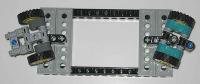
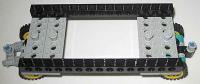
-
OK; done: http://www.eurobricks.com/forum/index.php?showtopic=94841 Robert.
-
This topic sprang off a discussion on Duplo trains. We were getting off-topic discussing the changes made in time of Duplo trains and the age of the kids the sets were aimed at. A few of us decided it was time to start a new topic, and as I was the one to suggest it in the frist place, here we are. Perhaps this can be incorporated elsewhere, but I could not find a suitable place easily. If it exists, we will be considering moving there. Note: this is NOT about Duplo, though the summary contains mostly references to Duplo. It is about how sets and parts evolved and what the target audiences were/are. Since I also proposed to give a summary of the thoughts expressed and make a back-link, both of these now follow. Enjoy & join. backlink to the original Duplo trains discussion Summary of the off-topic bits of that discussion: (heavily excerpted and some spelling corrections made) Adam Badura, 19 January 2013: How it was with the old “smart locomotive”? As I think it was far more “difficult” and “complex” Peter Nolan, 17 April 2014: The intelli train (http://lego.wikia.com/wiki/10052_Intelligent_Locomotive) was released in 2003. In my experience the extra features do make for more interesting play. However, I'd say that kids would have to be at least three to enjoy the set. Certainly fun for fathers though... Robert Cailliau, 17 April 2014: Yes I agree that the extra features are for older kids. They can probably enjoy the trains until much older (like 67...) IFF there are enough rails and enough switches. :-) Ambroise, 17 April 2014: ...kids were not using all the functionalities, and especially If they want the train to move backwards, they simply take it off, and put it back on the track in the opposite direction. I personally enjoy the Intelli train a lot, they have became quite rare and valuable. Peter Nolan, 19 April 2014: I think that this highlights the problem with the Intelli trains--the system is quite structured and prescriptive. For instance, if the child wants to fill the train up with fuel, they have to place the correct smart brick in the track, start the train and then wait for the train to travel over the smart brick before filling up with fuel (when the train makes the 'glug glug glug' sound). With the current model train, they just need to stop the train and start filling (and the train makes the 'glug glug glug' sound). I think that if the other Intelli functions (e.g. cargo and passenger sounds) had have been designed in a similar fashion it would have worked better as a childs toy. All that being said though, it is a great toy. Robert Cailliau, 19 April 2014: You say play with the intelli-trains is structured and prescriptive, and from what you describe I fully agree, it's too complicated even for 5 year olds. When they are old enough to play with that imaginatively, they have switched away from Duplo. It should not go too much in the other direction though: I learned that the latest issues of the locos no longer stop when they hit something. Now, that is not a "function", it is a protection, and it has been removed. The older issues have a little magnet on the axle that is not driven. It passes before a reed relay at each turn so the computer knows the axle is rotating. When the train falls over, is picked up or gets blocked, the computer stops the motor after a few seconds. That saves batteries and protects against wear and so forth. It also prevents little fingers getting caught in the driving wheels, at least for any length of time. But this feature has been removed. I find that annoying. Peter Nolan, 21 April 2014: On the subject of the latest Duplo trains having fewer features, I think that this is part of general shift in the positioning of Duplo in the market. It seems that Duplo is now being marketed to a younger market than it used to be. I've also noticed that a lot of parents see Duplo as more of a baby/toddler toy rather than something that is good for kids up to 5 years or so. It seems to be that people decide that once their child is a certain age it is time to get rid of the Duplo and then move on to Lego. (sorry if I'm repeating some of the sentiments that have been expressed earlier in this thread). At the moment I find that my son is happy playing with both Duplo and Lego and creating hybrid models (not everyone realises that Duplo and Lego are compatible it seems). When you throw in some Duplo Toolo (bought second-hand, like the Intelli trains) there are all sorts of play possibilities. Robert Cailliau, 21 April 2014: Yup, agreed. Now that you raise the point, there is also a degree of age-variety in Duplo: the big blocks are no longer very attractive after 5 or 6, but the trains certainly could go for much longer. Again, IFF there are enough rails. I consistently find that train sets of any make or scale have far too few straight rails. An oval, even with an intellitrain soon loses all attraction. And yes, few people realise that Duplo is called Duplo because it is "double size" and compatible (to some extent) with the single-size blocks. Thanks for reminding us of it. Toolo is very rare. Strange stuff, well designed. I ony have some incomplete things that Nora has "inherited" from cousins, but she does not play with it. zg0, 21 April 2014: my first try to make duplo compatible train base from lego pieces. Adam Badura, 21 April 2014: Nice! Be sure to check it with switches, crossings (both rail-rail and rail-street), and bridge. Those are places where other Duplo bases fail. For example 10558: Number Train doesn't fit on that type of track and that is sad. Yours looks like it would have no issue but it is always good to keep that in mind. zephyr1934, 22 April 2014: The intellitrain was from an era where Lego figured the under 3 set would be playing with quatro or primo. The rest of the toy industry is pushing "realism" down to an insanely young age these days. I played with Tonka trucks (the real ones, made of metal) until I was at least 10, but now the toy industry has the blue isle all figured out. First dinosaurs, then trains, the superheros, then .... With trucks falling by the wayside somewhere around 5 years of age. I think duplo has also been pushed to younger ages as a result of consumer demand. It is too bad, because the modern lego sets can't be anything more than a model for the 5-8 yr olds (as in, there is very little room to go off and build what you like with so many specialized pieces, you can build the main model and that is it). For the simplicity of the bricks my first grader still plays with duplo even though he has a room full of system bricks. Nolan ... the trains certainly could go for much longer. Again, IFF there are enough rails. As it happens, my son's train set does seem to have many more curved rails than straight. We are yet to run out of either though... BTW do you mean IFF in the mathematical sense? Robert Cailliau, on 21 April 2014 - 04:07 PM, said: Toolo is very rare. Strange stuff, well designed. Peter Nolan, 22 April 2014: Toolo is quite interesting. Some of the parts look like they would be very expensive to produce--the standard 2x4 block has screw threads on five surfaces, which would necessitate quite complex mould tooling. Although there are no retail Toolo sets available now, you can still buy two educational sets: http://education.lego.com/en-us/lego-education-product-database/preschool/45002-tech-machines http://education.lego.com/en-us/lego-education-product-database/machines-and-mechanisms/9656-early-simple-machines-set zg0, 22 April 2014: disagree. lego bricks sets long time was 3+, now 4+. creator was 4+, now 6+/7+. so lego clears 1-2 years from lego for duplo. and in 2013-2014 set we can see that duplo sets became more "constructional". cars from monolitic became consists from 4-5 pieces. and pieces became more universal. Peter Nolan, 22 April 2014: Interesting. I was skeptical to start with, so had a look at some of the new Duplo sets and can see your point. If you compare the new ambulance (10527) with the old one (4979) the new one does indeed have more parts.
-
Hmm... one of my posts seems to have disappeared or I did not press the right button. In it I proposed that the topic of the evolution of Lego sets, their target age and the brick content is interesting in itself, and those of us (like myself) who are interested in pursuing it should start a new topic rather than keep it here under Duplo trains. OK anyone? We could start there with a summary of what has been said here.
-
Peter: Yup, agreed. Now that you raise the point, there is also a degree of age-variety in Duplo: the big blocks are no longer very attractive after 5 or 6, but the trains certainly could go for much longer. Again, IFF there are enough rails. I consistently find that train sets of any make or scale have far too few straight rails. An oval, even with an intellitrain soon loses all attraction. And yes, few people realise that Duplo is called Duplo because it is "double size" and compatible (to some extent) with the single-size blocks. Thanks fro reminding us of it. Toolo is very rare. Strange stuff, well designed. I ony have some incomplete things that Nora has "inherited" from cousins, but she does not play with it.
-
Wow again. Very good. Did you make photos of the steps? It would be useful to have those available for others attempting the same repair. But do consider that tinier things are more expensive to make. Look at the cost of your kids' shoes compared to yours (not suggesting you have large feet though). Nora does not have an intellitrain. She has two of the intermediate ones: they will go back and forth as guided by thingies that you put on the sleepers. She also has two of the "new" locos, which make the gurgling sound but do not look at the thingies. You say play with the intelli-trains is structured and prescriptive, and from what you describe I fully agree, it's too complicated even for 5 year olds. When they are old enough to play with that imaginatively, they have switched away from Duplo. It should not go too much in the other direction though: I learned that the latest issues of the locos no longer stop when they hit something. Now, that is not a "function", it is a protection, and it has been removed. The older issues have a little magnet on the axle that is not driven. It passes before a reed relay at each turn so the computer knows the axle is rotating. When the train falls over, is picked up or gets blocked, the computer stops the motor after a few seconds. That saves batteries and protects against wear and so forth. It also prevents little fingers getting caught in the driving wheels, at least for any length of time. But this feature has been removed. I find that annoying.
-
WOW!! Good! And an excellent resource that "Papa-mach-ganz" site; I'll remember that. Yes I agree that the extra features are for older kids. They can probably enjoy the trains until much older (like 67...) IFF there are enough rails and enough switches. :-)
-
In the real world this does not matter for railways, but there may be other applications. E.g. planes cannot go backwards by themselves, and one day I found myself in a situation where I had to climb out and turn the thing around by hand (watching the wingtips carefully). Fortunately a P2002JF is very light. And yes, you better book a good restaurant or some such thing. Your penultimate sentence is too difficult just after lunch. The last one however I will probably follow up.
-
Perhaps, but now you have set me going… That last reflection in parentheses effectively means "topologically speaking", so now you are in the realm of topological mathamatics. You may be right. We need a mathematician of a different kind now. There is a way in but no way out. Interesting statement of a theorem. Prove it. Ah, so: if a layout has an APR subsection, then it is APR all over? New theorem. This seems a good starting point for the textbook "Fundamentals of Railway Layouts", though I'm not sure it would sell very well. I'll buy a copy, and Adam too I'm sure, and perhaps a few others on this topic, and you will give copies away to your close family, but after that… Ah, and don't forget to thank your wife in the introduction, because I did, and that omission cannot be rectified ever! All jokes apart though: your statements may be true. I'm going on a river cruise in June. I'll take along some paper & pencils and reflect on it if/when things get boring. Yah... :-D
-
Yes Peter, as a child one wants to go to extremes (as an adult sometimes too...) and build the longest train possible. I remember that even on Märklin sets the limit was reached fast, especially when going around a bend (pulling over cars) or uphill (not making it at all). Duplo trains are no exception, and given the need for sturdiness, friction is present more than we would wish. As to the number of revs per minute: that does not say anything about the power output. You need to know how many watts it can supply to the driving axle. There is also the consideration that the driving axle should not turn too fast nor too slow, hence torque at that desired mean speed is important. A good drive that gives high torque has a worm, but worms cannot be reversed and also have high friction. One could indeed build a special locomotive from parts of a Lego one and a "foreign" motor. Interesting project. The loco would then also have to weigh enough to provide traction without its drive wheels slipping. I do predict though that on a very long train a powerful loco would pull over the first cars when the train goes through a curve. The angle between successive cars is too big (the radius of a circle is too small). I also predict that most would be gained from letting the wheels on each axle turn independently. That would relieve the large amount of friction caused by the fact that the outer wheel has to turn faster than the inner one on a curved track. But they are fixed to the axle, so one of them has to slip. This is why on curved rails only one side has the grooves and the other is smooth. As pointed out on my page, real railways cope with that problem by having conical wheels and the added 1/2 inch to the original 4'8" track, so they can move slightly and the outer wheel then presents a larger diameter and the inner a smaller one, so no friction is present. (or did I talk about that? perhaps not...) Making the wheels independent would give the best advantage, but even that is not a simple modification: one would have to drill holes, provide new axles, ... Maybe I'll give it a go, but I'm certain that a reasonable workshop is needed. As to the APR property: yes, you are right. Any loop with only one switch will act as a trap, and any loop with all switches connected in the same orientation also acts as a trap, hence such layouts will not be APR. Excellent. I'll add that to the page. There are probably other patterns that show non-APR, but this one is easy to spot. Thanks! (anyone try to work the LiveCode program?)
-
Hey Joe: Er... Yes. Thanks for the accolade (this is totally off-topic, guys! I hope you will indulge). Reality is a little more prosaic, you can read about it all in great detail in "How the web was Born" (ISBN 978-0-19-286207-5). Please note that my name is on that book but it was James Gillies who wrote it (and rightly gets the royalties). First I have to say that the web is completely different from the Internet which is much older (we were doing [/quote] well before there were web pages). Let it also be known that the web idea was in the air. The earliest vision was probably by another Belgian, Paul Otlet in 1934 (use Wikipedia to find him; Otlet also had the idea of the League of Nations in 1918, unfortunately quite badly set up by Wilson) Later the web idea cropped up again in thoughts by Vannevar Bush, then Ted Nelson, then some of it got implemented by Doug Engelbart (who unfortunately died last year), then again implemented by the University of Graz (Austria), France Telecom (1980), etc. etc. At CERN, at the time of the planning of the LHC in the late 1980s, two people independently had the idea of a networked hypertext again, Tim and myself. What Tim did was to realise that every document could be uniquely addresses, even if it did not exist or was virtual: the idea of the URL name space. All the other elements were already there. But that URL idea was crucial and is what made it all workable. So yes, we did it, but to quote Newton, we stood on the shoulders of giants (however, even that phrase has a much older history...). BTW, I am not sure, but I think I may now have more Lego than Tim does. :-)
-
Bastiaan, Don't worry. Those tracks will do the job for everything, except for the extremely rare occasion that you might want two of them side-by-side fixed to the same long plate. I have never had that "problem" at all. I just found out by accident, when trying to get good measurements of the curvature. So f I were you I would not worry. Buying second hand is fine ( I bought many) and I seriously doubt that (1) you can get many "proper" ones on the second hand market, and (2) that any seller would know what we are talking about. The difference is so slight that even on a good photo it is hardly noticeable. From your purchase it seems that even Lego does not care much. So don't be disappointed... :-)
-
Agreed, thanks Adam. And happy new year to everyone!
-
dhutch is right in a sense: the old black tracks divided the circle in 8, not 12, and had a 90º crossing. These old tracks do fit more or less with the new ones, but their sleepers are not as high and their pins are too low down to avoid getting in the way of knobs on bricks. I bought a few "half" length straight rails from the old black sets, as a measure to deal with some spaces left in some layouts. In fact, apart from the standard oval, almost no layouts, even from Lego's own examples, can be built in a strict sense, they need the play in the connections. Another interesting thing perhaps: with the help of some mathematicians, the second problem of the "all-points-reachable" topic got solved. You can find the proof here: http://www.cailliau.org/Alphabetical/M/Mathematics/APR/Proof/ Not for the faint-hearted. It transpires that the property of the APR algorithm is more general and not linked to railway problems at all.
-
Thanks jlemusk: I'm working on more pages, time always being a problem. In the meantime I did find the directed graphs, but did not post about it. The general problem is indeed solvable in linera time, my solution works also very well for the particular problem and indeed it does so in linear time as well. Problem 2 looks close to a solution, I hope to be able to post that soon.
-
Hi Kyle Johnson, Yes, I have actually sent this set to a friend for her boy, who is almost 4. He enjoys it very much. Note two things: (1) the set allows only an oval, (there are no switches) but there is a bridge and a lot of other stuff. (2) the loco is of the new type, which no longer stops when it is picked up or falls over or hits an obstacle (zg0 reports above that there were problems with the stop detector, though I have never had any problems with the locos I own) A few weeks later I sent the same friend the set 10506 which has two switches (points) and more straight rails, and this was a success too as it added a lot more possibilities to play. Finally, for my granddaughter (now 4 years old) I bought a previous set that was very similar to 10508, when she was 2.5 years old and she loved it. I also bought her quite a few rails on ebay, especially straight ones which are always lacking. All of them arrived in excellent shape. Be wary though: do not get any of the black ones as those are of a different type and do not mix well with the grey ones.
-
Possible indeed. Given that there are two switches, 5 straight, 8 curved, one road crossing and a few bricks in the set 10506, I found 25CHF not expensive however. It looked to me rather like a very good price, compared to that of a pair of switches alone. But I agree, I do not understand the pricing nor the evolution of sets. And one always ends up having too few straight tracks. It's a good thing there is the BrickLink, so I can buy (ordinary) parts in the quantities I need. The sets in the shops are often frustrating. I wonder if there is a site (other than the BrickLink) that combines all the information known about Lego parts. The BrickLink has the part numbers and colours as well as some info on whether it is an "old" part or in some way special. There should be some semi-official site with a data base of part numbers, names, dates of production, and so on. Dimensions are less important. A tremendous amount of work I suppose. There is Peeron and Brickset, but I find them less easy to use than the BrickLink. Lego must have such a data base though. And I cannot imagine what harm there would be in publishing it. Anyone bent on producing and selling fakes can already do that. Maybe I am missing something...
-
I went out, spent 25.60 CHF on 10506 and can confirm that StephanSz and Rick are indeed right! Thus I have updated http://www.cailliau.org/Alphabetical/L/Lego/Duplo/Train/Rails/Dimensions/ and will add to that page even more. A few more things here: 1. set 10506 contains a railroad crossing, but with only one barrier! 2. I had noticed that the switches, which are a "meld" of two curved rails, were slightly different. In fact they match perfectly with the type-3 curved rails. My hunch is this, but please note it is only a conjecture: the mold maker goofed up the curved rail molds but not the other ones. How, I have no idea. The mistake was only discovered late, possibly when thousands of curved rails had been produced and shipped. Since only people like us (Adam, you started it all ) on this forum would worry about such small issues, no corrective action was taken until the molds were worn out. But only someone inside Lego could tell us what really happened. One thing is certain though: the mistake was not through an accidental small scale factor, because then the sleepers would not fit any plates.
-
That is really crazy... If the child lets the locomotive runs under a piece of furniture, it will empty its batteries and damage its tyres before the parent can come to retrieve it. Stupid. I noticed that too, and I agree that the new ones are more difficult. The hitch top has been widened to prevent slipping the hook over the top. They are stronger, so they resist better to kids who use force instead of brains. Unfortunately there are more and more of those :-( Cute. However, you can buy a 90º crossover of the black, old style rails on the web, and it fits well, though the running surfaces are slightly lower down. Ah, well... Why not? It is a push train, not meant to go on rails. From separate bricks of the Duplo from 1982 of my daughter and the Duplo of 2013 of my granddaughter, we can build this "train" easily. It's not forbidden. In fact it will even run over Duplo rails too, though it will not go over switches. That said, I do agree with a more general remark that I will make here: there are too many different scales and types for certain objects. For example, there are at least three different scales for human figures in the normal Lego alone. Fortunately there is only one scale for Duplo. There are different scale doors, again at least three I think, for normal Lego. Technics has a number of problems that I have written about on my old site, and will comment more about on the new site (and that does not belong in this topic). Lego is also in direct competition with PlayMobil, and this can be seen in the evolution of figures for people and animals. As long as the shareholders do not become dictators of what goes and what does not, and the engineers have a good say in the final shapes of bricks, "we" are safe. However, "we" are, I suppose, all over 30 years old (I am 66) and the toy must remain accessible to the kids. So I fully agree with your remark about the changes to the wagon hooks: they are more difficult now than before, and I hate that. I do understand you are upset about 10558, but it's OK I think. But inside the company it must be difficult to make the necessary compromises. Many parents (a fortiori grandparents) have no idea what the kids really want, so they buy sets based on what they see on the cover. I remember when I was 11 years old: I had a Meccano set but no gear wheels. I asked my grandmother to give me a set of gears for Christmas. When I showed her the illustration of the box, which contained only gears, she laughed out loud and said: "What in heaven are you going to do with that? What is it anyway?" I did get the gears, and she never understood. Robert.
-
Zephyr: One way operation is cheaper, also they now have an automatic detection system to stop if they come off the rails (extra safety). I suspect making that auto stop function work in two directions would have been expensive and less reliable. The auto-stop function is on the non-driven wheels. It is a simple tiny magnet fixed to the axle, that passes in front of a reed-relay that is monitored by the on-board "computer". If you run a loco, then pick it up but keep the front axle spinning with your fingers, the motor will not stop. You can spin the axle in either direction. However, a few weeks ago I had a set sent to a friend, and the loco in that set does not seem to stop at all when it is picked up or hits a wall. I wonder if this is a new feature or if that loco was defective on delivery.