Robert Cailliau
-
Posts
80 -
Joined
-
Last visited
Content Type
Profiles
Forums
Gallery
Everything posted by Robert Cailliau
-
:-) There was/is a real Lego Turing machine: http://www.turing2012.fr/?p=530〈=en Note that there were a few others built around the same time (Turing 100th anniversary), like this one : http://www.legoturingmachine.org which however is NOT a Lego machine: the Turing code is inside the NXT brick, so that is cheating. The one from the people in Grenoble is the only one I know of that is entirely made of Lego components with no hidden tricks. As I live close to Grenoble, I'll go and have a look sometime.
-
Peter: I may have mentioned this in an earlier post, but your son's friend's brother, the aspiring coder, might want to have a look at LiveCode, get the free system, and instantly do some interesting stuff. I have a beginner's page here: http://www.cailliau.org/Alphabetical/L/LiveCode/Annotated%20Examples/ He will probably be most interested in the fact that he can make his own apps for his smartphone (which 11 year old does not have a smartphone these days?)
-
Owwww.... I need another life to explore all this. Next stop: a universal Turing machine? Maybe Douglas Adams had sensed something, except that in reality the computer the mice were building used Duplo switches. Fortunately we know the answer without having to wait for the locos to reach the end: 42. Guy, I wished I had your stamina in all this. My granddaughter has now switched to regular Lego.
-
This is great! Fortunately Guy puts it all on his cr31 site. I wonder if the Duplo kids who inspired it all will be interested when they have gorwn up. :-)
-
WOW! :-)
-
:-D :-D A "rat computer"! What about a labyrinth with little kids? My granddaughter (who got me into this thread) would probably love it. Would it be child labour? It might be slow though and consume a lot of sweets per bit.
-
Guy, I think this deserves a book on the subject! Plus, perhaps, an Ig-Nobel. Ig-Nobels started as somewhat derogatory, but now have acquired a certain standing. Indeed, there is suspicion that some researchers purposely write papers in order to win an Ig-Nobel: it attracts a lot of attention. But write that book first. "Turing Trains" is a good title.
-
To Guy Walker: Yes, this certainly heads to a different site altogether. Agreed about your terminology. Fascinating. I explored cr31.co.uk a little. Well beyond what I have time for right now. :-( You are also right that it's necessary to be able to write programs directly to a web page. There was a LiveCode plugin, but plugins are no longer "allowed". Hence the project of html5 at LiveCode, so it will be possible again in the near future through a different technology. The story of programming in the web is (to me) a sad one, but also not for this forum. Perhaps more via robert at cailliau dot org. To the others: sorry for this digression.
-
The other way round perhaps? the old ones did remember their setting, the new ones do not, i.e. if you let the loco go, then after a while you can still see how the old ones were set, but not how the new ones were. I seem to remember reading about a discovery of an extremely complex model train layout in the attic of some manor house, with the only explanation offered that it was a computational device in disguise. But it may have been an SF story, my memory is not too good. But wow. How many points for Fibonacci? b.t.w do you know about LiveCode?
-
cortex31: If you look at http://www.cailliau.org/Alphabetical/L/Lego/Duplo/Train/Rails/Switches/ you will see that the old Duplo switches did remember how they were set. You can buy old switches cheap on the net. The new switches have been "dumbed down", have fewer parts and are probably easier for kids to operate. There are therefore two types of APV tracks: with switches that remember and with switches that do not. What a very interesting set of problems. Good luck…
-
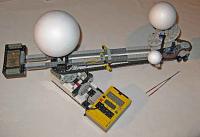
Gentle people, this is VERY interesting. However, I think it should go to a topology/mathematics forum (though it does not mean we can't have fun with it right here!). And I sincerely wished I had more time right now to explore these problems, but I'm too busy. Two small points (I'm short of time): (1) has anyone tried the gear meshing calculator I posted? (2) how about this one I built last Sunday: to help a friend understand why solar eclipses and lunar eclipses often occur close together (sorry for the styrofoam balls representing the Sun, Earth and Moon)
-
Now that is an interesting but different problem. As I'm still thinking about a suggestion from Peter Nolan, I'll leave yours for even later. You possibly need a few more conditions, such as: is it OK if the train goes over everything but then gets trapped in a loop? Or does the train have to go through everything and return to its original position? Etc.
-
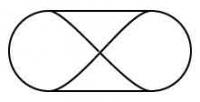
APR means you can get from any point in any sense to any other point in any other sense by only manual switching. I.e. you can set the switches, but you cannot pick up the loco to move it to another place, or turn it around, and the loco also can only travel forward, it's not allowed to switch into reverse.
-
Here is one: The crossing can be a level crossing or it can be a bridge, it does not matter.
-
I suppose you could open up the locos and then cut one of the wires to the little speaker. Not advisable if you don't have enough tools or experience. However, they don't use much for sound effects: once in a while they blow the whistle, rarely. They do so when you push the start button, and also when they reverse direction (the ones that can do it). They gurgle when you "fill them up". But that's all. So it's all fairly quiet.
-
Good point. Fortunately, for some strange reason, I have a 3709c! Comparing it carfully (lining up etc.) it has its centres at exactly the same height as the 1xn bricks: 5.8mm. The hollow under it is 2.0mm, good enough for a 1.8 knob with embossing, still leaving 0.1mm, but tight indeed. Since there is 9.6-5.9-(4.9/2)=1.35mm plastic at the top, then if the same amount is needed at the bottom that would leave 5.8-(4.9/2)-1.35=2.0mm, which is what we find. 2.0mm is the minimum for accommodating a knob, I would agree, and it is what plates give. The hollow under 3709c is the same as that under a plate. Good, so then if the centre is put at the middle of what is left, it would go at 2.0 + (9.6-2.0)/2 and that is 5.8! I note also that the holes of 3709c are 5.0mm in diameter and hence do not grip knobs at all (there is even a little play). 3709c appears a number of times in only two sets (according to the BrickLink) the first having old style gears and the second being an extension set of the first. So, you may have found the reason: later Technics bricks were made to be compatible with that first brick, and that first brick did not accept knobs. Berard says sticking knobs into the axle holes of Technics bricks is not really allowed because the holes are a little smaller, so the fit is very tight. This is true. Berard is an official Lego Designer. But again, there is no need for that amount of plastic, and it is in fact not present in many bricks, at least not all around the hole. I think you have probably found the real reason: (1) 1.8+0.14=1.94 and so 2.0 is the minimum hollow depth to receive a knob, that of plates. (2) with a 2.0mm hollow, putting the 3709c hole centres in the middle of the remaining height leads to 5.8 from the bottom and 3.8 from the top. (3) at the time no-one thought of fitting knobs into Technics holes (they were too large in diameter anyway). (4) later Technics bricks were made compatible with the old one. (5) we're stuck with it. His stated reason is the amount of plastic, but I'm certain that is not so. Rather I now believe the choice of "put it in the middle of 9.6-2". Thanks for that reference to the 3709c! As to the cardan connectors: they are 7.6 in diameter at their thickest. That is just about thin enough for 5.8 not for 5.7. But their bushing end is 7.4 and I'm sure that had 5.7 been chosen, then 7.4 would have been used for the other end as well. I also looked at the much older bricks for holding wheels: 7049. There the height seems completely different and without relation to our discussion, but I have not gone into details.
-
Woutr: Well, it's the only reason I can see, but I don't think it is a good reason at all. The two constructions I put forward are very much contrived. I believe that in all cases a workaround can easily be found, i.e. that clearing is not needed. The knob is only in the way if it is a "shifted" knob, i.e. in some way derived from part 3794 -- plate modified 1x2 with 1 knob (some part like that has to sit somewhere in the construction). I do not believe any strange, contrived construction like those two was in any way the cause for going to 5.8. On the other hand there are advantages of having the centre at 5.7 instead of 5.8: it's simply more convenient, allowing more combinations that will "legally" work together, and it fits logically in the grid. As I study the parts more and more closely, I find more places where early forms were replaced with later ones that correct some inconvenience or slight error in the earlier form. The first time that was really flagrant was with the Duplo rails, where the black ones have been discontinued, then later with the curved grey rails that would not fit next to each other nor would line up with straight ones. Those were mistakes that were easy to correct and did not matter much, in fact had no influence on backwards compatibility. If 5.8 was an error that slipped through somehow, and it is more and more what I suspect, then it is now impossible to set straight: bracing would not work anymore. Especially not if you used many pegs instead of only two, at several places and with combinations of 5.7 and 5.8 type bricks. They all have to be the same. I do not believe we will ever get an official statement about it. Unless there is a really good reason that we have overlooked. I doubt that. But I do hope that someone somewhere in Lego is writing it all up for posterity so that the truth can be uncovered by some historian from a galaxy far, far away. :-) Did anyone try out the gear meshing calculator?
-
OK, I updated section 5.4 of http://www.cailliau.org/Alphabetical/L/Lego/Dimensions/More%20Dimensions/ It was in the end much simpler than I thought: just measure, and find that there was ample space to put the centre at 5.7 instead of 5.8. I'm not sure whether this is good or bad.
-
Yes, I'm aware of the excellent documents by Jamie Bernard. But I don't think in this particular case his argument holds: 1- The worry of accommodating the knob only applies to the few bricks where there is a bearing directly above a knob, as in the1x1, or the 1x2 with two holes (I don't know of any other ones where a knob can sit directly under a bearing). For normal Technics bearing bricks there is no problem at all: the knobs are between the bearings. 2- If the hole sits 3.8 from the top, the diameter of the plastic cylinder around the bearing hole is 2x3.8=7.6 which leaves 9.6-7.6=2.0 for accommodating a knob, which is more than sufficient. 3- The diameter of the plastic cylinder around a bearing does not need to be larger than 7.4, as shown by many beams. That would leave an extra 0.1 without compromising anything. And even a lot less plastic around a hole would still mechanically work: note that the newer standard 2x4 brick has walls that ar only 1.5-0.3=1.2 thick.. 4- Close observation of the "lantern" (part no. 4070, but not 87087) shows the plastic just above the "lip" under the knob on the front face is actually zero thickness and depending on the mould the 4070 came from, one can even see through a narrow slit of missing plastic. That is because the front face is set back sufficiently that there is nothing left at just that point. But it does not compromise the strength of the brick or its ability to fit others. From that I conclude that if the plastic around the hole, which is 3.8-(4.9/2) = 1.35mm thick, would have been flattened at its bottom, where it would go over the knob, to even 1.0mm thickness in those few bricks where a knob does need to sit straight under it, there would still be no problem whatsoever. The bricks where a bearing can sit just above a knob were likely designed later than the normal ones. They would have shown a local flattening if there had not been enough space with a hole centre at 5.7 from the bottom but still a need for a thick cylinder. So the choice of 5.8 instead of 5.7 was probably made early, and independent of anything else. 5.7 is the natural choice since it places the centre of the axle at the centre of the square that fits at the top of the 8x9.6 design rectangle. My strong conviction is that someone at the mould factory goofed by 0.1mm, and then it was too late. Thousands of sets may have been sold before it was spotted. The same happened with the curved Duplo rails, and there the moulds have been corrected only recently. Lego is fantastic, but nobody is perfect all the time. We will only know what really happened if someone from Lego makes an "official" statement (highly improbable), and such a statement would have to be based on the memories of Lego engineers, some of whom may have left or even died. In addition, it is very difficult to remember the reasons for decisions (if there was one in this case), even your own. I can usually figure out why I made some weird choice in the past, but it may take a long time and much effort before I remember, and more often than not I need to consult other people's memories too. Hm. This is probably all easier to show with drawings; I'll put those on my pages somewhat later.
-
Sorry All, for very late reaction! My fault: I failed to follow this topic, so I was not warned of new posts here. Corrected now. First Zephyr1934: yes, there is the Kiddycraft story. I'm pretty sure those were made with moulds expressed in imperial, but I have not (yet) found information on how the Lego bricks were derived from them. Both would have had to go to local mould manufacturers, and so would have used local units. There certainly is nothing in any of the current measures of bricks that indicates any prior use of Imperial whatever. And those measures go back at least 40 years. Also, but on a different tack, there are good engineering reasons for using measures that are easily divisible by 2, also by 4, and it seems to me that at least in the beginning Lego only used powers of 2 (2, 4, 8, 16, 32,...) in mm. Avoiding 3 as a factor led (again in my opinion) to the failure of the first Duplo train rails, as the circle could not be divided into tree, which precluded some interesting figures. The new Duplo rails have circles composed of 12 rails, thus allowing more use of oblique angles. I still have no "official" statement about why the centre of the Technics bearing hole is 5.8mm from the bottom of the brick and not 5.7. In practice it does not matter, but I cannot find any good reason at all. Second Lyichir: It's me? Yes, it's me, but tell me where I know you from? With age memory fails. :-) And finally: I have been working on gears, so the gears pages are going to expand. The item I struggled most with over the last few weeks was the updating of the gear meshing calculator as that should be ready before I put more stuff out. That "calculator" was written a very long time ago (2006) and it used raster images. The new version uses vector graphics but is more power intensive, so you may at times hear the cooling fans of your computer kick in. Nevertheless, all comments (and especially bug reports) are welcome: for OSX: http://www.cailliau....culator.app.zip for WindowsOS: http://www.cailliau....culator.exe.zip Should someone want it for Linux, that could be done too. This is not "official" yet, and as they say: if everything else fails: RTFM, i.e. press the Help button and read the explanations, but it should be relatively straightforward. When doing the first version the surprise was how (relatively) simple the algorithm for the stack turned out to be. I'm curious to read your thoughts. BTW: both OSX and Windows will probably warn you that these apps come from an unknown developer and should not be opened etc. I do assure you that there are no viruses or trojans. For OSX you will have to right-click and choose "open".
-
Hi Zephyr1934, Yes, interesting new (to me at least) ideas. But let's move this to the other topic, it's really not about Duplo trains any longer. If you post it again on http://www.eurobrick...showtopic=94841 I'll reply more extensively there. See you onver there, Robert.
-
zephyr1934: Thanks for the links, I was not aware of these items, mostly because the titles do not reflect what the discussions are about. And, yes, this should be in a different topic, maybe the one I started earlier on evolution ( http://www.eurobrick...showtopic=94841 ) But, unless someone from Lego officially contradicts it, the original design was definitely NOT in imperial. The basic units (8mm, 9.6mm) hold over very long distances, and almost all other dimensions are "round" and "even" numbers such as 4.8, 5.0, 3.2 ,... Plus that it would have been terribly difficult if not impossible to get any workshop to make precise moulds in imperial units in Denmark or anywhere outside the UK (or US). The reason why the Technics bearing hole centre is 5.8mm from the bottom and not the expected 5.7 is still not quite clear to me. The reason Jamie Berard gives may be valid, but on the other hand it is only applicable to the exceptional 1-unit brick. A drawing reveals there is more than enough room left for the knob, a little less plastic than in a normal technics brick would not be a problem at all. Anyway, there is a counter-example: the "lantern" face is set inwards by an amount that makes a slight opening at the base that is an artifact of too little plastic (I guess this needs a few photos); this opening is not visible on all bricks so slight it is. But it did not seem to disturb the designers. I'll try to explore it further. But let's move this to the other topic.
-
jtlan: interesting, had not thought of that, but obviously there must be something like that. Shall we move this to the Lego evolution thread? Also: I'll see if I can find some easy to spot evidence.
-
Hello everyone, I have updated a few pages of my site. Not Duplo though, straight. Comments welcome. http://cailliau.org...Considerations/ from which, at the bottom, there are two more links. Note that the drawings can be zoomed and panned, click the little red [sVG] link in a caption for instructions. Have fun. Quote MultiQuote Edit
-
Hello everyone, I have updated a few pages of my site. Comments welcome. http://cailliau.org...Considerations/ from which, at the bottom, there are two more links. Note that the drawings can be zoomed and panned, click the little red [sVG] link in a caption for instructions. Have fun.