


Ashi Valkoinen
-
Posts
550 -
Joined
-
Last visited
4 Followers
.thumb.jpg.9192516dafb46956946ec33aff8b5798.jpg)

About Ashi Valkoinen

- Birthday 05/08/1988
Recent Profile Visitors
5,897 profile views





-
While as a standalone each of the cars and the locomotive feature a lot of nice building techniques, and as odd as they just as really nice builds, but I am not LEGO-nerd enough to enjoy the whole composition. My favourite detail was the removeable decoration for the knight's horse, it is really well made on the horse and on the inside wall of the freight/sleeper car. The bridge is really on spot, I love that design. Not the fancy one, but the heavy one, captured really well!
-
Man, that would be awesome! If you have Discord or any other platform, we can also do some screen-share talk about. SBricks can handle four outputs, but SBrick+ units can also take inputs from WeDo 1.0 motion (distance) and tilt sensors. I have both SBrick, SBrick+ and distance sensors spare at me so I would gladly help you to improve blocky! If I could mix SBrick and Interface B in the same program, it would mean the real heaven for me!
-
Hello @Bliss, my Interface B arrived and works like a charm with Blocky. I have still no sensors do start with serious experiments, and I especially have no other Interface B (I think I will need four in total :D), but all things should start at some point!
-
Help needed with sloped side walls for a LEGO funicular railway
Ashi Valkoinen replied to Zimmi78's topic in LEGO Train Tech
If you raise every second slope with half plate, the gap will be removed. In this large scale bracket will fit in, without interrupting the interior too much. -
MOCs: Models of trains running in Hungary
Ashi Valkoinen replied to Ashi Valkoinen's topic in LEGO Train Tech
So, let's get started in LDD. For first, I learnt the needed dimensions from the draws I fortunately got from Stadler (by the way, they ordered one dummy LEGO-model for themselves as well!), after this I could get started with the green arrow pattern which seemed to be the hardest part for this model. Fortunately recently I bought 50 pieces of old hinge plate 1×2 with two and three fingers - this part from decades ago is one of the most useful LEGO parts (you can see them at the edge of the green arrow). The allow rotated coupling without exceeding the height of one plate, and the three fingers part is a nice spacer when you have a one plate height gap with slightly less the one stud on lenght (check the green part under the first window). Front was less challanging to design, I was lucky to discover that the relative new wedge slopes do exist in LBG. Very fortunate, that they also exist in dark orange now, so after making the experimental physical build, I can update my Traverso train's front cone as well. The rest of the train is just bricks and plates, however, if you look closely, you can discover a nice 0,5 stud offset between the bottom (they yellow line and below) and the row of windows. Also I think the green - bright green - lime - yellowish green - yellow - tan - dark tan - dbg - block row of blocks represent nicely the colour transition used on the real train - I still prefer brick-built instead of a sticker. What do you think? -
MOCs: Models of trains running in Hungary
Ashi Valkoinen replied to Ashi Valkoinen's topic in LEGO Train Tech
Seems Stadler delivers a lot of different trains to Hungary, and now I have to figure out something for this beauty, too: https://www2.gysev.hu/hirek/rovidesen-elkeszul-a-gysev-uj-intercity-motorvonatainak-elso-negy-jarmuve (The article is Hungarian but contains photos of the new InterCity service Stadler FLIRT4 electric motor units.) -
@Bliss About SBricks: There were three different products. SBrick, SBrick+ and SBrick light. SBrick was the first one, 4 by 4 block with 4 PF plug outputs. Could have been powered from any 9V LEGO source via PF-extension cable, both battery boxes and 9V train speed regulators can power them. I use them in trains with AA battery box, and trackside powered from speed regulator, which doesn't consume batteries since they are plugged into the wall. SBrick+ was the same case with 4 PF plug putputs, but the PF plugs can also read sensor data - the WeDo 1.0 sensors. SBrick light was a 3 by 9 block, with 8 channels of 5V light outputs. Each channel could handle an RGB led output (of course, you could split more leds on the same channel), or each channel could have been splitted into 3 different white led outputs, so in total 24 single white leds OR 8 RGB leds could have been controlled independently. All units using BLE. SBrick and SBrick plus could have been used with SBrick app (now removed from official sources, but apkpure have the corresponding apk files), SBrick+ with inputs and SBrick light can be controlled from pro.sbrick.com. It is quite logical you cannot find any on sale, I bought my last 5 SBricks one year ago from a LEGO-themes spanish store and the last store I found any. Sometimes they pop up on ebay, but quite rare. About my current program: SBrick Pro uses the same "building blocks" for programming. Almost the same, like it has some "events", less math options, but you can also construct a graphic interface and add buttons and sliders on the screen. It would be the best if we can arrange a date and I will show it and its options to you via shared screen, on Discord or Facebook call, whatever you prefer. You blocky seems very promising for me, and if you don't mind it will be nice if I can ask some questions during a call. But my Interface B is still on its way, so nothing in hurry.
-
Thank you for your detailed explanation in the previous comment. I will give a try to Thonny and the Python module. Basically I have no prior programming studies or experience, I find always the hardest part to install the right versions of programming environments and get started. Learning a language is okay, I submit this for my hobby. I'll also take a look at your Blocky, my previous impression was that it needs your site to reach and works only if your site in on - just like the pro.sbrick.com where you can save your programs, but everything is in cloud. Basically my train concept is different from automated train control, at my approach trains are all driven by individual drivers at club shows, but all of them drive as the corresponding signalling tells them to drive. My previous work based on SBrick Pro controls no train, it manipulates the switches, lock the routes set for different trains and turns green, yellow, red signals. When a train passes a free-to-go signal, it turns the signal automatically back to red. Maybe this sped up video shows the approach better, people with phones on their hand drive their train, but they go only when the route is set and the signals on their track shows a free aspect. So basically what I will need to make this work wired, using Interface B, without Bluetooth and internet connection: - 9V Light sensors to detect trains. A bright light source (like PF ledlight) is put in front of the sensor, at the opposite position of the train track, when a train passes by, the measured brightness decreases, when train passed, it increases back to previous value. - My PF M-motor can drive the switching mechanisms as built in currently, each point needs a power output. - Modified PF ledlights (modification: always one led lits up of the two depending in polarity) will go to signals, one power output needed for each two lights. - Rotation sensors are mechanically connected to the switching mechanism, so a feedback for the positions of the switches can be given to ensure safe rute. And all these are connected with the logic built up - if Blocky gives enough coding possibilities (your block are really similar to SBrick Pro), then there, if I can't store enough variables, number, boolens, etc., than I need to move for Python and Thonny. I went around 10k blocks in SBrick Pro, my station control is a really complex thing. Thank you once again for your feedback and I'll let you know if my Interface B arrived and I can test things. Unfortunately adding SBrick to your project will require also handling bluetooth connection, but as the SBrick as company fades away, their services won't last forever, so many user would be happy if you can give a software solution for them to keeps their bricks alive. (It is an unfortunate story, SBrick was one of the first Bluetooth receiver units, 3 years before LEGO intrduced PU, and still superior compared to LEGO products in connectivity and features. The company produced 15k-20k SBricks in total, and couple thousand SBrick+ units which could handle WeDo 1.0 sensor inputs as well, but their design got copyrighted with someone else and they had to stop to produce their own product they didn't own anymore... :( )
-
Hello Bliss, I am really happy to find your topic and work on Eurobricks. It was only a week ago when I discovered the existance of LEGO Interface B, but seems that thing is exactly what I am looking for - lot of possible inputs and nice amount of outputs. I made a huge project couple of years ago, a full lego train security system to detect trains (WeDo 1.0 distance sensors), switch points (PF M-motors) and change lights (SBrick Light products) corresponding to the occupation of tracks and position of the switches: All the motors, sensors are lights are controlled via SBrick hubs (basic, pro, light), the hubs are connected with bluetooth and the program runs online. And here comes my issues. Bluetooth has some hard limit, I cannot connect more than approx 10 hubs, after that it seems on of the will be always dropped from connection. The other issue is being dependent on an online surface - what if it disappears? --- I found multiple topic of yours and still very lot of information, so I found it easier to ask some questions: 1. Is there a programming environment of yours, which can by used offline? No matter the language, I'll learn it. 2. Is there a way to control more than one Interface B, but offline? 3. What do you think, is it possible to use PF-plug distance sensors with converter cable on old (9V) input ports? I ordered my Interface B on Bricklink just yesterday, and I am really excited about it, what can be done!
-
Now it is 100% sure that I will participate BSBT this year, too, and for normal gauge train I'll bring the Croatian electric motor units. This year my "main" contribution will be a narrow gauge layout.
-
[MOC] HŽPP 6112-101 EMU manufactured by Končar
Ashi Valkoinen replied to Ashi Valkoinen's topic in LEGO Train Tech
Thank you guys all for nice comments! Some personal stuff - when I started the hobby back in 2009, I had a vision, what is ahead and what I want to achieve. A large station, with functional switches and lights, track ballast, acceptable radius and rolling stock I love to build. I did know that it will be a long story, a lifetime project. Metal rails of LEGO went off the market, no large radius custom track, neither plastic not 9V was available at that time. I waited with patience with my R40 system, trains adjusted to the limits of R40, that some day someone will make it, and we can have metal tracks again. And FX Bricks did it, was a long journey of them too, and as the succeeded, the way opened up for me to continue. The same thing was with this train, I have seen it in Zagreb in 2011, I returned to that city between 2014 and 2015 a lot, while I had a girlfriend there, and always bugged me to make it once. As in April of 2025 we got an invitation to the Alpen-Danuv-Jadran Railrod modell show for May, 2026, it was the final kick to start again with that Croatian beauty, and after the battery-electric one was completed I knew that the "old" 6112-101 electric train can be built as well. And changing the blue from simple blue to discontinued medium blue (it is a nice color with relatively low saturation compared to other colour) made the build challanging. -
[MOC] HŽPP 6112-101 EMU manufactured by Končar
Ashi Valkoinen replied to Ashi Valkoinen's topic in LEGO Train Tech
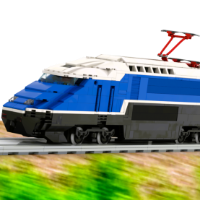
And NOW, 11 years later I am happy to show you the completed train! It was a while when I made the first attempt to create this train. The height, the shade of blue and the most important front design changed a lot, but this year, in February I finally made her. However it was ready 3,5 months ago, I kept her in secret and the first event for running was in Zagreb Railroad modelling show in May, I built the train especially for that event for the Croatian kids and adults to see some domestic train running around (no traditional railroad model company making these trains). The front design is heavily based on my previous physically built Končar-train, the 6211-001 battery-electric prototype, however, I was sad when I discovered that different series of these trains were build with slightly different front cones. The first of these trains were 6112-001, regional electric prototype and 6112-101, suburban electric prototype (this is the train I built, it has 8 doors each side), these trains had a little narrower white part under the windscreen and the third headlight is under the windscreen. The frist series (6112-0XX and 6112-1XX) had the same front, but with third headlight on the top, and later series (6112-2XX and 6112-3XX) had a differently shaped front as well, just like the battery and battery-electric versions. I hope you like it and you can forgive me raising such an old topic here! -
Fx Bricks (Michael Gale) announces Fx Track system
Ashi Valkoinen replied to HoMa's topic in LEGO Train Tech
Same issue, I cannot order anything to my Hungarian location. I tried to open a cart with none of the new products, but generates the same error. For me it seems the error occurs when you enter your Postal Code. -
Fx Bricks (Michael Gale) announces Fx Track system
Ashi Valkoinen replied to HoMa's topic in LEGO Train Tech
No, when a new item appears at the FX shop, but still not available for order, they used the sold out tag in the past. When they finish the first batches of production and packaging, they will be available in the shop. -
It is a Siemens Taurus (1116 series in Austria), not a Vectron.