

Wurger49
-
Posts
378 -
Joined
-
Last visited
2 Followers

About Wurger49

- Birthday May 10
Recent Profile Visitors
18,562 profile views


-
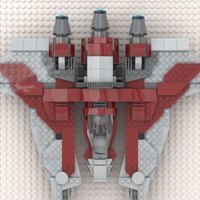
 The Fairchild Republic A-10 Thunderbolt II is one of the most distinctive and purpose built aircraft ever created. Designed for close air support, the A-10 is famous for its durability, unmistakable silhouette, and the massive GAU-8 Avenger cannon it was built around, responsible for the aircraft’s legendary BRRRRT and its nickname Warthog. Transformers fans may also recognize the A-10 as the alt mode of the Autobot Powerglide. After designing sleek stealth fighters using parts from the LEGO Star Wars 75440 AT-AT, I wanted to push the parts palette in a completely different direction. Many of the AT-AT elements turned out to work surprisingly well for recreating the A-10’s straight fuselage, broad wings, and high mounted twin engines. The nose is based on a modification of my F-22 design, with a bar element added to represent the GAU-8 cannon. The 4x4 round bricks form the turbofan engines. While slightly oversized for the model’s scale, they capture the distinctive engine pods mounted above the rear fuselage. The A-10’s straight, high aspect ratio wings are another defining feature. Unlike swept wings on most jet fighters, these wings improve low speed handling, stability, and manoeuvrability during low altitude operations. The broad rectangular planform also allows the aircraft to carry multiple external weapons. These features are particularly effective for anti-drone roles, which could help extend its operational lifespan. At the rear, the twin vertical stabilizers are connected by a wide horizontal stabilizer positioned behind the engines. This configuration improves directional stability and control, especially at lower speeds or when carrying heavy loads. The engine placement and tail design also reduce vulnerability to heat seeking missiles, further contributing to the aircraft’s reputation for survivability. The A-10 is famous for its ability to survive heavy battle damage and remain controllable, reportedly capable of flying with one engine, half of the tail, one elevator, and even half of a wing missing. Like its real counterpart, this model is designed to be sturdy and swooshable. The central structure is strong, while the extremities are slightly more delicate due to the limited connection points. The display stand follows the same philosophy as my previous builds: simple, sturdy, and purposeful. The AT-AT plaque remains as a nod to the donor set, and the model pairs nicely with the F-22 and F-35 I have also designed from the same set. Instructions are on Rebrickable: https://reb.li/m/254616
 -
Everyone is very excited about the new The Lord of the Rings 11373 Sauron’s Helmet, especially since it includes the Sauron minifigure that was previously exclusive to the massive and expensive Barad-dur set. With such a strong helmet design for the Dark Lord, I began imagining a brick built helmet of his deadliest servant, the Witch-King of Angmar, whose presence in The Return of the King was truly fearsome. The helmet rises in a stark vertical silhouette, constructed in dark bluish gray pieces to echo blackened steel. Its surface is defined by wedges, slopes and curved plates that create a rugged, battle worn look. The narrow elongated cone is the dominant feature, capped with an angular extension plate layered with various slopes to sharpen the profile. The helmet is fused with spikes. Due to the limited number of brackets available for attaching them, I focused the four spikes at the front of the helmet to maximise display impact. There is no visible face beneath the helmet. It opens below the eye holes into two long downward curving prongs that function almost like iron fangs, giving the impression of a twisted metal skull. Wedge plates and curved slopes create a recessed void, an empty gaze that suggests no physical features beneath, only darkness. I had to raise the display stand slightly to accommodate the length of the downward prongs. Instead of the Sauron name plate, I placed the Ring on a jumper plate at the base of the stand, symbolising how the Nazgul are enslaved to Sauron through the Ring. I am very pleased with how this rendition turned out using only the pieces from Sauron’s helmet. Its brutal dark presence is something you can feel from across the room. Instructions are on Rebrickable and OpenStuds. https://reb.li/m/252304
-
The Lockheed Martin F-22 Raptor is widely regarded as the world’s premier air superiority fifth-generation fighter. Even though it is around 10 years old than the F-35, it still has unmatched air combat performance, combining super cruise, extreme manoeuvrability and advanced stealth into a single airframe. For this build, the nose benefited greatly from my F-35 design. The Raptor’s gold tinted bubble canopy is achieved using trans-clear tiles and yellow slopes. The rest of the jet is a complete redesign from my F-35. Angled air intakes Clipped diamond wings Blended body shaping by positioning the wings a plate closer to the spine Outward canted twin vertical tails the horizontal stabilisers’ s shape is a compromise due to the wedge plates available Triangular exhaust nozzles for thrust vectoring As the benchmark air dominance fighter, it absolutely had to be swooshable. The blended wing root and broad fuselage create perfect grip points for high G turns across the living room, preferably with an appropriately epic soundtrack in the background. The display stand follows the same philosophy as the previous build, sturdy and purposeful. The AT-AT plaque remains on display as a nod to the donor set. A fitting tribute to a fighter designed not for compromise, but for control of the skies. Instructions are on Rebrickable: https://reb.li/m/253460
-
The Lockheed Martin F-35 Lightning II is a fifth-generation multirole stealth fighter. While the F-22 Raptor remains the premier air superiority platform, the F-35 is designed as a versatile, sensor fused strike fighter with advanced networking and data sharing. It emerged from the Joint Strike Fighter program to replace the F-16 Fighting Falcon, F/A-18 Hornet, and AV-8B Harrier II. Australia has received 72 F-35A aircraft, with one squadron based at RAAF Base Williamtown, just north of Sydney. I found the nose of this stealth fighter particularly challenging to design. I spent far too much time refining that section to achieve an acceptable shape. As soon as I felt satisfied, the next problem appeared, the cockpit windscreen. I experimented with yellow cheese slopes paired with trans clear tiles, but in the end I chose the only dark bluish gray slope from set 75440. It gave a cleaner and more aggressive profile that better matched the F-35’s faceted look. To overcome the restricted choice of only 1x1 cheese slopes, I used hinge bricks to create angled plates as a substitute for curved slopes. That adjustment helped capture the sharp stealth geometry without breaking the part limitations. With those challenges resolved, I focused on refining the aircraft’s distinctive features: Forward pointing air intakes Portside cannon Trapezoidal wings Outward canted tail fins Larger horizontal stabilisers The tucked in exhaust nozzle As the most advanced fighter in the world, it had to be swooshable, and it absolutely is. The fuselage and wings provide solid grip points for barrel rolls while blasting Danger Zone in the background. I also built a substantial display stand, making use of the black bricks that were not needed for the jet. The AT-AT plaque remains on display as a nod to the donor set. A fitting presentation for a fifth generation fighter born from a galaxy far away and reimagined in modern airpower form. Instructions are on Rebrickable: https://reb.li/m/250781
-
There has been a lot of interest in my Imperial Gunship, which naturally led to my next design. This time I wanted to explore another Republic era starship that was later pressed into Imperial service, the Nu-Class Attack Shuttle, as seen in The Bad Batch and the upcoming Maul - Shadow Lord. Like the gunship, I scaled the model based on the cockpit windscreen. Using a two stud wide windscreen allowed me to incorporate 4x4 round bricks as the folding wing roots, giving the shuttle a much stronger visual presence when displayed. The Nu-Class was designed by Cygnus Spaceworks as a faster, long range supplement to the LAAT gunship. It featured heavier armour and shielding, and included a hyperdrive for extended travel. In its role as an armoured transport, it could carry up to 30 clone troopers, though it lacked the missile launchers found on the LAAT. The cockpit module features angled side walls and a sloped top panel, with the white boarding hatch positioned on the front right beneath the nose. Armament includes two cheek mounted laser cannons beneath the cockpit, along with an additional pair of laser cannons built into the wing roots. The Nu-Class has its iconic folding wings, similar in concept to the V-19 and Lambda Shuttle. The wings are mounted using clip elements and fold up and down to the correct angles seen on screen. The angled side hulls are achieved using hinge plates underneath, while the dorsal fin is constructed by stacking plates, including the black Star Wars display plate. I was especially pleased to reuse the 2x2 angled plate to achieve the correct looking engine exhausts, only the second time I have used that part since incorporating it into the Millennium Falcon cockpit. Most of the longer bricks are used internally, resulting in a very solid core structure. The folding wings are strong enough for general swooshing, although I would not recommend overly aggressive movement. Even though most of the black elements were consumed by the shuttle itself, I still managed to build a simple display stand. The Nu-Class looks right at home next to the gunship, as if both were sitting inside an Imperial hangar. Instructions are on Rebrickable: https://reb.li/m/251531
-
Thank you so much! Working at this scale with a limited part palette was definitely a fun challenge!
-
After Order 66, there were still tens of thousands of Republic Gunships in service, many of which continued operating under the Imperial Navy. A large number were repainted in Imperial grey, and we can see these grey gunships appear in The Bad Batch and the upcoming Maul-Shadow Lord. As I continue my journey of creating alternate builds from the 75440 AT-AT, I realised the four 1x1 yellow cheese slopes could work perfectly as cockpit windscreens that stand out against the grey hull. This discovery paved the way for my Imperial Gunship design. I experimented with both a single-stud and a two-stud wide spine as a starting point, and ultimately decided the single stud wide option worked best for the cheese slope windscreens, sandwiched between wedge plates on both sides. While this gave the best proportions for the cockpit, it proved challenging to create a strong internal support structure alongside the side fuselage panels. I had to rearrange several elements to fit a 1x6 tile mounted on jumper plates, which is essential for the overall rigidity of the gunship. Achieving sloped sides at this scale is tricky, and clip plates were used on the side-door panels to make it work. Those elements combined to create a solid model to swoosh around in. The sloped wings are mounted using hinge bricks, and the result is surprisingly close to how the wings are installed on the real gunships. The missile launchers are built using improvised parts such as 1x1 bricks, partially buried into the wings so they do not appear out of proportion with the rest of the ship. Three levers are used to represent the armament, with two nose laser cannons and one tail laser cannon. The troop bay measures 3 by 4 studs. Two white round plates are used to represent each stormtrooper, with four in total. A small V-Wing was also designed to escort the gunship, serving as a cool nod to the transition of starships during the early days of the Empire. Both ships are displayed on stands, as they both deserve to be. This Imperial Gunship and V-Wing are strong representations of early Imperial starships transitioning from the Republic and would make a great addition to any Star Wars collection. Instructions are on Rebrickable: https://reb.li/m/250813
-
The YT-2000 freighter Otana is another saucer shaped transport from the Corellian Engineering Corporation, first appeared on Star Wars: X-Wing Alliance. This time, it features a centrally positioned cockpit sandwiched between two large mandibles. The cockpit extends beyond the mandibles, giving the pilot a clear and unobstructed forward view, a far more practical layout similar to the Rebel’s Ghost. The ship has a fully symmetrical layout, with crew and cargo space at the front and the engines positioned at the rear. I initially planned to piggyback on the design language of my Millennium Falcon due to the nature of alternate builds, but the mandibles and side airlocks required so many changes that this ultimately became an entirely new build. The 4x4 round bricks are used to form the aircrew quarters, while a wheel element is used for the cockpit instead of the 2x2 round bricks used on the Falcon. The flattened saucer hull is expressed through layered plates behind the mandibles, while the sloped rear hull behind the airlock corridors is achieved using two hinged sections. Reddish orange and yellow elements were added to the fuselage to echo the red and tan weathering commonly seen on Rebel ships. Medium azure elements represent the iconic blue glow of the sublight propulsion system. The upper laser cannons are built using clip bars, allowing the barrels to elevate up and down, although the cannons themselves do not rotate. All six 1x6 black bricks are used as the internal core beneath the hull, making the Otana a very solid model. The only parts to watch are the 2x2 macaroni tiles mounted on brackets, which can be pushed in from the sides but are easy to place back if dislodged. A new display stand was designed to present the Otana at an angle, making it ideal for displaying alongside other midi scale Star Wars starships. Instructions are on Rebrickable: https://reb.li/m/250273
-
You might be surprised by how many different freighters exist in the Star Wars universe. Here is another one. The Outrider shares the same basic saucer shaped hull as most YT series freighters, but is set apart by its tubular cockpit, which is connected to the hull by two starboard bracing arms. It was heavily modified by the smuggler Dash Rendar in Shadows of the Empire. Various wedge plates form the front bracing arm and extend around the bow of the Outrider. The AT AT 4×4 round foot bricks are repurposed to great effect as the cockpit module. I used slopes to recreate the convex hull shape where possible, and I was especially happy with how I achieved the shape of the dark bluish grey maintenance access panels above the cargo hold. Reddish orange and yellow elements were added to the fuselage to reflect the red and tan weathering seen in the source material. Printed 2×2 round tiles are used for the engine vents and the escape pod hatch. Medium azure elements represent the iconic blue glow of the sublight propulsion system. The dorsal laser cannons are built using clip bars, allowing the barrels to elevate up and down, although the cannons themselves do not rotate. The construction method is plate stacking, so the finished model is very solid and great for swooshing around. The bracing arms are not as strong as the port side saucer hull, but they should be more than adequate for play. A new stand was designed to display the Outrider with the AT AT plaque showing the donor set. This Outrider model would be perfect for display next to a midi scale Millennium Falcon. Instructions are on Rebrickable: https://reb.li/m/249057
-
After completing my saucer starships, it felt like the right time to return to Star Wars. It has been a while since I designed my first Razor Crest, and the few hints of yellow and tan bricks hidden inside the otherwise grey dominant palette of 75440 started the idea. The model also pairs nicely with the upcoming The Mandalorian and Grogu, which is certainly an inspiring movie title. The Razor Crest is an ST-70 assault ship manufactured by the Corellian Engineering Corporation, the same company behind the iconic Tantive IV. Jon Favreau’s original design brief to Lucasfilm referenced the A-10 Thunderbolt “Warthog”, most notably through the use of two large turbofan engines. Their unusual placement reduces ingestion risk and allows the engines to run while the craft is serviced and rearmed, shortening turnaround time. The Razor Crest features top mounted wings with massive engines positioned at the wingtips. This configuration gives the ship impressive speed and manoeuvrability, allowing it to operate alongside much smaller starfighters. Recreating those engines took many design iterations. The biggest limitation was part availability, as the set only includes seventeen cheese slopes including one spare, which is not enough to fully shape both engines symmetrically. On the plus side, I finally found a satisfying use for the two 1x4 Technic gear racks in the engine assemblies, pieces I could not integrate into my other three alternate builds from 75440. Small levers were a perfect fit for the twin blaster cannons, while brackets form the shape of the nose section. Two differently coloured tiles help disguise the gap between the brackets. The entire AT-AT contains only a single curved slope, and fortunately that one piece was enough to serve as the Razor Crest canopy windscreen. I love simple solutions to design challenges. To capture the angular, industrial wedge profile of the Razor Crest, I built the fuselage using six angled panel sections across the hull. Most of these panels rely on three or four stud connections for clutch power. Structural strength is a major focus in all my designs, especially since my family loves to swoosh models around. That said, the angled side panels can be pushed inward at their joints. If this happens, I recommend removing the central panel, reattaching the loose panel, then reconnecting the three panel section as a whole to the trans-clear side studded brick. When handling the model, pick it up by the two engines and hold the ship around the central fuselage panels while swooshing. The structure is very solid in these areas. If the angled panels are accidentally pushed in, simply reattach them using the method described above. To complete the display, I also designed Mando’s N-1 Starfighter to accompany the Razor Crest. I am proud to say the N-1 is highly accurate and includes its own display stand. Naturally, the Razor Crest received a larger stand to balance its increased size. Overall, this Razor Crest was a satisfying return to Star Wars and a great way to push the limits of what 75440 can offer as a donor set. Working within the strict part constraints forced more deliberate design choices, especially around the engines and angled fuselage panels, and ultimately helped define the character of the model. The result is a relatively sturdy, swooshable build that stays true to the Razor Crest’s rugged, industrial identity while remaining practical to handle and display. Paired with the N-1 Starfighter, the two models make a cohesive and character driven display that feels right at home on the shelf. Instructions are on Rebrickable: https://reb.li/m/246421
-
[MOC] Enterprise NX-01 Midi Scale - Alternate Build of 75440 AT-AT
Wurger49 replied to Wurger49's topic in LEGO Star Wars
Totally agree with the more rounded saucer! Thank you! The shuttle pod is built with a mix of snowspeeder parts and some AT-AT. -
Hot on the heels of the Enterprise NCC-1701, I started looking for other Star Trek ships to rebuild from 75440 AT-AT. I considered the LEGO Icons Enterprise D, but the limited selection of curved slopes in the donor set quickly became a constraint. That pushed me to look elsewhere. The NX-01 is humanity’s first true deep space exploration vessel and, importantly, it does not feature the tubular secondary hull attached to a dorsal neck seen on later Enterprises. That alone solved one of my biggest design challenges and made the NX 01 the perfect candidate for this alternate build. Features The saucer shaped primary hull is constructed from layered plates and tiles, with the centre subtly bulging outward on both the top and bottom surfaces. The recess for the navigational deflector has been modelled directly into the hull shaping. A combination of slopes and tiles is used to create the hull bulges that flow into the impulse engines and nacelle pylons. A surprising amount of detailing went into this small transition area, and it ended up being one of my favourite sections of the build. The warp field governor, located just behind the saucer, is represented as a structural element and also serves as a natural attachment point for the nacelle pylons, helping to tie the ship together visually and structurally. The twin warp nacelles are built using 2x2 round bricks and tiles at the front to emphasize their tubular form. Each nacelle core is constructed from two 1x8 black bricks, with light bluish grey elements covering the top and bottom surfaces for contrast. The sweeping angle of the pylons is achieved using 2x4 wedge plates. These are clip connected, with the wedge plates acting as backstops to lock the angle in place. The blue engine glow of the impulse engines is recreated using medium azure elements, adding a subtle splash of colour without overpowering the overall palette. A full size display stand is included, allowing the model to be tilted and displayed at two different angles. Where possible, I prefer to keep the nameplate to clearly showcase the donor set. Small changes were also made to the shuttle pod to better suit the NX-01 design language. Aside from the saucer edge, the model is very solid. It can be comfortably picked up by the impulse engine arms or the warp field governor and swooshed around without issue. The warp nacelle pylons are short and sturdy, so they don’t normally flop during handling. This makes the NX-01 a great companion ship to the NCC-1701, ready to be swooshed through space or proudly displayed as part of a growing Starfleet lineup. Instructions are on Rebrickable: https://reb.li/m/247699
-
The model is 13.5 cm wide, 28.0 cm long, 13.0 cm tall (including stand) Or 5.3 inches wide, 11.0 inches long, 5.1 inches tall (including stand) After completing my first ever Millennium Falcon alternate build, I wanted to take what I learned and apply it to another iconic saucer shaped starship, the USS Enterprise from Star Trek. The Constitution Class USS Enterprise NCC 1701 is one of the most iconic starships in science fiction and a lasting symbol of exploration, optimism, and discovery. First introduced in Star Trek The Original Series, it features a distinctive saucer shaped primary hull, an elongated secondary hull, and twin warp nacelles. This design became instantly recognisable and set the visual language for Starfleet ships. Features • The saucer shaped primary hull is built using various plates and tiles stacked together, with the centre bulging outward on both the top and bottom. Black pieces are used to represent the ship’s name. • The secondary hull is formed using a combination of 4x4 round bricks at the front with the sensor probe. Six 1x6 black bricks combined with plates form the core structure, with various slopes used to smooth out the hull. • The dorsal neck connecting the primary and secondary hulls required quite a bit of trial and error. In the end, I achieved a solid and accurate representation using two large brackets with multiple bricks acting as support. • The twin warp nacelles are constructed using 2x2 round bricks and tiles at the front to showcase the tubular shape. The core of each nacelle is built from two 1x16 black bricks, with light bluish grey elements covering the top and bottom surfaces. • The pylons connecting the warp nacelles also went through several iterations. A simple and effective solution was ultimately used, combining clip connections with a 2x6 plate acting as a backstop to maintain the outward angle. • In addition to the main model, I was able to build a display stand using spare pieces, as well as a small shuttle pod for fun, inspired by LEGO’s GWP designs. The secondary hull is very solid, there are weakness around the saucer dish. Since the engine pylons are mounted on clips, they may move inward during handling. I recommend holding the model with your index and middle fingers supporting the top of the secondary hull, while your ring finger and thumb support the bottom. This prevents the pylons from shifting inward. I am extremely pleased with my first USS Enterprise alternate build, and it is ready to be swooshed around or proudly displayed. Instructions are on Rebrickable: https://reb.li/m/247351
-
[MOC] Millennium Falcon Midi Scale – Alternate Build of 75440 AT-AT
Wurger49 replied to Wurger49's topic in LEGO Star Wars
Thank you, I really appreciate that. The AT-AT parts were quite helpful actually, the fun of alternate builds. Finding unexpected ways to reuse those shapes is what makes it so rewarding. -
The Millennium Falcon is the most recognisable ship in the Star Wars universe—and the fastest hunk of junk in the galaxy. Originally a Corellian YT-1300 light freighter, it was heavily modified by Han Solo and Chewbacca and went on to defy all expectations, famously completing the Kessel Run in less than twelve parsecs. The Millennium Falcon has been recreated in LEGO countless times—but this is my first. With the 2026 release of set 75440 AT-AT, this alternate build is a new year, new me approach, pushing a walker part palette into an unexpected silhouette while still paying respect to the most iconic ship in Star Wars. The Falcon’s unmistakable flattened, asymmetrical saucer shape is defined by its offset starboard cockpit and twin forward mandibles. In this build, 4×2 wedge plates form the mandible outlines—while 3×2 wedges would create a more circular profile, working within such limitations is part of the fun and challenge of alternate builds. The AT-AT’s 4×4 round foot bricks are repurposed to great effect as the side airlocks, and the single 2×2 angled plate from the bending AT-AT leg provides the angle for the protruding cockpit—one small piece that made a big difference during the design process. The flattened saucer hull is expressed through layered plates behind the mandibles, with the radar dish mounted on clip plates. Various different pieces are used throughout to fill gaps created by the offset, angular cockpit connection. The rear hull, behind the airlock corridors, is split into three hinged, interlocking sections to achieve the saucer profile. Medium azure elements are used to represent the iconic blue glow of the Falcon’s sublight propulsion system. The set includes eight printed 2×2 round tiles, which presented a design choice: rear heat vents or mandible maintenance access bays. After experimenting with multiple layouts, the 2×2 round plates were used for the vents, while the printed tiles were reserved for the access bays and the airlock doors. The upper laser cannons are built using clip bars, allowing the barrels to elevate up and down, though the cannons themselves do not rotate. Two 1×16 black bricks form the ship’s main structure, making the model very solid from the mandibles through to the airlock section. The three hinged rear sections, connected by two studs each to create the sloped hull shape, are slightly less rigid, but the model remains fully swooshable when handled from the core structure. The first version of the model was built entirely in grey, which felt too flat, so reddish orange and yellow elements were added to the fuselage to reflect the red and tan weathering seen on the source material. The included Snowspeeder was changed to the grey version piloted by Luke Skywalker during the Battle of Hoth. The stand was also redesigned to display the Millennium Falcon at multiple angles, with a clear brick supporting the Snowspeeder so both models can be displayed together. I believe the two builds are also in scale with each other. I hope you enjoy my first-ever Millennium Falcon alternate build as much as I enjoyed designing it—may this iconic ship find its place among the rest of your Star Wars fleet. Instructions are on Rebrickable: https://reb.li/m/246765