

Cumulonimbus
-
Posts
682 -
Joined
-
Last visited
Content Type
Profiles
Forums
Gallery
Everything posted by Cumulonimbus
-
 Well, it is easier and quicker to get parts with 3D printing, but my point is that they will be of limited use unless you invest much more time en effort to make them really functional. That said, I'm a big fan of using 3D parts during a developing phase. They can help you to find issues, iterate quickly, explore different concepts, figure out assembly sequences etc. Even though CAD software suites are getting better each year, nothing beats a physical model of your design. For a lot of those tests, your parts do not need to be fully functional. Only when you have full confidence in your design, you can invest in machined parts. And I must admit, seeing your parts getting formed in front of your eyes still is rather magical.
 -
Speaking from considerable experience with FDM (Fused deposition modeling) 3D printers, both professionally as in my spare time , I’m afraid the news is not that good for your application. The FDM process which is used in almost all home 3D printers has its limits when considering functional models: Details can’t be smaller than the selected nozzle size, the smallest one being 0.1mm. Lego parts are made with injection moulding which allows for much tighter tolerances (think more like an accuracy of 0.01mm) Most complex shaped models need to be supported by a temporary structure to keep underlying layer in place while printing an overhang. Luckily, the slicing software figures this out for you, but you will need to remove this structure by hand after printing and it will leave a rougher surface behind. Sanding and smoothing 3D printed parts can be challenging. Sanding introduces heat which will quickly affect the materials (which are often optimized for a lower melting point). The result can lead to an even rougher surface than you started with. You can add fillers and primers to improve the surface quality, but this requires considerable effort. As mentioned, vapor smoothing is possible with some materials like ABS, but if you’re after a dimensionally stable part, this process will be purely guesswork and is likely to weaken your part. Although you can choose several thermoplastic materials, even with all kinds of additives to tweak certain properties, the limiting factor is the production process. The fact that any printed product is build up one layer at a time, means that the bond between those layers will always be the weak point. Clever orientation of your part in relation to the layer direction can improve results, but even then you can expect delamination under load. A workaround can be to increase material thickness, but since you are bound by the scale of the Lego system, there might not be enough room to do this. Since you talk about sealing a chamber: In my experience, FDM printed parts always leak between layers, especially when the pressure is increased. You will need an extra layer like a coat of epoxy to really seal the surface of your chamber. In my professional functional models and prototypes, anywhere where mechanical loads occurred the printed parts just failed too fast under load. As a solution often extra hardware was added like threaded inserts, metal rods, standard bolts, standard O-rings, bearings etc. Other 3D printing processes are possible in consumer 3D printers like SLA (Stereolithography) which can give you better level of detail (up to 0.025mm for a Form 2 for example) and it is possible to make watertight parts with this process. But I think the strength of the bond between layers will remain the weakest link in your part. Not to mention the laborious task of curing and cleaning your part. Services like Shapeways use different processes,such as SLS (Selective Laser Sintering) or MJF (Multi Jet Fusion). Accuracy is as high or higher as SLA, and it's even possible to print in metal, but parts still have rough surfaces, unsuitable to seal. I have no experience with the mechanical strength of parts made with these processes, maybe @efferman can help you with this. I do know that parts ordered at these services are not cheap. If you are willing to splash out on services to get your parts made, why not looking for a service which can mill and turn your parts in more suitable materials. If your goal is to get parts which can reliably handle mechanical loads, I agree with @dr_spock and @allanp: look at traditional manufacturing processes like milling and turning. The investment in parts and/or labor will probably be higher, but the functionality and reliability will be much higher, leading to a more enjoyable outcome. However, if you enjoy solving the puzzle with lower costs and have no issues with iterating your design and learning from mistakes, then consider 3D printing and building a hybrid model with more durable purchased hardware at critical points.
-
But the removable battery holder does suggest a rechargeable battery pack similar to the EV3 Mindstorm rechargeable battery will be available at some point in the not too distant future.
-
42110 - Land Rover Defender
Cumulonimbus replied to 1gor's topic in LEGO Technic, Mindstorms, Model Team and Scale Modeling
Funny, over here that version (the L319) is seen as the fourth generation Discovery, but I agree. To me it's not a bad thing, I found the L319 an appealing and clean design language with some clever lines. I don't mind family resemblance, but as I others mentioned, the Defender should have its own (visual) character. Time will tell if this is the case. The interior spy shots seem to suggest it will. -
42110 - Land Rover Defender
Cumulonimbus replied to 1gor's topic in LEGO Technic, Mindstorms, Model Team and Scale Modeling
I feel sorry for the engineers working on this car. Spending years working hard to develop a car and then seeing it being burned down months before the official launch based on hunches, guesses and leaks. I understand why they want keep it a secret as long as possible. This is one of those projects which you can't win simply because your newly developed product must fight against a tide of assumptions, old fashioned ideas and unrealistic wishful thinking. Anyway, I wish this car and its creators all the best and I hope it will be successful because I think it will be a modern, capable little vehicle in its own right. -
42110 - Land Rover Defender
Cumulonimbus replied to 1gor's topic in LEGO Technic, Mindstorms, Model Team and Scale Modeling
Another leaked image of the new Defender (with the engine cover missing obviously) has turned up. It looks like a real vehicle, not just a concept car or mockup. It looks a bit more rounded than I expected based on the Lego version, but it is recognizable. I found it here (Dutch): https://www.autoweek.nl/autonieuws/artikel/land-rover-defender-weer-in-beeld/ -
42110 - Land Rover Defender
Cumulonimbus replied to 1gor's topic in LEGO Technic, Mindstorms, Model Team and Scale Modeling
But all the examples shown to convince people that live axles are better are heavily modified vehicles build for extreme conditions. Was the old/current Defender really such a good offroader as a standard vehicle? And even if it was, it was probably due to the relatively low weight of the body (so a low center of gravity) since it had little onboard equipment and the body was mainly riveted aluminum sheet metal. If you're going to modify your vehicle for hard core off-roading anyway, does it really matter what the standard suspension setup was? By the way, I was reading this article about Ultra4 buggies, custom off-road buggies designed to take on brutal terrain like the King of the Hammer race in the USA. Even those guys are not unanimous about which setup (live axle versus independent suspension) is best in the field. I find it funny that the Defender has become such a status symbol. Seeing a Defender in full expedition spec (including a snorkel and permanent roof rack tent) driving in commuter traffic or trying to park in a crowded city really feels like an anachronism to me. I have always seen the Defender as a working vehicle used for jobs as first responder, construction site support vehicle and to perform countless other tasks in forestry, wildlife protection, etc. I think that even in those situations, offroad capability is just part of the requirements. On-road handling at highway speeds and stability while towing for example is at least as important for those users I suspect. Hence independent suspension still makes sense, even for an utilitarian vehicle. I'm very curious how rugged and capable the basic version of the Defender will be and how good it will suit the needs of the professional user, that is the true test to judge whether or not the design of new Defender has been successful. -
42110 - Land Rover Defender
Cumulonimbus replied to 1gor's topic in LEGO Technic, Mindstorms, Model Team and Scale Modeling
The first hint of the real car without camouflage has been leaked via this site (in Dutch) and apparently comes form Autocar magazine: So far, it seems like a close match with the Lego version: the straight shoulder line, sky light windows in the rear roof section, squarish wheel arches, bulge on the engine cover. -
42110 - Land Rover Defender
Cumulonimbus replied to 1gor's topic in LEGO Technic, Mindstorms, Model Team and Scale Modeling
I guess it is supposed to represent the so-called Heritage color, hence also the white roof. But as a color match it's not that successful, would any other TLG color be a better match? I'm glad the rims aren't this color as well. -
42110 - Land Rover Defender
Cumulonimbus replied to 1gor's topic in LEGO Technic, Mindstorms, Model Team and Scale Modeling
Not without camouflage yet. It is supposed to be launched in October, so this set really is the first glimpse of the real car. EDIT: @Ngoc Nguyen: that is an artistic rendering of a motor journal, not a picture of the final car. It misses important Defender details such as the skylight windows in the rear, the iconic angle in the roof and the squared wheel arches. The fact that the leaked images of the set has these are very good clues for the real car. -
42110 - Land Rover Defender
Cumulonimbus replied to 1gor's topic in LEGO Technic, Mindstorms, Model Team and Scale Modeling
Looks good at first sight. A bit bulky maybe, but so might the real thing. I was not prepared for that color though, I imagine that it will make modding it without buying a second set near to impossible (but that might just be the intention). Another surprise to me is that it is the short wheelbase version, not the 110 version. As mentioned before, I would have imagined this as the B-model. -
42110 - Land Rover Defender
Cumulonimbus replied to 1gor's topic in LEGO Technic, Mindstorms, Model Team and Scale Modeling
Forgive me a spot of speculation: if the rumor of 2573 parts without control+ is correct, what scale can we expect for this set? Should the it be standing on Unimog wheels and tires like the Defender 110 @Sheepo designed a couple of years ago (which had 3442 parts including a lot of PF)? Or are those wheels too big and will it become a smaller scale set where a lot of parts go into the detailing like the 41078 Mack truck (which has about the same part count)? -
42110 - Land Rover Defender
Cumulonimbus replied to 1gor's topic in LEGO Technic, Mindstorms, Model Team and Scale Modeling
It wasn't really the speed I was taking about, but more the driving comfort: As I remember, the seating position in Defenders is a bit awkward because you sit very close to the door (at least this was an issue in the left-hand drive 110 I drove). Secondly, the noise (wind, engine and tires) in the cabin at speed is not really acceptable for modern standards because people tend not to notice how good standard cars have become. Not to mention the spartan equipment levels , no airbags available for example. Most potential customers for a new, rather pricey, offroad vehicle will have high expectations for the looks, onboard equipment, safety and comfort. The Defender was destined to go extinct if it refused to evolve, either for economic or legislative reasons. -
42110 - Land Rover Defender
Cumulonimbus replied to 1gor's topic in LEGO Technic, Mindstorms, Model Team and Scale Modeling
Slightly off topic, but I think air ride suspension on an off-road vehicle can be an advantage. In off road situations it allows for active leveling, adjustable ride height and increased ground clearance under the axles. In on road situations it means added comfort, more predictable handling in tight maneuvering and high speed cruising. I had the pleasure of driving a LR3 Discovery (aka Discovery 3) and while it was a heavy vehicle due to its chassis design, it was a very comfortable cruiser and a very capable off-roader. Live axles have their merits as well, especially for extreme off-roading vehicles: very big articulations in some cases, very sturdy end more easily repaired in the field. But the drawbacks of these cannot be dismissed in a modern vehicle. I once drove a recent Jeep Cherokee in a multistory car park and while taking a slow speed turn driving onto the ramp towards the next floor, the rear live axle just couldn't cope: The simultaneous turning, transmitting power and articulating created a very discerning wobble from side to side as well as up and down. It really wasn't an extreme situation and any other car (with other suspension types) I drove in similar conditions never showed that behavior. I guess this means that the new Defender will be much more on-road focused than the old version, but let’s face it: the outgoing version is a glorified tractor: very good off road, but very compromised on road. It makes sense that LR really wants to create a market which is as big as possible to justify the developing costs and unfortunately, this market mostly consists of people who rarely drive of the pavement. Prove of this is the simple fact they are testing the pre-production cars on the Nurburgring which you only do if you want to test and tweak high speed behavior.. Back on topic: I like the idea of a classic Defender as B-model, but how big are the chances for this? Seems this set is part of the effort of Land Rover to create acceptance for the radically new model (just look at the discussion here to illustrate how strong the opinions about the Defender are). Putting it directly besides any previous version in real life and as a set will not help people to convince that the chosen evolution is for the better when they are reminded of the out of reach icon. My best guess for a possible B-model (if any) is a short wheel base version, maybe tricked out a bit with an extra winch, roof rack (similar as the Creator Mustang). -
42110 - Land Rover Defender
Cumulonimbus replied to 1gor's topic in LEGO Technic, Mindstorms, Model Team and Scale Modeling
Since the new LR Defender will almost certainly have independent suspension with airdampers on all corners, it will not have live axles anymore (blasphemy according to some off-roaders). You can see this clearly in this picture of one of the pre-production vehicles which are being tested all over the world at the moment (found on https://www.caradvice.com.au/748546/land-rover-defender-air-suspension/). So I would expect the model to represent something similar and I'm really hoping for adjustable ride height in this set. -
Sounds logical, is it also true that the impact of the inevitable backlash in a Technic drivetrain is smaller in a high speed system? This could mean that for example the amount of roll-back after stopping on a hill is limited? I understand why you would want a low torque high speed drive train, but I imagine that the drawback is increased wear on axles and gears (the dreaded white powder)?
-
Perhaps this is obvious for experienced crawler builders here, but I'm curious what the advantage is of a planetary gear reduction in the hubs in a Lego model? Why would you want to do the final reduction in the hubs instead of in a gearbox? Is there a mechanical advantage or is it just fun to copy real world machines?
-
Although this truck is a nice play set, I still can't get over the odd proportions of this vehicle. The dimensions of both the truck and the trailer are so skewed that they're almost caricatures of the real things. I made some crude cut-and-shunt images to illustrate what I mean: The length of the truck should be increased by at least half of the current length while the overhang of the upper deck should be reduced. Where I live, these trucks mostly have a single rear axle (although double rear axles exist as well). Below you can see the side views of the original design compared to my virtual MOD and a drawing of a real truck for reference: The trailer has the same dimensional issues and additionally the placement of the axles is just weird (not to mention the use of fold down ramps). Again, I made a comparison between the original, my proposed MOD and a real trailer: I understand that in the interest of costs and play value some compromises needed to be made, but for my taste, the designer(s) went too far. At the moment I'm rather put of by this set. If I ever do purchase this set, this is what I will have in mind, but for now I don't have the time to spend on a comprehensive MOD:
-
The German Promobricks site has photo's and information about the new Control+ components: (link):
-
In your next MOCs, you could include subtle but intentional errors which prevents crucial functions working properly. The solution should only be revealed directly to trustworthy builders somehow. Leonardo da Vinci did this in all his drawings of war machines. If you copied his drawings exactly, the machine wouldn't work. For example his tank design had a handcrank which drove the front and rear axle. In his drawing however, the mechanism was drawn is such a way that the axles worked against each other, immobilising the vehicle.
-
That stucks @Jeroen Ottens. I’m not a lawyer, but I’m not sure if there even is a foundation for any legal action: I wonder to what extend the term intellectual property is applicable in case of our MOCs: We use a building system patented by TLG because as far as I know, the patents for Technic elements are still active. Additionally, most of the high-end MOCs represent real machines, for which the industrial design rights (Wikipedia) is in the hands of the OEMs of those machines. This means that you can’t make any claim related to the building system, nor the model. As I see it, you can only claim the pictures, instructions and videos you made of your creation as your own intellectual property as mentioned above. Proving that they use your pictures and videos is easy enough, but how do you prove they used your instructions? Of course I understand the huge investment in time a complex MOC represents but I’m afraid that a homemade Lego Technic model of a real machine cannot be seen as intellectual property of the AFOL. But maybe someone can prove me wrong?
-
42093 Corvette ZR-1
Cumulonimbus replied to letsbuild's topic in LEGO Technic, Mindstorms, Model Team and Scale Modeling
Hi, welcome to the forum. If you mean the small version I started a while ago, I must admit that I haven't finished it. I ran into a dead end while trying to make a boxer version of the small engine the Corvette set has. The problem is that being a boxer, the "cylinders" lay flat so there is no gravity to make them move back to the lowest point after they have been moved up by the camshaft. I have tried rubber bands to make them move inwards, but this increased the friction so much, the entire drive train locked up. Another question I found hard to answer for myself is whether to develop it as a true C-model using only the parts from the 42093 set (which I haven't done before) or allow extra parts form my collection and make a better looking model, possibly with more functions. I'm rather busy in life at the moment, but if there is enough interest for it, I could make an LDD file eventually. What do you think: Should it become a mini-Porsche without a functional engine? Would you like to see a true C-model or can I allow myself allow more artistic freedom? -
You are absolutely right about the smaller sets. I really liked the 42092 Rescue Helicopter which is just a gem with its scale and functions. It is great to look at and I image very fun to play with, all for a very reasonable price. The point i was trying to make is that in my (maybe old fashioned) view, big sets come with big expectations. Recent big sets increasingly fall short of my expectations. An example with the risk of going offtopic: In my opinion the 42082 really should have had a pendular axle and two stage stabilizers for its size. I’m not against big sets per se, but I believe a set should only be as big as required for the functions it will have. In the examples @Erik Leppen mentioned, this used to be the case, but now it isn’t anymore. Part of the problem of building big is that due to the limitation of plastic parts, the bigger a Technic set becomes, the bigger and beefier the structure must be to keep things rigid enough. This leaves proportionally less room for functions. At a functional level, I honestly don’t really see the need to create all those big sets: Models of machines which are huge in real life don’t have to lead to huge sets automatically: the fantastic 8288 Crawler crane was a model of a huge machine, but was a small scale model with limited part count. Similarly, licensed models don’t necessarily need to be big neither. The 42053 Volvo and the recent 42093 Corvette were pleasant surprises which demonstrated that a licensed model can be a good small or medium set. At a commercial level though, this might be very different story: As long as big sets sell well, they will be made by TLG. To bring this rant back ontopic: In my eyes, the 42100 is targeted at AFOLs and being one, I feel like I should want this set more than I actually am (first world problems). I understand the 42100 seems to be perfect storm of new RC hardware, a licensed model and the choice for a huge part count. The consequence is an astronomic price, but the value (to me) is not equally high. One last point: Of course I like a big flagship each year. Those were the sets I coveted as a kid in the 80s and 90s and worked hard for to earn a 8862 Backhoe for example. I don’t know much about the current generation of kids, but I guess the 42100 will be completely out of reach of almost all of the current 8 to 14-year olds, which I find a pity.
-
Technic Pub
Cumulonimbus replied to jantjeuh's topic in LEGO Technic, Mindstorms, Model Team and Scale Modeling
That sounds like another awesome trip, Jim. Have fun! -
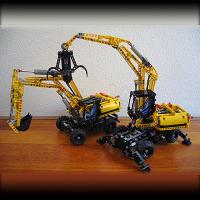
Sorry to spoil the vibe, but I'm not that thrilled with the ever increasing size of official Technic models. If bigger models mean more or more realistic features, then I can accept the increased part count and higher price tag which comes with it. But I’m starting to dislike the TLG strategy of creating sets which are big simply for the sake of making bigger models than last year (which obviously sell well). The 42082 and the 42083 for example were huge and cool sets as well, but for their size and price, I was disappointed in their features and functions. Essentially this 42100 set has no more functions than the 8043 did nine years ago. But the Liebherr set has over 3 times the amount of parts (1143 vs 4108) and will cost about three times the price (give or take). I get that the R9800 set is more detailed and it’s a bigger machine in real life. But this inflation in parts and price is worrying. To me, this price level is very steep for the play value it will provide. I’m not convinced it will be 3 times as fun as the 8043 to operate or give three times the joy to look at in an AFOL collection. I know for sure that the 42082 and 42083 didn’t, compared to older but similar sets, and I feel that I made a mistake to even have bought those sets. At the moment, I think I will draw my personal line here and not buy this set. I can’t shake the feeling that €450 can give me a lot more joy in many other ways than getting this set.