

ProvenceTristram
-
Posts
423 -
Joined
-
Last visited
Content Type
Profiles
Forums
Gallery
Everything posted by ProvenceTristram
-
[MOC] NYC J3A 4-6-4 Hudson - Empire State Express
ProvenceTristram replied to ProvenceTristram's topic in LEGO Train Tech
Thanks! Here are the internals. -
[MOC] NYC J3A 4-6-4 Hudson - Empire State Express
ProvenceTristram replied to ProvenceTristram's topic in LEGO Train Tech
Cylinders are 10, valve gear should vary from 8 to 9. I'll try to remember to rip it open and take some screenshots of the mechanism tomorrow, but it's pretty simple - just the PF 3-wide motor laying on its side. -
[MOC] NYC J3A 4-6-4 Hudson - Empire State Express
ProvenceTristram replied to ProvenceTristram's topic in LEGO Train Tech
One more photo - fixed the cabling on the front. -
[MOC] NYC J3A 4-6-4 Hudson - Empire State Express
ProvenceTristram posted a topic in LEGO Train Tech
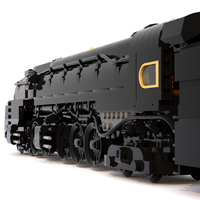
So, a few things right off the bat. 1) You're going to have to forgive the wheels - I needed stand-ins for custom drivers in LDD, and those were the size I required (they're different because I wanted to represent wheels with and without flanges). Therefore, it's necessary to use your imagination for that part. And 2) bluerender does horribly with silver, so I felt like there was no point in running it through that app. when it was just going to come out looking like some deranged glitter choo-choo. The locomotive itself is actually powered, which I always think is a minor achievement. I wish I could lower the skirting on the tender, but I don't see any way to do so without dramatically impacting the appearance of the trucks (or their ability to turn). Overall, I am satisfied with it, though I am always wary of these streamlined engines, since you have to go really light on the greebling, and thus risk a model that looks too toy-like. Proto: Model: Overall, I feel like it wasn't a bad 6 hours spent. -
LDD-MOC: HŽ-6112 EMU manufactured by Končar
ProvenceTristram replied to Ashi Valkoinen's topic in LEGO Train Tech
I'm not a fan of the nose, and have a feeling that there is some better way to do it. However, the swinging doors are awesome. -
BR51-761-5 (Octrainber 2018)
ProvenceTristram replied to LEGO Train 12 Volts's topic in LEGO Train Tech
You got caught on the drivers in that ugly no-man's land between what is "too close" and "too far away." Don't get me wrong: I think when you smush all the driving wheels together, you a) lose all braking detail, and b) don't wind up with prototypical spacing. Still, most people do it because it runs better. One advantage with this specific locomotive class is that it probably has wider-than-average driver spacing, so this is likely the best compromise. -
[MOC] Great Northern Lima-built, reconstructed 2-10-2
ProvenceTristram replied to ProvenceTristram's topic in LEGO Train Tech
Thanks! I think this is the one I am going to wind up building. I've decided that when it comes to the truly big engines, I prefer freight locomotives to eight-coupled passenger or dual purpose engines (with the possible exception of the Daylights - but those are kind of done to death). Even if burly 2-10-2s like this weren't speedsters, they exuded raw power, which - for me - is infinitely preferable to finesse. YMMV, of course. -
AT&SF #2926 - 4-8-4 Steam Locomotive
ProvenceTristram replied to Daedalus304's topic in LEGO Train Tech
When it comes to wheels and running gear, the fault is with Lego, not the builder. If we were provided the tools, we could definitely do without third party pieces. But the staggeringly small selection of official wheel and driver parts is almost insulting at this point, so people are doing their own thing. We want to build better models, even if they aren't 100% Lego. -
[MOC] Great Northern Lima-built, reconstructed 2-10-2
ProvenceTristram replied to ProvenceTristram's topic in LEGO Train Tech
Okay, I am confident that the problems have been resolved: 1) The loco appears to be about as close to a Q-2's proportions as you can come. 2) I dropped the running boards down one stud - this matches the prototype. 3) The loco now has a motor, and will be able to pull. 4) I didn't need to extend the firebox. Adding the angling to the cab produced the desired proportions on its own. -
[MOC] Great Northern Lima-built, reconstructed 2-10-2
ProvenceTristram replied to ProvenceTristram's topic in LEGO Train Tech
Spent five minutes staring at it and fixed the cylinders issue. I can't decide if the locomotive is too short or not. To my naked eye, it looks too stubby. But then I line it up with the photos and angle everything properly, and the sizing is correct. Sigh. Anyway, there is the fix. ***Edit*** Kay, I'm not nuts. The smoke box definitely needs to grow by about one stud. Bleh. Tomorrow, then. -
Blech. Ever start one of those projects at a reasonable hour, and say something like "this'll be a piece of cake!"... and then 6 hours later realize that you're still not done? Well, I do. Frequently. And this turned out to be another one. So, this may look familiar, but I assure you - aside from the tender and cab - it is pretty much a whole new engine. And its familiarity is actually somewhat intentional. You see, GN's first 4-8-2s - the P-1s - were the basis for the design of the later P-2 (which I posted on here the other day). In 1928, GN took 15 of the old P-1s and rebuilt them into Q-2s for mainline freight service. The resulting steamers looked a lot like the earlier (and unrelated) Q-1 2-10-2s, and a lot like the P-2s, albeit with much smaller wheels. Confused yet? One distinguishing feature of these locos was their boxy Belpaire firebox, which, for the purposes of a model built in Lego, helps to break up an otherwise uniform boiler. I have no idea if they were ever painted in green - in every photo I have seen of them, the engines are so filthy that you can't tell what color they are (although I know at least a few had silver smoke boxes). Another oddity is that not one seemed to be configured identically to the others - some carried square cabs, others had cabs that angled forward; some had their compressors on the nose; others on the flanks. What I've produced here isn't any specific Q-2, but rather a mish-mash of details from the series. Prototype photos (with a few Q-1s mixed in): Model: Non-Bluerender: I tried my best to cram as much piping as possible onto the sides to make it look a bit more accurate (and properly muscular), though I still think it looks less meaty than the prototype. I know for a fact that I can fit a motor into the firebox, so I may attempt to mess with that tomorrow (as well as try making the cab angle forward, although I hate to lose the forward facing windows by doing that). The cylinders are also too small, so I can mess with them, as well... though I may try something more radical, like lengthening it (although I am not sure how that would make it look bulkier).
-
[MOC] Great Northern Baldwin P-2 4-8-2 (modernized)
ProvenceTristram replied to ProvenceTristram's topic in LEGO Train Tech
God, no idea. At 1750 pieces, it's probably going to be 300-400 dollars. -
[MOC] Great Northern Baldwin P-2 4-8-2 (modernized)
ProvenceTristram replied to ProvenceTristram's topic in LEGO Train Tech
Threw together a GN wooden caboose tonight. And yes, I know the side paneling is horizontal, rather than vertical on the real thing. Proto: Model: -
[MOC] Great Northern Baldwin P-2 4-8-2 (modernized)
ProvenceTristram replied to ProvenceTristram's topic in LEGO Train Tech
Actually, I just went and took a look at this. At first swipe, this is what I came up with. Although light on the details, the lead trucks of the 4-8-4s are actually pretty nondescript. AND it's very low profile, which might allow it to turn under your cylinders. I wend ahead and uploaded the digital designer file if you'd like it. https://ufile.io/mkrgx -
[MOC] Great Northern Baldwin P-2 4-8-2 (modernized)
ProvenceTristram replied to ProvenceTristram's topic in LEGO Train Tech
They're similar. The Great Northern mountains were essentially just expanded mikes with bigger drivers and a four-wheel lead truck for better tracking at speed. So, yes, this could be very, very easily turned into a mikado. -
[MOC] Great Northern Baldwin P-2 4-8-2 (modernized)
ProvenceTristram replied to ProvenceTristram's topic in LEGO Train Tech
Thanks! I don't think that part is available in LDD yet, is it? If I build it, though, I will definitely include the parts necessary to work those little triangles in. As for the colors, after looking at all the photos, and bouncing between olive and sand, I think sand is the way I am going to go. The real kicker is that about 90% of the silver parts are actually available in those colors, but if I went all silver on those areas, I would have to do some painting - I am not sure how I feel about it. As for the roof - I am not sure anyone is really certain about the colors. I mean, someone, somewhere probably is, but, like, models have their reds all over the spectrum. And the real-life examples are all suffering from sun fading. However, I will definitely take another look at it. No, the pony truck on the P-2s is pretty easy, whereas the ones on the Northerns are, as you pointed out, much more difficult. My guess, though, is if I were doing one of the 4-8-4s, I would start with the 50254 wheels, rather than the larger ones. These might be too small to accurately match the diameter of those on the prototype, but when you're hiding them behind the details of the truck, it won't matter (and thus the easier fitting and smaller size will grant an advantage over the 57999 with no drawbacks). As for the power, I put a power functions battery box in the squared off portion of the tender, and then an LPF motor on its side in the round part. I prefer the idea of having the locomotive powered, but I didn't want to sacrifice the ability to pose minifigures in the cab in order to accomplish that. -
I figured it out, guys, thanks.
-
So, the caveat here is that I'm pretty sure that the P-2s never carried their air compressors on the front of the boiler. Having said that, as those compressors on the nose - along with the green paint job - represent the signature "face" of a GN locomotive, I decided to utilize that look with this engine (besides, they COULD have carried the compressors there, so why not?). Also, the wheel spacing with the tender is crappy, but I am fairly certain there is nothing that can be done about it - you either wind up with trucks (bogies for you Europeans) that are astoundingly out of proportion to the tender itself, or you have trucks that feature no detail at all. Given this choice, I went with the former. Why didn't I just build the 4-8-4? Well, a couple of reasons - I am partial to mid-sized driving wheels, and it's a difference between 73" wheels on the P-2, and 80" on the 4-8-4. Also - and perhaps more pertinently - it seems like everyone does 4-8-4s and 2-8-4s. I almost never see any Mountain types in Lego, and wanted to do something at least slightly different. Oh, and in case anyone is wondering, the drivers are flipped inside out to mimic Big Ben's. Prototype (with some shots of both a GN 4-8-4 and 2-8-2 to give you an idea of how the front should look): Model in Bluerender (posed with a Milwaukee Road caboose, just to give a sense of scaling): Photos without Bluerender, so the black will come through a bit better:
-
I'm totally exhausted - stayed up all night working on a large standard gauge locomotive, and then wrote a 16-page paper today (for a job interview - can you believe that? A job that I don't have had the audacity to ask for a 16-page paper. I'm probably not even going to get the friggin' thing). Anyway, I really like the Cale Leiphart solution: But can't figure out the gearing based on that photo (in fact, I don't even know how it sticks together). Does anyone have an LDD file with this design (or something like it) that you could share? I don't need your tender, just the gearing for the powered truck (and one that allows for external framing like that, so I can add details). Many thanks.
-
Obviously, there are significant elements I borrowed from the 2-8-0 - namely the cab and the tender (with some modifications to both). However, barring some kind of a breakthrough on my end, I am not going to be able to build that one, whereas this is 100% achievable with all-Lego parts. Having said all that, I'm not sure I like it quite as much... though I do feel like it trots a nice, neat line between standard gauge 4-4-2s and narrow gauge 4-4-0s. Inspiration: Model:
-
AT&SF #2926 - 4-8-4 Steam Locomotive
ProvenceTristram replied to Daedalus304's topic in LEGO Train Tech
Many thanks for the link and spacing information! -
[MOC] North American narrow gauge 2-8-0
ProvenceTristram replied to ProvenceTristram's topic in LEGO Train Tech
This is correct. The medium drivers cannot be spaced close enough to fit on the loco. -
[MOC] North American narrow gauge 2-8-0
ProvenceTristram replied to ProvenceTristram's topic in LEGO Train Tech
Sadly, it's probably not going to happen. Apparently, Big Ben's medium wheels cannot be made to fit flush with one another like the larger ones. As a result, there's no way to do the drivers. I'm going to be looking into doing a narrow gauge 4-4-2 over the next few days along similar lines, though, and that should actually just use all stock lego parts. -
[MOC] North American narrow gauge 2-8-0
ProvenceTristram replied to ProvenceTristram's topic in LEGO Train Tech
The cab is called a doghouse - it was a fairly common feature on later-stage American steam locomotive tenders, and was a place for the brakeman to shelter. Doghouses were pretty varied - some were even buried in the bodies of the tenders themselves: As for the cupola, it is semi-functional - it has a ladder up to the floor, but no place to sit. I feel confident that I could design a fully-functional one, however, and may at some point soon. -
AT&SF #2926 - 4-8-4 Steam Locomotive
ProvenceTristram replied to Daedalus304's topic in LEGO Train Tech
Amazing. Runs smooth as silk, too. I really wish I could get access to those driving wheels. I'd love to design something incredible like this around them :/ Shupp doesn't sell those, does he? Also, would you mind saying what the technic axle hole spacing required to mount them is (like how many holes between)? I've been meaning to design a Hudson...