

ProvenceTristram
-
Posts
423 -
Joined
-
Last visited
Content Type
Profiles
Forums
Gallery
Everything posted by ProvenceTristram
-
Was really bored tonight and decided to screw around in a theme I'm not accustomed to. I think it turned out alright, but not amazing.
-
 Why - *WHY* - is Cho Chang the same skin color as Dean Thomas? Cho is east-Asian - her first name is Sinitic or Korean, and her last name is solidly Chinese. She is never - ever - implied or portrayed as anything other than of eastern Asian descent; not in the books, not in the movies. And yet, Lego has made her... black... or, I guess, possibly Indian or Pakistani. And before someone screams "oh, it's racist to mention it" - no, it's not. But it IS racist of Lego to take a character that is Asian and turn them into some race that they are not; it is extremely racist of Lego to say "well, this character isn't white... so she's BROWN." That's insanity. I saw her minifigure and my mouth fell open. Our first - and possibly only - Cho, and she's the 21st century embodiment of Danish bigotry.
 -
Man... I want to build this thing.
-
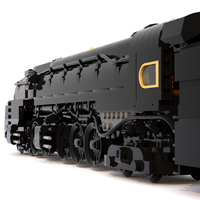
I did cheat a bit - elements of the smoke lifters are unsupported. I would fuse the pieces with modeling glue IRL. While this is a sin, and not a move I typically (or, really, ever) resort to, in this case (and in the case of all future such elements on an engine), I feel like the necessity of maintaining the narrowness of the part outweighs the gravity of the crime. In essence: deflectors are such an oddball item that I think they require a custom part - much like, say, third party wheels - to produce satisfactory results.
-
So, right off the bat I need to apologize: I cannot do renders while on the road. My parents' computer is not capable of such advanced technical sorcery. Second, I changed my mind (as I am prone to do) and went with 8w for the JNR. Ultimately, I feel like a loading gauge of 9.6 feet is so close to North America's ~10 feet that it wasn't worth jumping down. So this is a 5w wheel base (3w between the rails) on what amounts to a nearly full-sized locomotive and tender (which is essentially what the JNR's 3'6" cape gauge is - it's "ultimate" narrow gauge). I'm very happy with how this engine turned out, although it would definitely require a fair number of stickers for the gold boiler striping, white on the tender, more white on the running boards, etc. If I can find the motivation, I'm going to attempt a C62 4-6-4 next (I was really torn between these two), though I may hold off on it and do some cars, instead. Proto: Model:
-
Seeking opinion: JNR loading gauge
ProvenceTristram replied to ProvenceTristram's topic in LEGO Train Tech
Right now I am going with 7w even for the JNR. It's not perfect, but nothing is going to be. -
Is it wrong that I am presently about 25% done with another? :P I won't finish it until at least Tuesday - have to fly cross country tomorrow.
-
Okay, so North American standard gauge steam locomotives tend to be right around 10-11 feet wide (some variation, of course). JNR steam is apparently between 9 feet and 9 feet 6 inches. I have previously been representing NA standard gauge with 8 width builds (with 10 width cylinders by necessity), and I am pretty happy with that. With 3 footers (and 3 foot 6 inches 'cape') narrow gauge, I had been doing 7 studs, with 9 stud cylinders. This works very well for New Zealand, Canadian and American locomotives in these gauges, because our smaller sized railroads tend to have pretty small loading gauge (NZR's maximum is 8 feet, 6 inches - so on the same track that JNR runs, the New Zealanders are working with a full FOOT less width!). So, the question is: if I want to maintain some level of scaling consistency, should I model JNR steam in 8w, or 7w? I see arguments for both: 7w has a smaller overall part count for everything (locos, cars, etc.) by almost a quarter. It also keeps the narrow gauge "narrow" - at least more slender than my 8w models. However, 9 feet 6 inches is really closer to American standard gauge width than it is most of NZR/North American narrow gauge. Japanese "narrow gauge" is undeniably bigger than that being run in NA and other places by a wide margin; heck, the tractive effort of their 2-8-2s is almost 1/4th greater than a K-36 locomotive - widely acknowledged as the beefiest of all NA narrow gauge locos. I'm honestly flummoxed. And I don't want to go with one or the other just regret it later. --- And, just in case you were bored to tears by all that, have a super sweet train video:
-
These were the most common engines produced during WWII, and are still fairly prevalent in steam railroading - a number of U.S. railroads either run them or have one in storage, and a few more are scattered throughout Australia and southeastern Asia. This particular example was modeled after White Pass & Yukon #190, which is currently still operating at the Tweetsie Railroad. However, it could be converted to any of the others with pretty minor cosmetic changes. Proto: Model: I'm considering doing some JNR 3'6" stuff over the holidays, but the loading gauge is almost as large as American standard gauge (just to put it in perspective, JNR cape gauge locomotives are typically about 9 feet, 6 inches wide; the American SP 4449 4-8-4 is an even 10' wide. So I'd essentially be producing standard gauge trains with narrow gauge wheels. Not sure how I feel about that, but I will look into it).
-
[MOC] Erie L-1 0-8-8-0 Camelback Mallet
ProvenceTristram replied to ProvenceTristram's topic in LEGO Train Tech
It allowed for an enormous firebox. And, theoretically, it also gave the engineer a better view forward. However, they were regarded as widow-makers due to the fact that, when driving rods broke at speed, they would rotate upwards into the cab like a scythe and kill the person inside. -
[MOC] Erie L-1 0-8-8-0 Camelback Mallet
ProvenceTristram replied to ProvenceTristram's topic in LEGO Train Tech
Thanks. IRL, I'd have better represented the piping just forward of the cab on the right side, but it's impossible in LDD, so I just did some greebling there. I try to keep my designs accurate, but allow for running, too. It may not look like it, but the front wheelset can actually swing almost 30 degrees. I wish I could have powered it, too, but there was no place to put a second motor. -
Proto: Model:
-
-
Wow, that is lovely. The problem with Lego camelbacks (and this is nothing exclusive to your model - mine suffer the exact same issue) is that the cabs are so narrow that you can't fit a minifigure unless they are sideways and half out the window. :P
-
[MOC] NZR 3-foot, 6 inch gauge KA Class 4-8-4
ProvenceTristram replied to ProvenceTristram's topic in LEGO Train Tech
Not to mention that NZ doesn't have dual gauge track - 3'6" is their "standard gauge"... Thanks, I actually made that one up myself. -
No - no experience. But that is one narrow-*bleep* curve. It looks like something that only trolleys or something very similar would be able to negotiate.
-
And I thought my engines would have problems with curves. What piece are you using for the very last (smallest) circle on the nose cone?
-
[MOC] NZR 3-foot, 6 inch gauge KA Class 4-8-4
ProvenceTristram replied to ProvenceTristram's topic in LEGO Train Tech
Thanks. I always spot at least one flaw with my loco after posting. In this case, I've raised the cylinders one full brick to their correct (and unusual) height: -
I've decided to start doing all 3½' narrow gauge locomotive and equipment with actual 3-wide wheel spacing, and 7-wide bodies. Although (curved) track doesn't exist and cannot readily be made for this gauge, I do feel like these dimensions do a much better job of capturing Cape gauge as a whole - the result is a model that is properly scaled to minifigs, and still allows for some level of interior detailing (and makes it easier to fit electronics. Another nice benefit of this size is that - just like the real thing - it's about 3/4ths the size of a standard gauge locomotive... and is therefore about 3/4ths the number of parts [in this case, a very thrifty 1,432]). An obvious downside is that it pretty much destroys all narrow gauge work I have done up to this point... but I'm willing to make that sacrifice to produce better results overall. This particular locomotive is powered (by a worm gear running under the drivers), and has decent play on the lead and trailing trucks. I feel like it's a fairly solid representation of the real thing - which, despite being a 'big' engine, is still decidedly toy like IRL (look at the photo with the people linked below - the kids are almost as tall as the drivers!). As for the KAs, NZR designed them when garratts intended for North Island work proved to be mechanical disasters (for the record, I hate garratts). Three still survive, and are either in service or are being restored to service. When running, they're pretty impressive, despite their size. Proto: Model:
-
A product that somebody should invent
ProvenceTristram replied to ProvenceTristram's topic in LEGO Train Tech
You obviously couldn't do ties with studs every space - only every so often when the holes did line up. The other option would be to actually go full-blown flex track - IE the track comes with ties built in, and they "slide" on one rail. The issue with this is that it wouldn't allow for differing rail spacing for competing gauges. I dunno - I'm not a manufacturer, more of an ideas man. I just figured I'd toss it out there. -
One of these crafty types needs to come up with flexible rails of something like 3-5 feet in length. Ideally, they'd be that kind of stiffer rubber (or a very flexible plastic) that bends laterally, but otherwise holds its rail shape and doesn't kink. It would also need to have negative studs on the bottom (just like the old straight plastic rails from the 1990s). MOCers could then 'flex' the rail to their ideal curve, and connect ties to force the shape to hold. One of the enormous benefits to this - in addition to allowing people to do all kinds of curve radii - is that it would instantly accommodate other gauges (like we could finally see a 3w gauge done to properly mimic 3' cape gauge railroads, and 2w track could see curves that wouldn't be lethal on a roller coaster). The sectional track approach that artisans have been using is good, but - ultimately - I think people in the hobby will want access to the same kind of flex track that is so infinitely useful in more conventional model railroading. Just a thought.
-
The rungs are actually just stand-ins. On the model, I would use something like 93609, which would look a whole lot narrower. I just couldn't do it in LDD (well, I didn't even try, knowing the behavior of the tubes). As an aside, I ran one high-detail POV of it last night:
-
Chances of an Emerald Night re-release?
ProvenceTristram replied to Eaglefan344's topic in LEGO Train Tech
I also thought the Hogwarts express was a slight improvement, if sadly having reverted to 6w. -
[MOC] ATSF 3450-Class 4-6-4 Hudson #3451
ProvenceTristram replied to ProvenceTristram's topic in LEGO Train Tech
I'd worry people would see me as conceited. I mean... I am... but it seems kind of risky to advertise it >.> Thank you, though. This is also my favorite locomotive (although it's only by like a hair over the 0-8-0).