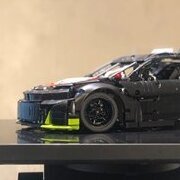
gheneli Posted 11 hours ago Posted 11 hours ago (edited) I started this idea a while back and I've decided this one is gonna be mainly aimed at sitting on my shelf and not necessarily building something that's appealing to the majority of Lego fans. I've always loved the cars/vehicles where you can take out a lot of the panels to see the inner workings, all the mechanisms, pipes and wiring and such. So, for this build, I'm only gonna have the whole chassis with the suspension (which is gonna be challenging, at least the rear one) and the engine, displayed without the final panel covers (removed front nozzle and engine cover) and without the wheels. I chose not to add any wheels mainly because I absolutely love how it looks displayed like that, making the details of the calipers and even brake cables stand out even more (and I can also add a more accurate caliper design, because I'm not worried about the wheel not being able to fit). My usual design process is pretty simple. I'll start in Studio trying to create a general mockup, see what problems could occur and how difficult they could be to solve, then order parts I might be missing and start test-building it in real life. Most of the times my Studio calculations are correct, but there were times when I was totally wrong. One of that type of situation was when I thought I could do a cantilever pushrod suspension with the big shock absorber (from the 1:5 bikes) on a 1:10 scale car. That shock absorber is way harder than I thought, and requires a crazy strong structure. In some of the ideas I had here, you can see me trying to add that suspension for the rear, but now that I know what that takes, I'm probably gonna stick to the normal hard shock, especially since the suspension is not gonna need to hold any weight, since the car will be mounted on a stand (because it won't have wheels) I love finding ways to add all sorts of interesting details, like pipes and connections. Those 3 barrels in the front (which I'm guessing they're containers for the brake and clutch fluids) were initially designed using 1x1 round tiles, but they seemed too small, so instead I tried a minifig head + a saucer on top and I think it looks really good now. I'm also happy with the radiator and with that pipe connecting to the radiator, even though that bionicle tooth is pretty rare in dark orange, but worth it. Also 2 more air intakes on each side of the radiator, which I have no idea what they're for (extra cooling for something) At this stage, I haven't physically built anything yet, so I'm still at the mockup stage, but I consider the front half solved. As in, I don't see any issues I might have when I start cleaning up the design and considering the final structure for the frame. You will, however, see a lot of messy connections and part collisions in these renders, because this is still in the early stages, and it's not cleaned up yet. The most interesting idea so far is the design of the side panels, that needed to have a certain roundness (a bit oval, I'd say), but stacking 2 curved panels on top of each other wasn't enough, so I had to come up with something that gave me a higher, relatively continuous curvature. I say relatively continuous because this is Lego and you can't always have multiple panels creating perfect surfaces with no gaps. I still have to find a geometric solution to reinforce the two side panels with a top connection between them. Shouldn't be that hard, now that I've learned so much from designing the frame of my Harley Chopper MOC. The front suspension was pretty straight forward. Added the extra oblique arm using the Pythagoras triangle. It won't be this simple for the rear suspension, unfortunately. I'm gonna also try adding the anti-roll bar (at least just visually, since I don't think it would be functional, because I don't want to stress and twist an axle to recreate it just like in real life - or maybe add a bar as resistance instead of an axle, since a bar has a strong grip but doesn't have a fixed connection like the axle has - we'll see) The seat and steering are pretty straight forward. The steering wheel will have an angled frame for support, and will use a universal joint to connect to the rack. The only thing I find slightly problematic here is reinforcing the structural frame past the seat area, as there seems to be little space due to the unusual position of the exterior side panels + side panels of the seat assembly. The engine, I believe, will be the most impressive part of the whole build. I really wanna get as much detail as possible. Below you can even see me trying to hook up ignition cables using strings. I will also try to find a good structure for those exhaust pipes. A bit challenging to get the transition from 3 pipes to a single, final one. I was thinking the pipes would look better if they were thicker than 1x1, but that means I'll have to stack a ton of parts to create such long pipes. Part number 35186 comes to mind, but I'm not sure it's even possible to stack that many of them. I'm thinking 1x1 will have to do. The biggest challenge remains the rear suspension, mainly the long arms that attach all the way near the cockpit area. I really wanna use those 16L links for that, but I want the geometry to work, so that no parts will be under any stress when compressing the suspension. Hopefully I'll have time to regularly work on this, and post constant updates. Hope you enjoy! Edited 11 hours ago by gheneli Quote
vascolp Posted 10 hours ago Posted 10 hours ago 1 hour ago, gheneli said: Hope you enjoy! I do! Quote
2GodBDGlory Posted 9 hours ago Posted 9 hours ago Thanks for the writeup! It looks like an interesting and unique build, with great attention to detail. It's fun to see a bit of your build process, too! Quote
Stereo Posted 9 hours ago Posted 9 hours ago 1 hour ago, gheneli said: I was thinking the pipes would look better if they were thicker than 1x1, but that means I'll have to stack a ton of parts to create such long pipes. Part number 35186 comes to mind, but I'm not sure it's even possible to stack that many of them. I'm thinking 1x1 will have to do. They are pretty easy to stack (you can just put an axle through a whole length of them, they'd be 1 stud length each - or put black pins in pairs of them, and bars to connect longer sections of those) but I think it'd be more accurate to make the primaries out of pneumatic tube and the final sections from 1x1, when I compare your picture to the original. Quote

Recommended Posts
Join the conversation
You can post now and register later. If you have an account, sign in now to post with your account.