gyenesvi Posted December 21, 2025 Posted December 21, 2025 (edited) 8L / 9L soft springs with 2 studs of travel in 1 stud diameter, parallel and perpendicular variants with pinhole / towball ends Hi folks! One kind of part in lego technic that I think could greatly be improved for certain situations is the shock absorber; I often find that existing ones are either small with quite limited travel, or too bulky in terms of length / width for medium sized builds. Another problem they have is the mounting points on their ends don't allow tilting in a compact space, like links / towballs could do. So in this thread, I set out to see how the situation could be improved in terms of part design, and what we can actually make ourselves using existing parts and a bit of 3d printing. For offroaders, I often find that short springs with 1 stud of travel are insufficient, while larger springs don't fit into medium sized (RC) models. There are tricks with which smaller springs can be used to achieve longer travel, but that often trades off space that would otherwise be used for other things. For example, springs can be moved inwards towards the centerline of the chassis, but that means that they occupy the space of the engine or trunk. Longer soft springs would be required to allow pushing them outwards next to the wheels, but the existing variants cannot really be used, as they are often too wide or too long, taking up significantly more space. So I asked myself the question whether it would be possible to make longer travel shock absorbers with minimal additional size? Ideally, only increasing the length, and keeping the width at 1 stud diameter? More specifically, what is the minimal length into which a spring with 2 studs of travel could be compressed? The design idea I realized that part of the complication comes from how shock absorbers must be assembled from (injection moldable) parts; the key problem is how to put the inner sliding part into the outer fixed part. It can be done in two ways: from the top or from the bottom. Older lego springs are assembled from 2 parts, the inner part clicking in from the bottom like this: This requires some tabs that click into place and that requires some molding tricks and also takes up some extra longitudinal space. However, RC springs are typically assembled from more parts, and the inner part slides in from the top (eliminating the need for a click-in mechanism), and then the two end mounts are screwed on. But screw-on parts are not easy to mold, and also cannot be made tiny but strong enough from plastic. Not too long ago, the thin long shock absorber for motorbikes came out, and I bought some as I was optimistic about them, only to realize they are way too long to be practical (11 studs), and their mounting points would also make them really complicated to use for things other than motorbikes. However, they also have some good properties: they are only 1 stud wide, have the (soft) spring inside, and also their assembly method resembles RC shock absorbers. So they looked like a good concept in theory. I started wondering whether it would be possible to make a more compact version using the same principles. My calculations for a minimal length were as follows. 2 studs are required for the sliding part when it's completely out, and two more studs are required as space to slide in. It needs at least 1 stud of overlap between the inner and outer part (the 6.5L and the 9L springs have about 1 stud of overlap only, so it should be enough). That's 5 studs so far, plus we need at least 2 more studs for the two end mounts, resulting in 7 studs in total. However, we need some more space for assembly/connection of the end mounts (for example by clicking in), and also for the spring itself as it needs to be a longer one, so probably 8 studs in total is the smallest length possible. As for assembly, the motorbike shock absorber sounds like a good overall design. It has two key features for assembly: the sliding part and the lower end mount are separate pieces clicked together later, and the outer shell has an opening on the top. These together allow for the sliding part and the inner spring to go in from the top (no need to click-in from the bottom), and it has a top cap that clicks into place later (however, this is possible because the top mounting point is more complicated, not just a simple pinhole). Also, the way the lower mount is clicked onto the sliding part takes up a full stud of space. Anyways, I figured that a minimalistic design could be something along these lines (the inner bar represents the spring here): The idea is that the top pinhole would slide in from the top to close the outer shell and hold the inner spring as well, and also that the lower mount could be pushed into the sliding part from the bottom. The top cap would need to be fixed into the outer shell to hold the spring securely, but the lower part could even allow for some flexibility: it could be replaceable and rotatable! Assuming a standard bar hole inside the sliding part (as the motorbike shock absorber part does have on the top end for the spring), the lower mount could be a part like one of these (or even this): The first would be a standard pinhole, while the second is a link end, allowing a towball connection, which would make the spring have multiple degrees of freedom (just like RC springs)! The following combinations could be made, even the existing towball on a bar part could be used as end: Furthermore, the lower end part could be rotated, so perpendicular springs could also be achieved, making it even more versatile: In order for this to work, the bottom connection should have a good amount of friction to prevent from sliding out by itself (under some moderate weight, like that of a wheel). It would be achievable by having the bar hole in the sliding part a bit tighter than normal. An advantage of these end mount parts would be that they would not be one-off parts for shock absorbers only, they could be useful for other purposes. The bars can be inserted into axle connectors too. As for the upper end mounting point, I did consider using a towball socket (link end) there as well. It is possible, however, it would be less practical. For one, that end is not easily removable / replaceable. Second, two link / towball ends would actually allow for too many degrees of freedom for the spring; it could rotate around its own axis, resulting in some unwanted wobbling (just like a standard link can). So I believe a fixed pinhole is most suitable on the top end. This could have a simple click-in assembly mechanism using some small tabs that would prevent it from coming out under weight. The practical implementation After thinking this through in theory for the ideal case, I actually realized that the motorbike springs provide a good starting point for the core parts, I can cut away the ends that I don't need and just 3d print new ends! So I did that, cut off 2 studs from each ends, leaving me with these parts (7L in total): As a result, the outer shell is 5 studs long, the inner one is 4.25 studs (overlapping with the outer one on 2.25 studs), and the spring is about 4.5 studs. Adding two ends results in a 9L spring. So I designed and 3d printed the following two mounts for the top/bottom; these simply slide into the end holes, but they are a tight fit, so they don't come out easily, but are still replaceable. The upper one also has tabs that prevent it from rotating. Unfortunately, the lower end of a sliding part does not have a standard bar hole, only a 2mm hole. For a 3d printed part it's not so much of a problem though, only it is somewhat weaker (still looks okay, maybe under load it could break). However, a drill can be used to enlarge the hole to 3mm or 3.2mm (the diameter of the bar hole). Luckily, 3.2mm drill heads also exist, although harder to get. So these parts resulted in a 9L shock absorber. To get an 8L overall length variant, I cut away further 1 stud length both from the outer shell and the sliding piece (on the top in both cases). Also, I had to use a 3.2mm drill to deepen the inner hole in the sliding piece from the top to allow the spring to slide deeper as the overall housing length decrease had to be compensated. Both variants work smoothly, and they are at least as stable as standard small lego springs. However, they are softer and can be used much more flexibly; they can be rotated and tilted in all directions. Next up is building something of medium size with these springs (probably in conjunction with one of my 3d printed brushless motors). One possible option to incorporate them in a more complex tilted way would be something like this (but obviously classical vertical positions are also possible): Let me know how you like this concept, whether you'd find these practical for building your own stuff! Cheers, Viktor Edited December 26, 2025 by gyenesvi Quote
2GodBDGlory Posted December 21, 2025 Posted December 21, 2025 Looks like a lot of work went into the concept; nice work! I can see how having those ball joints would be really helpful. Hopefully it does prove strong enough! Quote
bruh Posted December 21, 2025 Posted December 21, 2025 Wow! This could be awesome! I will definitely be interested in this thread and its outcome! Quote
gyenesvi Posted December 21, 2025 Author Posted December 21, 2025 1 hour ago, 2GodBDGlory said: Looks like a lot of work went into the concept; nice work! 22 minutes ago, bruh said: Wow! This could be awesome! Thanks! What I tried to work out is something that could actually be moulded as a genuine lego part. Who knows, maybe they are reading these threads ;) 1 hour ago, 2GodBDGlory said: I can see how having those ball joints would be really helpful. Hopefully it does prove strong enough! I don't think the upper part would be any problematic, and even if the first prototype breaks with those 2mm bars on the lower end, I can use the drill to make the hole 3.2mm and make the bar connection stronger (would increase the bar surface area to 250% of the current one). Also, I think if those end parts were actually injection moulded, they'd be definitely strong enough, as similar parts do exist with bars, like this: In fact, some of these could be cut an used here for a DIY solution. The link end could also be possibly 'manufactured' from a 6L link, I just don't yet know a good way how to cut out a round bar from an axle.. any ideas (besides using a file)? Also, these bottom end parts would not be one-off parts for shock absorbers only, they could be useful for other purposes. The bars can be inserted into axle connectors too.. Quote
PlasticGear Posted December 23, 2025 Posted December 23, 2025 I really like the idea. We do need an easier integration for suspension and you just give an answer to it, awsome ! My only concern is the suspension assy needs to support both compression and extension (ex: when you lift the model, the suspension act as the wishbone lower stop). Other than that it is really nice, I am tempted to do it myself too. Quote
2GodBDGlory Posted December 23, 2025 Posted December 23, 2025 On 12/21/2025 at 3:00 PM, gyenesvi said: In fact, some of these could be cut an used here for a DIY solution. The link end could also be possibly 'manufactured' from a 6L link, I just don't yet know a good way how to cut out a round bar from an axle.. any ideas (besides using a file)? Here's my suggestion for that: Start with a 6L link, and cut off one of the ends, so that you've now got a 5L axle with a joint on one end. Then hook up your new axle end to a a fast motor/drill in a rigid jig, and then press a file against the rotating axle (next to the remaining joint) and let it file down until you reach the proper diameter. I'm not sure how well that would work, but it could be worth a try! Quote
gyenesvi Posted December 24, 2025 Author Posted December 24, 2025 On 12/23/2025 at 11:44 AM, PlasticGear said: I really like the idea. We do need an easier integration for suspension and you just give an answer to it, awsome ! Thanks, glad you agree! On 12/23/2025 at 11:44 AM, PlasticGear said: My only concern is the suspension assy needs to support both compression and extension (ex: when you lift the model, the suspension act as the wishbone lower stop). Other than that it is really nice, I am tempted to do it myself too. Not sure I understand why that is a concern? I agree it should be like that, and for that, soft long springs are needed, and this one is exactly that, the softest long spring. I expect it would actually behave that way under a medium sized model! Or do you mean that such force could pull the lower mount out? On 12/23/2025 at 5:06 PM, 2GodBDGlory said: Here's my suggestion for that: Start with a 6L link, and cut off one of the ends, so that you've now got a 5L axle with a joint on one end. Then hook up your new axle end to a a fast motor/drill in a rigid jig, and then press a file against the rotating axle (next to the remaining joint) and let it file down until you reach the proper diameter. I'm not sure how well that would work, but it could be worth a try! Yeah, kind of what I roughly thought too, although it's a good idea to cut the other end of the link and use the axle to fix into a drill or something, I did not think of that. The only problem is that it's hard to know when to stop, when it is the right size, when tenth of millimeters matter.. but maybe worth an experiment.. Quote
bruh Posted December 25, 2025 Posted December 25, 2025 Well, compression is fine, but unless you lock the suspension assembly together so it can't come apart, when the suspension arms pull away from the body, they will pull the shock absorber apart. Quote
gyenesvi Posted December 26, 2025 Author Posted December 26, 2025 On 12/25/2025 at 3:23 AM, bruh said: Well, compression is fine, but unless you lock the suspension assembly together so it can't come apart, when the suspension arms pull away from the body, they will pull the shock absorber apart. You mean there may be pulling forces on the spring during articulation even when the body is sitting on it? I only assumed that if I lift the model, but as I think about it now as you say, that could be true for a live axle, though maybe only once it expands to its maximum length and would want to go more. This will have to be tested if this is a problem, but as I say above, the idea is that the lower end would be fixed with more friction than normal, to make it harder to pull apart. Quote
Zerobricks Posted December 26, 2025 Posted December 26, 2025 That's a really neat idea. Especially the ability to have the end freely rotate and be a ball joint recepticle would simplify live axle suspensions a lot. I also feel we could also use a shock ansorber with low travel and high force for the heavy supercars, something 3 - 4 studs long with half a stud of travel. Quote
gyenesvi Posted December 26, 2025 Author Posted December 26, 2025 5 hours ago, Zerobricks said: I also feel we could also use a shock ansorber with low travel and high force for the heavy supercars, something 3 - 4 studs long with half a stud of travel. Indeed, half stud travel could also be useful if it comes in a shorter size! However, I think 3-4 studs is too optimistic, it would have to be at least 5 studs long, which is already a significant improvement on the current shortest. Quote
bruh Posted December 27, 2025 Posted December 27, 2025 15 hours ago, gyenesvi said: You mean there may be pulling forces on the spring during articulation even when the body is sitting on it? I only assumed that if I lift the model, but as I think about it now as you say, that could be true for a live axle, though maybe only once it expands to its maximum length and would want to go more. This will have to be tested if this is a problem, but as I say above, the idea is that the lower end would be fixed with more friction than normal, to make it harder to pull apart. In a sense, yes. Also just in general, when handling the part, I wouldn't want it to fall apart on me. The idea of having my suspension potentially fall apart is scary, in real life and in LEGO. Quote
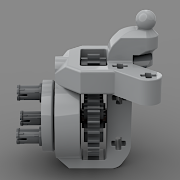
efferman Posted December 30, 2025 Posted December 30, 2025 A long time ago i made a similar shock absorber. same size like the 6.5 shock and it uses the same coiland has the same travel. The rod can free rotate to be flexible. Quote
gyenesvi Posted December 30, 2025 Author Posted December 30, 2025 7 hours ago, efferman said: A long time ago i made a similar shock absorber. same size like the 6.5 shock and it uses the same coiland has the same travel. The rod can free rotate to be flexible. That's an interesting design as well, good to know you were thinking along similar lines! Is this model 3d printable? Did you also make it in real life? Quote
efferman Posted December 30, 2025 Posted December 30, 2025 Yes, i have printed it and it works when the layers are good melted together. Quote

Recommended Posts
Join the conversation
You can post now and register later. If you have an account, sign in now to post with your account.