
Search the Community
Showing results for tags 'ultra4'.
Found 1 result
-
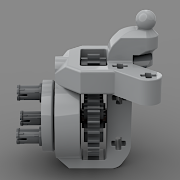 Hello Eurobrickers, Let me share my first finished model of the year, even though this one has been long overdue from last year. This time it is a fast buggy inspired by Ultra4 buggies, a variant of which I have built for last year's Buwizz camp, but I didn't get to publish it so far. The idea was to build a buggy with responsive independent suspension, but with something out of the ordinary on the rear: trailing arms with radius rods; something I have never seen implemented in Lego form. At the front the goal was to build a long travel (driven) suspension with long shocks and positive caster angle, which is not easy to do. The first implementation I built for the race was not very satisfying a bit weak and full of half stud offsets. Recently, I managed to redesign it to a more realistic and more robust form. Originally, I have designed this model with 2 Buwizz motors and one Buwizz 3 unit for the unlimited race category. However, after comparing to my fellow hungarian competitors' builds that used 4 motors, I decided to upgrade it and use 4 motors as well (at the chance of melting some axles). I managed to do an upgrade, which performed very well speed-wise, but turned out to be very hard to control (both speed and steering), so I did not fare well at the race unfortunately. I did not have much time for the upgrade, and the placement of the extra 2 motors was not ideal, was in the way for the steering motor, which I solved by adding one more CV joint to the steering actuation. This made the steering response even slower than usual and the whole car was hard to control at the race. So in the end I chose to publishing the 2-motor variant, which is more controllable, safer to use without melting and also cheaper to replicate. So without further ado, here is the usual performance video. Features Fast and powerful 4x4 drivetrain (2x Buwizz motors) Steering by PU L motor Powered by Buwizz3 unit Long travel double wishbone independent front suspension with positive caster angle Long travel independent trailing arm rear suspension with radius rods Complete interior with two seats Sleek curvy body on a tubular frame Suspension, drivetrain, chassis The whole experiment started with the rear suspension. Real high speed off-road buggies often have trailing arm suspension, which are stabilized by radius rods. I have already designed one such suspension in my Polaris RZR alternate of the Audi set. However, in that case I could only approximate the actual trailing arm and radius rod geometry with the available parts; the result was a bit of a fake variant, that's similar but not quite how it is in reality. So I wanted to build a more realistic variant of it too. On a larger scale this became possible, however, the space was still quite tight. In such a suspension, the radius rods keep the wheels moving on an arc, just like in case of a double wishbone independent suspension. At the same time, the trailing arm itself also moves the wheel on another, perpendicular arc. This is only possible if there is some wiggle room in the system, and the longer the parts (the trailing arm and more importantly the radius rods), the more flat those arcs become and less wiggle room is needed. So I had to maximize the length of the radius rods, and the 9L links were just good enough at this scale, but they had to be mounted as close to the center of the vehicle as possible, which made the space around the rear drivetrain very tight; no space for differential. No problem, it would be closed anyway on an off-road vehicle. Here is the linkage geometry I managed to implement. The planetary hubs are mounted onto the trailing arms, which was challenging to make solid, but the end result is quite good, thanks to using Defender rims, which can hide the hub assembly. The radius rods (9L links) cannot be pushed further back, that's why there's no room for differential. The 12T gears hold up surprisingly well, but knob gears could also be used, although they might not be efficient for high speeds. I didn't try. An advantage of this setup is that there's space in between the trailing arms for motors. At the front, I went for 9L suspension arms with 9L steering links, which just resulted in a feasible suspension geometry at the same width as the rear axle. However, there are a couple complications. First, I wanted to use long springs for realistic looks, which need to be mounted on the lower arm, and then somehow avoid both the upper arm and the driveshaft. This is not such an easy puzzle given the limited number of lego parts available for such a purpose. For the second try, I managed to come up with a geometry in which the shock absorber is just one stud off center, but the driveshaft passes safely next to it, and the upper arm is split in two going around the shock absorber, just like in real rigs. The other difficulty is the positive caster angle. To achieve this, I tilted the whole front of the chassis, which means that the drivetrain had to contain a CV joint. That's not an issue, but due to the single-sided nature of the 9L steering links, the steering rod could only go relatively low, close to the driveshaft, due to which it was not possible to integrate the steering motor into the tilted assembly because it would have collided with the driveshaft. So I had to add a CV joint to the steering axle too, and move the steering motor further behind. The final chassis came together like this; quite minimal but solid. The Buwizz unit is easy to access for charging or for taking it out of the model. The driveshaft itself is very simple to remain efficient. Joined Buwizz motors at the fast output, 16:16T gearing underneath and straight to the (locked) differentials (1:1 ratio), then to the planetary hubs. There would even be space for a 2-speed gearbox in the middle, but I did not want to complicate it for this one. Interior and exterior The interior has lots of space left, so I added two large seats and a dashboard / steering wheel. The shaping of the exterior was loosely inspired by the Ultra4 KOH buggy of Lazernut Racing: Besides trying to resemble the paneling using some simple flat and curved panels available in blue, I also aimed to replicate some of the tubing, both under the panels and the visible ones around the windows. The model can actually be lifter by the roof thanks to the two pillars in the middle of the windshield. Here are some renders and photos of the complete model from all angles. All in all, the model is quite fun to play with, it's fast enough but has good torque as well to climb some rocks, and the suspension is really responsive. It sits in a bit under its own weight, but is bouncy and floats nicely on uneven surface. More pictures are available on Bricksafe. Building instructions are available on Rebrickable. Let me know what you guys think of it! Cheers, Viktor