
Jump to content

thomas92

Eurobricks Vassals
  • Posts

    14
  • Joined

About thomas92

Spam Prevention

  • What is favorite LEGO theme? (we need this info to prevent spam)
    mindstorms
  • Which LEGO set did you recently purchase or build?
    Liebherr Crawler Crane LR 13000

Extra

  • Country
    Netherlands

Recent Profile Visitors

The recent visitors block is disabled and is not being shown to other users.

  1. Thanks for sharing all this and documenting it so well, really interesting!😄
  2. Interesting, that could be a reason the pins are so stiff of course, for longevity when used in display pieces. I can imagine that is a big factor. Although I usually take my builds apart fairly quickly (definitely not 5 years😄). I would think they also want to optimize the initial building experience though.
  3. The wheels in 42148 are connected with non friction pins right? Those tend to be a bit loose indeed :)
  4. Has anybody else notices that it takes quite a bit of effort to insert friction pins and axles form new sets? I added two screenshots from steps in the Volvo FMX Truck & EC230 Electric Excavator sets. I could have chosen any step from this set really😅 It takes quite a bit of twisting and turning to put elements together. In fact it takes a toll on my finger, and it slows down the building process. This set is from 2024 though, perhaps that plays a role, although I bought it a couple of weeks ago. Ironically this used to be a critique on alternative brands such as CaDa and Mould King, although supposedly they have resolved that now.
  5. This is the one I bought a while back: https://www.amazon.nl/dp/B0BXDKQZ1K/ref=pe_28126711_487805961_TE_item. Python/OpenCV is the most straightforward. I would really like to have a camera that works via bluetooth, though. If you run a geared down motor to an end stop, it will put quite a lot of force on the gears and joints right? Gravity also plays a role with regard to the resistance. Personally I'm always a bit hesitant to run a motor with a lot of force until it stalls. But too little force and it might stop before the end is reached. The approach of saving the joint angles on the hub is interesting. I'm wondering how you detect when the joints are out of sync. As far as I know, after booting up you can only retrieve the absolute position (-180, 180) in Pybricks from the motor. You can compare this to what you stored on the Hub of course. But that still leaves the possibility the motor is out of sync but happen to land at a position that is modulus 360 the same as what you stored... I'm a bit confused now 😅 I guess the chance of this happening for all connected motors at once is very small.
  6. Interesting idea. The hub wouldn't be placed at the very end right.. and you would only have the rotation, not the position. Can probably do some clever tricks with that though. Another thing to take into account though is that the IMU is not 100% accurate:) I've been thinking about adding a mini camera either in the end effector or somewhere at the base of the hub. And then use ArUco markers (via black and white LEGO studs) and some computer vision to figure out the position of the camera / end effector relative to the base. Adding in non-LEGO parts is a bit of a last resort though. Another idea (in theory) is that you could attach the small angular motor at a joint purely as absolute encoder. This has the downside of more space / motors / ports needed. But you could then very easily retrieve the absolute position of that joint. Finally... even though the motors are geared down, and one 0-360 degree position can map to many joint positions, the number of joint positions are limited. If you combine that with the limited number of positions the other joints can be in (based on their motor positions), you already have a smaller solution space than all possible configurations. I'm probably a bit extreme in this but a LEGO robotic arm that instantly knows where it is in 3d space would be so cool. I still remember building this Mindstorms robot arm as if it was yesterday🥹
  7. Gotcha! Okay yeah fair point (also a programmer here).
  8. Oh yes that is a big factor for sure as well. Funny you say that cause I bought the Spike Prime hub exactly because the regular Technic Hub with 6 batteries is so heavy and has only 4 ports. So Spike Prime is definitely an improvement. But yeah the hubs and motors are quite bulky.. And yes really a shame they cancelled it. Mindstorms is what I grew up with. Have you looked into (inverse) kinematics for the robotic arm? I have some ideas about this:)
  9. Great work @Glaysche. Love it :) Interesting that you are using the three functions through turntable part. I would think the extra gear introduces more gear slop though, but maybe it's not so bad? Thanks for sharing the STL file and sharing all these great insights. Regarding the calibration, have you considered storing the motor angles via Pybricks on the hubs? That allows the motors to know what position they are in when the program boots up again. That is of course assuming the arm is not moved manually between runs.
  10. Wow, very impressive build. And nice to see Pybricks mentioned. How are you planning to control the two hubs and do they communicate with each other? This has been driving me crazy as well, I commented on it in the thread below as well. So far I only one (!) out of seven Z60 turntables that I own runs perfectly fine. Two mesh really badly with the 12T gear and the others are just not great either but okay-ish, sort of like what you describe. I am trying to figure out if this is a problem in older or newer sets. The thing is that 42042 is a set from 2015, and that uses a similar set up as yours. And I would assume it meshed fine back then. The Z60 beveled turntable gear was in sets between 2015 and 2021.
  11. Same problem here. It could be that some Z60 turntables are faulty, but I doubt it since that should be fixed in the newer batches then. And many of them seem to have this problem. What I did notice is that it matters a lot how close the 12T bevel gear is pressed against the turntable. If the gear can move away from the turntable ever so slightly, it has trouble engaging with the next tooth. The margin is very small.. might need to put a small plastic ring or something between the gear and the part that holds it. I noticed that they use the H-shape lift arm (14720) in the 42042 set for example: https://www.lego.com/cdn/product-assets/product.bi.core.pdf/6151636.pdf (starting at step 32, page 87) Edit: Ok I just received a new Z60 gear and it _does_ mess well.. 🥴
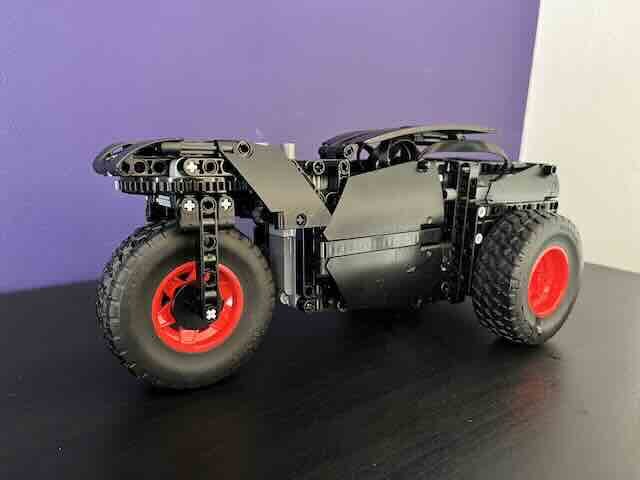
  12. Hi all, first post here. Made this using Pybricks, it's pretty straightforward but there is a neat little mechanism in there with two differentials that allows the vehicle to roll freely independent of the motor. Also programmed it so that the vehicle tilts depending on the speed and the steering angle. Because of the space the three motors and the hub take up, I didn't really have space for a passenger seat. Let me know what you think! while Button.B not in controller.buttons.pressed(): power = controller.triggers()[1] - controller.triggers()[0] steer_percentage = controller.joystick_left()[0] steer_percentage = 0 if abs(steer_percentage) < 5 else steer_percentage car.drive_power(power) car.steer(steer_percentage) if Button.LB in controller.buttons.pressed(): tilted_car.steer(-100) elif Button.RB in controller.buttons.pressed(): tilted_car.steer(100) else: tilted_car.steer(100 * (steer_percentage / 100) * (power / 100)) wait(10)
×
×
  • Create New...