

ProvenceTristram
-
Posts
423 -
Joined
-
Last visited
Content Type
Profiles
Forums
Gallery
Everything posted by ProvenceTristram
-
[MOC] Indiana Harbor Belt 0-8-0
ProvenceTristram replied to ProvenceTristram's topic in LEGO Train Tech
-
[MOC] ATSF 3450-Class 4-6-4 Hudson #3451
ProvenceTristram replied to ProvenceTristram's topic in LEGO Train Tech
I modernized the heck out of it, to bring it in line with the preserved 3450. -
I'm not sure what else I could do with the sides. Because it's an older car, the sides aren't fluted (like they might be with a theoretical 1940s streamliner) - they're riveted. And there really isn't a good way to mimic that in Lego. Ultimately, I think it's just going to have to have stickers.
-
I figured I should start doing cars. Since heavyweight trainsets by Pullman were (almost) interchangeable between roads, all that should be required to switch from railroad to railroad is a livery change. Just four more to go (baggage, sleeper, obs/lounge and diner). Proto: Model: The roof lifts off and there is an interior (although given that it's a coach, it's kind of boring - like 25ish seats and a bathroom at one end).
-
Unlikely. I'm unemployed and destitute. I am in large part doing these to try to distract myself from crippling depression.
-
These are the slightly-less-well-known younger sister to the world famous 4449 - and an engine I'd love to one day see run again (the lone survivor is at the St. Louis Transportation Museum). The build itself was less difficult than I thought it would be, though widening/narrowing of the boiler was annoying, and I was exhausted by the time I got to the tender, so that took longer than it should have. Big Ben XL or Shupp XL are probably a bit too small to represent 72" drivers, but I feel like Shupp's XXL are closer to the 80" mark... so XL it is. Proto: Model:
-
[MOC] Indiana Harbor Belt 0-8-0
ProvenceTristram replied to ProvenceTristram's topic in LEGO Train Tech
Thanks. I'll look into it. The firebox may be in the way, however. *Edit* Fixed. The firebox was in the way, but - mercifully - the fix wasn't that involved. I also extended the front pilot to better match the prototype. There should be nothing to preclude it running. It has the motor, the gearing (powering 3/4 axles), and space for all the wiring. I even left conduits running the length of the boiler that would allow for future LED wires if someone wanted to light the thing. -
Chances of an Emerald Night re-release?
ProvenceTristram replied to Eaglefan344's topic in LEGO Train Tech
1) Nice ad hominem. I don't give a wet fig about your opinions of me, and I stand by my take: it's a weak product. 2) Moreover, you cannot play both sides of the same coin - either the Emerald Night is beautiful, and a strong effort by Lego, or it's a "mass produced children's toy," in which case you are conceding the point on whether its aesthetically acceptable given its high dollar command and ridiculous after-market price. 3) Lego Creator sets are, by the way, marketed almost exclusively towards adults. Their city sets are of a very high quality... but we're just supposed to accept mediocrity because it's a train? -
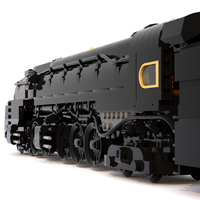
I had no connection-to or affinity-for this locomotive until I started designing it this morning - it is, rather, yet another case of "wow, this is so weird looking that I need to build it." These 3-cylinder engines were designed for drag transfer freights in the Chicago area, and were among the most powerful 0-8-0s ever assembled. I think the "beefy" quality of the prototype came across in the model. Un-fun fact - the tender on this thing was more difficult than the engine :/. Proto: Model:
-
Give me 2-rail O, or give me death.
-
[MOC] ATSF 3450-Class 4-6-4 Hudson #3451
ProvenceTristram replied to ProvenceTristram's topic in LEGO Train Tech
Thanks! -
The Atchison, Topeka and Santa Fe Railway didn't boast the world's most powerful 4-6-4s... or, arguably, the most comely. But they were, IMO, the most balanced in design, with a kind of compressed appearance (shared by the road's 4-6-2's) that left them looking sleek, rather than big and burly (this was likely in large part due to the fact that they were originally equipped with 75-inch driving wheels, but later upgraded to 79" - thus leaving them with a somewhat 'wearing shoes too large for their feet' appearance). I went back and forth on whether or not to build this loco last night, and I am glad that I decided to, because I think it turned out wonderfully. As with my previous engines sporting drivers around 80ish inches, this engine features stand-ins intended to replaced by Shupp's. Proto: Model:
-
Not in LDD, but I can make them fit IRL. I understand your overall point; there's always the possibility I may at some later date regret not doing 9w, myself :P.
-
Because I still view the minifig as the ultimate arbiter of scale. Even then, 8w is probably a little too small, but in terms of the proportions of thr overall "Lego world" - particularly the great Creator stuff Lego churns out - it's likely the closest match.
-
You mean broader? That truck was meant for an 8w. Honestly, I think you're looking at a problem of physics, after a certain point, when it comes to 7w - by chopping off that extra stud, you are losing the opportunity to expand detailing on the trucks. Yes, you can get creative with technic pieces and force a resolution, but you basically eliminate the possibility of all mounts similar to the one I posted - there just isn't room; it cannot be done in a manner that provides the most flexibility. This is part of the reason why I urge everyone - including British modellers - to accept an 8w standard across the board. 7w isn't just hanstringing your creativity - it is making the issue of track gauge-to-stud-width (something that is by no means resolved in 8w, but at least manageable), almost absurd. At 7w, standard gauge comes out looking like 6 and a half feet. That's not a problem anyone who is worried about the details on bogies should casually overlook.
-
Yup, this is one of my favorite railroad videos for that very reason.
-
Yeah, it's great until you find out that 5 men were killed during the R&D process.
-
[MOC] 007's Aston Martin DB5 in minifig scale
ProvenceTristram replied to hachiroku's topic in LEGO Licensed
This is definitely as close as anyone is ever going to come. -
I went with the second one because it was weird. And the file: http://s000.tinyupload.com/?file_id=00085392392247092549 Honestly, I think you should stop worrying about width (within reason). Lego models are about compromise, and detail should always win out over precision scaling.
-
The flex tool is bizarre - sometimes it does some astonishing things that you didn't think were possible... other times (most of the time :/) it refuses to do the most simplistic of fits regardless of what you try. Unrelated, but I completely redid the steam and sand domes - I wan't satisfied with how blocky they were. Although this introduces some small gaps in the top of the boiler, I feel like the tradeoff is worth it for shapes that are far closer to the prototype:
-
I'll take a look at the problem tonight, if I can remember.
-
As soon as I saw this crazy looking thing, I knew I had to build it. IRL, the locomotive itself was a spectacular failure, being active for less than a decade, and spending almost half its service life in the shops. However, it was the largest engine ever fielded by the Canadian Pacific, and - really - how could you not love something that looks like its torn straight from the pages of a steampunk comic? Proto: Bluerender: LDD:
-
Can you perhaps share a few screenshots of a real life prototype?
-
[MOC] Southern Railway GP30 Locomotive
ProvenceTristram replied to ProvenceTristram's topic in LEGO Train Tech
Just wanted to show that it is an engine that is very easily convertible into the lower-hood option, as well as different color schemes (with necessary decals absent, of course). CP: UP: -
Chances of an Emerald Night re-release?
ProvenceTristram replied to Eaglefan344's topic in LEGO Train Tech
I feel like a driving rod isn't something you can really fake - it's a specialized part that just needs to be what it is. The thing is, though, were they to design, say, a three or two-couple driving rod mold, that could be reused on all Lego-designed steam locomotives going forward for the next 20 years or more; it would definitely have multi-set use. I think the fact that they haven't done a proper rod since the early 80s is really pretty chintzy - especially when they go ultra cheap with cop-outs like this: Even as, like, a 5 year old, I would have immediately recognized that something enormous and necessary was absent from that picture.