Peter Nolan
-
Posts
43 -
Joined
-
Last visited
Content Type
Profiles
Forums
Gallery
Everything posted by Peter Nolan
-
Wow... that really is a very neat solution. Nice work... As for the drawings, I did most of the layout in MoI (http://moi3d.com) and then tidied/coloured it in Adobe Illustrator. MoI is actually a 3D modelling package, but it has some handy 2D drawing tools. Plus it is relatively inexpensive...
-
Although you could try this: (two intelli-trains, one going forwards, one going backwards, with two carriages connected by Toolo turntables, hinges and a beam).
-
Good point--I didn't think of that. I guess you'd also need some kind of hinge to allow them to follow the curve of the bridge.
-
Hi Robert, A few possible solutions: Production year. You can search the Bricklink catalogue by part and by year at http://www.bricklink.com/catalog.asp. You can also download the bricklink catalogue from http://www.bricklink...ogDownload.asp. Talking to Lego. You could try 'The Embassy' on this forum (http://www.eurobrick...p?showforum=108) or try someone else from the Lego ambassador program (http://aboutus.lego....lego-ambassador). Or you could always take a holiday to Denmark Odd axle lengths. Most of my knowledge of Technic comes from when I was a kid. Back then axles only came in even lengths. I suspect that the introduction of odd lengths was related to increasing complexity in models. I haven't really had much to do with Technic lately, but some of the big sets certainly look very appealing...
-
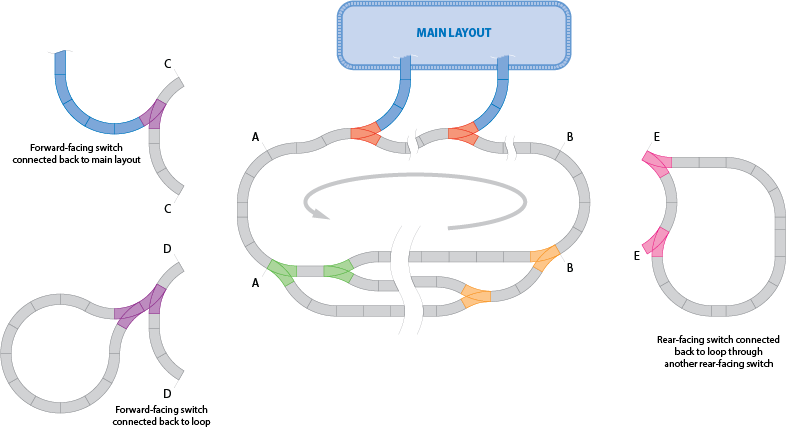
Hi All, A while back I tried to come up with a few sentences that describe what conditions lead to the 'non all points reachable' (non-APR) condition that Robert discussed earlier in this thread. I got a little mixed up with the words though, so have come up with the diagram below instead. So here goes... I've drawn one loop which is connected to a main layout (represented by the blue box). If a train enters the loop from the main layout it won't be able to get out, as all the routes back (the two red switches) are facing the wrong way. As the train goes along the track there are some switches that face the right way for escape (the green ones), but since they simply rejoin the loop (through the orange switches) the train remains trapped. From this you could say that a loop will create a non-APR condition if: --all of the switches that connect back to the main layout (i.e. red switches) face the same direction (lets call these rear-facing) --any forward-facing switches (i.e. green) rejoin the loop though rear-facing switches (i.e. orange) If a forward facing switch is connected back to the main layout (e.g. replace section A-A with section C-C) the loop will become APR. Also, if you join a forward facing switch back to the loop through another forward-facing switch (e.g. replace section A-A with section D-D) the trains direction will be reversed and the loop will also become APR. However, you can add more rear-facing switches to the loop (e.g. replace B-B with E-E) and the loop will still create a non-APR condition. Indeed, this sub-loop would never be reachable from the main layout. From this we can see that it doesn't really matter whether rear-facing switches are connected to the main layout or back into the loop (through either a forward- or rear-facing switch)--the loop still creates a non-APR condition. From this I think that the description could be simplified to: A loop of track within a layout will cause a non-APR condition if (for a given direction of travel) all forward-facing switches rejoin the same loop through a rear-facing switch. So.. what do you think? Are there any other layout types that lead to a non-APR condition?
-
Nice work on the technic train carriages Robert, zg0. The independent bogies is an interesting idea. Lego did make a very short train base (4 studs long) for one of the Thomas the Tank engine sets (http://www.bricklink...?P=4195c04&in=S). If you took two of these and connected them via turntables to a long plate you could make a good long carriage that would run smoothly and be compatible with switches and bridges. Sadly I don't have any to try my idea out.
-
Hi Robert, thanks for creating this new thread. I came across an old article (circa 2008) that suggests the number of specialised pieces (which some people associate with 'dumbing down' of sets) has actually been decreasing rather than increasing. It is the fourth subheading in the 'design' section of this article: http://lego.gizmodo....know-about-lego The article is six years old though--I wonder if the trend in the number of specialised pieces has continued? I also noticed another old (but interesting and hopefully relevant) article about Lego's 'Memory Lane' archive that contains pretty much every Lego set ever made. http://lego.gizmodo....sets-in-history I was surprised by how many of the sets I remembered from the catalogues (or owned) as a child.
-
Good call--we have gone a little off-topic recently.
-
Yes, things certainly are different these days... Even the fact that there are pink and blue aisles for boys and girls is interesting. When you visit a large toyshop it can feel like it is more about marketing and profit than play and education. I guess that is the world we live in though :-( Ok, it turns out I may have been a bit of a hypocrite... I have just come back from a large toyshop with a lego set (from completely the wrong age range) for my young son... Of course it was too advanced for him to build by himself, but we are having fun playing with the model now :-)
-
Nice work! As it happens, my son's train set does seem to have many more curved rails than straight. We are yet to run out of either though... BTW do you mean IFF in the mathematical sense? Toolo is quite interesting. Some of the parts look like they would be very expensive to produce--the standard 2x4 block has screw threads on five surfaces, which would necessitate quite complex mould tooling. Although there are no retail Toolo sets available now, you can still buy two educational sets: http://education.leg...2-tech-machines http://education.leg...le-machines-set Interesting. I was skeptical to start with, so had a look at some of the new Duplo sets and can see your point. If you compare the new ambulance (10527) with the old one (4979) the new one does indeed have more parts.
-
Sorry, I didn't take any photos :-( There are a few resources online though if you search hard enough... On the subject of the latest Duplo trains having fewer features, I think that this is part of general shift in the positioning of Duplo in the market. It seems that Duplo is now being marketed to a younger market than it used to be. I've also noticed that a lot of parents see Duplo as more of a baby/toddler toy rather than something that is good for kids up to 5 years or so. It seems to be that people decide that once their child is a certain age it is time to get rid of the Duplo and then move on to Lego. (sorry if I'm repeating some of the sentiments that have been expressed earlier in this thread). At the moment I find that my son is happy playing with both Duplo and Lego and creating hybrid models (not everyone realises that Duplo and Lego are compatible it seems). When you throw in some Duplo Toolo (bought second-hand, like the Intelli trains) there are all sorts of play possibilities.
-
Haha :-) I think that this highlights the problem with the Intelli trains--the system is quite structured and prescriptive. For instance, if the child wants to fill the train up with fuel, they have to place the correct smart brick in the track, start the train and then wait for the train to travel over the smart brick before filling up with fuel (when the train makes the 'glug glug glug' sound). With the current model train, they just need to stop the train and start filling (and the train makes the 'glug glug glug' sound). I think that if the other Intelli functions (e.g. cargo and passenger sounds) had have been designed in a similar fashion it would have worked better as a childs toy. All that being said though, it is a great toy. Yes, the pinions are expensive considering how tiny they are. Also, replacing the pinion isn't a trivial job--I was quite nervous about it. However, once you have done it once it becomes easier. I have made the repair twice now, as I had bought a second Intelli train engine, just in case the first broke down. Happily my son now has two fully functional trains :-)
-
Success! I have just replaced the pinion gear on my son's intelli train. It now runs much better, and can now pull two of the heavier intelli carriages over a bridge. If you are interested I used the instructions at: http://www.papa-mach-ganz.de/lego.html (you can buy the pinion gear on ebay). Adam--regarding one of your original questions: The intelli train (http://lego.wikia.co...gent_Locomotive) was released in 2003. In my experience the extra features do make for more interesting play. However, I'd say that kids would have to be at least three to enjoy the set. Certainly fun for fathers though...
-
Haha--perhaps it could be called 'Duplo track layout for slightly-obsessed dads'. I keep thinking that someone must have already considered this problem. I guess in the real world though train networks are full of dead ends and other complications--and the train just stops and reverses out... As it turns out it is my wedding anniversary tomorrow, so I really should stop thinking about this for a while lest I end up in a similar situation... Actually thinking on it further, I have become a bit mixed up on all this. If you take the 'simple loop with one switch’ trap and add a pair of opposed switches (i.e. both outputs of one switch connected to both outputs of the second (opposed) switch) then you have an APR subsection within a non-APR layout. I think that what this means is that it's not the orientation of the switches that matters, rather it is about where the outputs of the switches go to. I’m not quite sure how to word this, but I’ll give it a try: A loop of track will cause a layout to become non-APR if, while travelling in a given direction, one (or both) of the outputs of any switch that the train encounters (and enters from the input side) eventually connect back to that switches own input. And now I think it is time to go have a rest on the couch...
-
If you did want to create a 'one-way' section of Duplo track though, you could do it like this:
-
Thanks for your reply Robert. I'm starting to think that modifying a Lego train might be a bit too large a project... But it is fun to think about such things. I'm wondering if the 'loop with all switches connected in the same orientation' might in fact be the only condition to cause a non-APR track. My suspicion is that any other apparent condition that makes a track layout non-APR could be untangled to reveal a simple loop of aligned switches (if you weren't constrained by the physical limits of Duplo). Put another way, let us assume the train is trapped in a complex-looking portion of the layout. It travels along the track as we look for a way out (a switch). Each switch we come to is facing the wrong way though. So even though the train may have gone over bridges and through crossings, it is still essentially traveling along a simple loop of aligned switches. Wondering about other possible types of patterns that show non-APR, I thought that perhaps it might be possible to create a large track where the train gets trapped in a complex sub-section (but is able to get to all points of this sub-section). In other words, a non-APR track with a subsection that behaves as APR. However, I realised that you'd need to essentially need a 'one-way' switch to make this occur. If you use a real switch, the train would be able to leave the sub-section as soon as it approached the switch from the right direction. Perhaps 'a track will become non-APR if and only if there exists a closed length of track where all switches are connected in the same orientation'?
-
I’ve also found this to be a problem. If you’ve got numerous carriages, it’s natural for a child to make the longest train that they can. It’s then disappointing when it runs very slowly (or stops when going over a bridge). I briefly considered replacing the motor with a high performance one from a Tamiya mini 4WD (http://en.wikipedia.org/wiki/Mini_4WD). Some of these motors, such as the 'Plasma Dash', can spin at up to 29,000RPM. Unfortunately though, these motors turned out to be physically smaller than I expected (20mm diameter vs 24mm for my intelli train) so wouldn't fit. Conceivably you could modify the existing motor to provide more torque or speed at the cost of battery life, but this is beyond my skill and knowledge. Incidentally, from the external dimensions I suspect that the motor is something like a Mabuchi FC-260SA 2670.
-
Hi—I found this topic really interesting. I have a 3-year-old boy who enjoys playing with his duplo train (as do I!). In particular I found the all points reachable (APR) problem (and the work that went along with) fascinating. It seems to me that a track will become non-APR whenever you connect one of the output arms of a switch back into that same switches input arm. When a train travels along a switch from the output arm side to the input arm side, the switch behaves as a simple curve. If you connect a switches input back to it’s own output you have (for one direction of travel) made a simple loop that the train can’t get off. Further, since a switch can act as a simple curve (if used in the correct alignment)) you could replace any number of curves within that simple loop with switches and the train would still get stuck in the loop. Robert Cailliau's photo of a circle made entirely of switches (http://www.cailliau.org/Alphabetical/L/Lego/Duplo/Train/Rails/Dimensions/SwitchRing.jpeg) shows this well. Could we simply say that a closed track layout will become non-APR if it contains within it a loop of track where all switches are connected in the same orientation (relative to the travel of the train)?