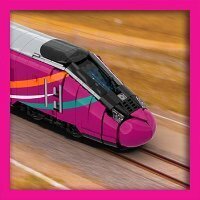
Ferro-Friki Posted November 9, 2025 Posted November 9, 2025 Hello everyone! I have another MOC I’d like to share here, the 251-004. After the success of the S-269 (“La Japonesa”) in Spain, RENFE ordered Mitsubishi an advanced, more powerful version of the engine. Which turned out to be the S-251. As such, both locomotives share a lot of similarities, most noticeably, an almost identical bogie design. Although as you can probably tell, the S-251 has 3 bogies instead of the S-269’s 2. This earned the S-251 the nickname “Japonesa y media” (Japanese and a half). You might even notice the similarities with JNR’s Class EF66 locomotives, very closely related to the Series 251. (Photo by Javier López Ortega on Flickr) Despite being very capable of providing passenger services, the S-251’s power was better suited for pulling freight. Since the beginning of their work life, they were employed in the treacherous mountain pass of Pajares, between Asturias and León. Unfortunately, since the opening of the new Pajares tunnel, the reign of the S-251 in the mountain pass is not what it used to be anymore. They can still be seen running around the region, as well as pulling containers and other cargo between Barcelona and Zaragoza. In an effort to homogenize the corporate image, since the late 80s, RENFE applied a new livery to all of its locomotives. With yellow cabs and grey bodies, the age of the taxi livery begun. It lasted until 2005, when RENFE was split into two public entities, ADIF, for infrastructure operation, and Renfe Operadora, for train operation. Accordingly, a new locomotive livery followed. Very similar to the taxi one but replacing the yellow for white (borrowed from the AVE) with a magenta stripe, the new company colors. With the recent introduction of the S-256 (Stadler Euro 6000) into its fleet, Renfe revealed a completely new livery out of nowhere. Bravely embracing the striking magenta color with broad diagonal white stripes, I really thought all locomotives would adopt this scheme. Years later, all engines apart from the 256s have kept the boring old 2005 livery, and it doesn’t seem like that will change anytime soon. Maybe one day... I really think it suits the S-251. The 251-004 is the only engine of its kind to preserve the original blue and yellow livery. This is due to a successful effort by the Railway Friends Associations of Gijón and Madrid, and Renfe employees. This earned her the title of “La Reina” (The Queen). My MOC of the 251-004 has 12 M size wheels and a 9V style magnet from HA Bricks. It is designed to be powered by two PF L motors and a BuWizz battery box. It’s a bit cramped on the inside, so it can’t fit LEGO battery boxes since they’d be too tall. The challenge with this engine was creating a functional middle bogie. Not only does it need to pivot, but also slide side to side. After many overengineered failed attempts, a very simple combination of two 1 x 4 bricks with channel and an upside-down 2 x 2 tile with technic pin connected to two 1 x 2 plates with door rails did the trick. This also allows the middle bogie (unpowered) to move slightly up and down, which ensures that the other two bogies will always be on the rails when running on uneven track. Unfortunately, the locomotive can’t navigate R40 curves, and it’s restricted to R56 or higher. Some of the part choices and techniques I’m particularly proud of in this MOC are the windshield assemblies, a technique similar to many amazing diesel-electric locomotive MOCs I’ve seen out there, the blue sword spikes at the fronts, the boomerangs as the number plate nose fixture, the blue claw pieces as the windshield visors, or the SNOT side grills, which although not too complex, took a few attempts to get right. It also has some silver TrimLine tape to recreate the iconic steel “whiskers” and custom stickers. Quote
Sven J Posted November 9, 2025 Posted November 9, 2025 Well, the original is rather ugly in my opinion, but your model is simply breathtaking! Awesome attention to detail and crazy building techniques make this a gorgeous piece of LEGO art! Quote
Ferro-Friki Posted November 9, 2025 Author Posted November 9, 2025 1 hour ago, Sven J said: Awesome attention to detail and crazy building techniques make this a gorgeous piece of LEGO art! Thank you! I don’t think anyone has called one of my trains a piece of art before :) 1 hour ago, Sven J said: Well, the original is rather ugly in my opinion Be careful! If other Spanish train nerds heard you they might come after you! Quote
Sven J Posted November 9, 2025 Posted November 9, 2025 47 minutes ago, Ferro-Friki said: Be careful! If other Spanish train nerds heard you they might come after you! Don't worry - there are many widely celebrated German locomotives which I find rather ugly, too (BR24, V200, BR10, 18 314, ICE3...) P.S.: May I borrow your idea of the sausage/minifig-hand combo for the compressed-air hoses? Quote
Ferro-Friki Posted November 9, 2025 Author Posted November 9, 2025 1 hour ago, Sven J said: BR24, V200, BR10, 18 314 Hey, these all look pretty good. I understand you don't like round streamlined trains? Now that you mention it, I don't really like the ICE3 that much either. It’s objectively one of the best AVE trains we have here, but it’s just not interesting to me. 1 hour ago, Sven J said: P.S.: May I borrow your idea of the sausage/minifig-hand combo for the compressed-air hoses? Of course, you and anyone. It’s not patented or anything Quote
Sven J Posted November 9, 2025 Posted November 9, 2025 9 minutes ago, Ferro-Friki said: I understand you don't like round streamlined trains? I can't really explain. 18 201 looks really good, 18 314 is ugly... maybe it's more a matter of proportions than of basic forms. And I don't like unneccessary ornaments (V200 with its two-tone paint scheme and that ridiculous chromed "V" at the front) and "cluttered" looks with lots of visible pipes and tubes and angles and edges - that's why I love Swedish steam locomotives with their clean, elegant design. Back to topic, I suppose... 14 minutes ago, Ferro-Friki said: Of course, you and anyone. It’s not patented or anything Thanks! No matter if it's formally "patented", I just consider it to be a question of good manners. When someone else has a good idea, I won't copy it without asking. Quote
LL1982 Posted November 12, 2025 Posted November 12, 2025 Wow impressive locomotive. Very peculiar styling in its design which you found a good solution to. Also love how you handled that middle boogie. Simple and perfectly functioning but you need to come up with it first. Quote
zephyr1934 Posted November 12, 2025 Posted November 12, 2025 Those angles on the cab simply not feasible. Congratulations on breaking the laws of physics with this amazing build Quote
Toastie Posted November 12, 2025 Posted November 12, 2025 Well. Nothing to add, other than that breaking the laws of physics (I completely agree on) don't cause a frontpage presentation of what can be achieved when it is done. Some get the Nobel Prize in Physics for doing so. It appears as if the bars on EB are even higher. Thank you very much for sharing @Ferro-Friki!!! I am a bit late, but this is not only a phantastic representation, I'd say replication of the authentic machine, it is a technically brilliant approach as well! All the best Thorsten Quote
Ferro-Friki Posted November 13, 2025 Author Posted November 13, 2025 Thanks guys! :) On 11/12/2025 at 1:09 PM, LL1982 said: Simple and perfectly functioning I did try some more complicated designs, but they didn't work as well. In the end, the more simple and straight-forward, the better. 1 x 6 bricks with channels would work better, but I don't think they'll be coming up with that piece anytime soon. 15 hours ago, zephyr1934 said: Congratulations on breaking the laws of physics with this amazing build 15 hours ago, Toastie said: (I completely agree on) Don't worry, no atoms were split in the making of this train, just some transparent bars and ribbed hoses 15 hours ago, Toastie said: I'd say replication of the authentic machine I tried to do her justice, this is a very beloved engine in Spain Quote
idlemarvel Posted November 14, 2025 Posted November 14, 2025 Your attention to detail is inspirational. Many people (me among them) would have been happy with an approximation and been very pleased with it, but you take it to the next level. I can't image how many hours you spend on Studio. Some of the details I really like are the slight bulge along the bottom of the body in the middle, to accommodate the middle bogies. And the detailing of the bogies. And the staggered headlights. And, and, and... Just disappointed you couldn't make it run on R40 curves (not really!). Thank you for sharing and taking time to provide details of the prototype - educational as well! Quote
Ferro-Friki Posted November 16, 2025 Author Posted November 16, 2025 (edited) On 11/14/2025 at 12:09 PM, idlemarvel said: Your attention to detail is inspirational On 11/15/2025 at 12:41 AM, Shiva said: Nice locomotive :) Thanks! On 11/14/2025 at 12:09 PM, idlemarvel said: I can't image how many hours you spend on Studio I'd rather not think about that... On 11/14/2025 at 12:09 PM, idlemarvel said: Just disappointed you couldn't make it run on R40 curves (not really!) I’m still hang up on that actually. This is how far the current middle bogie pivot would have to slide out in order to navigate R40 curves. If I could reduce the same blue fold on the bottom that you mentioned to just 1 tile thick, and the sliding pivot to be 1 stud wide somehow, it could work. I’ve been thinking that R56 curves are a bit pointless. If a model can’t run on R40 and you have to buy larger radii, you might as well get the R104+ curves, which look far better, allow for more straight-forward couplers, and higher speeds. R56 has none of that, nor the universality of R40. Right now I want to make other trains, but I might look into making the S-251 R40 compatible in the future. BONUS: here's La Reina in motion :) I wish the video had better quality, but this is the best my potato phone could do :/ Quote It’s a bit cramped on the inside, so it can’t fit LEGO battery boxes since they’d be too tall. Turns out that this engine can be motorized with a PU city hub and just one PU L motor (there’s no way for a second motor’s cable to reach the hub port), unlike what I first thought. Still, my intended 2 PF L motors and Buwizz 2.0 setup would be far better. And yes, I’m a big fan of Holger Matthes’ brick-built large radius curve design. Edited November 16, 2025 by Ferro-Friki Pointing out alternative motorization options, which I forgot Quote
L-Gauger Posted November 18, 2025 Posted November 18, 2025 On 11/16/2025 at 8:10 AM, Ferro-Friki said: I’ve been thinking that R56 curves are a bit pointless. If a model can’t run on R40 and you have to buy larger radii, you might as well get the R104+ curves, which look far better, allow for more straight-forward couplers, and higher speeds. R56 has none of that, nor the universality of R40. Yeah, I think the primary purpose of R56 is for double-track R40 mainlines... aside from that, R104 or larger tends to make better sense. On 11/16/2025 at 8:10 AM, Ferro-Friki said: And yes, I’m a big fan of Holger Matthes’ brick-built large radius curve design. Do you know if Holger's design produces a polygon with an exact on-the-stud radius? I know the technique makes a 4-degree angle between track sections, which uses exactly 90 sections per full circle, but I don't know the radius for sure. Quote
LEGO Train 12 Volts Posted November 21, 2025 Posted November 21, 2025 This wonder was flying under my radar! Stunning and meticulous reproduction of the real model (I don't understand how the cockpit glasses and the front can be held together ). Nice mechanism for the free-sliding center bogie. Quote
Hod Carrier Posted November 29, 2025 Posted November 29, 2025 Firstly, huge admiration for crafting a wonderful loco so full of detail and so faithful to the original. On 11/16/2025 at 2:10 PM, Ferro-Friki said: This is how far the current middle bogie pivot would have to slide out in order to navigate R40 curves. If I could reduce the same blue fold on the bottom that you mentioned to just 1 tile thick, and the sliding pivot to be 1 stud wide somehow, it could work. I’ve been thinking that R56 curves are a bit pointless. If a model can’t run on R40 and you have to buy larger radii, you might as well get the R104+ curves, which look far better, allow for more straight-forward couplers, and higher speeds. R56 has none of that, nor the universality of R40. Right now I want to make other trains, but I might look into making the S-251 R40 compatible in the future. Loving your commitment to the curvature. I have given some thought to the B-B-B arrangement in the past and how it might be made to work with the track geometry we are given, and I came up to the inescapable conclusion that it wouldn't be enough just to articulate the middle bogie. You'd have to articulate all three. The problem with this is that you would need some kind of internal linkage to ensure that the loco stays straight, and that might mean space inside the loco body becomes a premium. Given that you have already designed and built your wonderful engine, this would unavoidably mean a wholesale re-engineering. There is a concept in my head that needs to be refined and tested, but I don't have much time at present to work on it. However, if you'd like, I can see what I can come up with which might help in your quest to run Her Majesty wherever you wish. Quote
Ts__ Posted November 29, 2025 Posted November 29, 2025 This implementation looks fantastic, really well built! 4 hours ago, Hod Carrier said: how it might be made to work with the track geometry we are given, and I came up to the inescapable conclusion that it wouldn't be enough just to articulate the middle bogie. I also built a B-B-B locomotive, and the outer bogies are only rotatable, while the middle one is rotatable and side-shiftable. So far, I haven't noticed any problems with it at various exhibitions. However, we only run on R104 or larger tracks. 4 hours ago, Hod Carrier said: There is a concept in my head that needs to be refined and tested, but I don't have much time at present to work on it. However, if you'd like, I can see what I can come up with which might help in your quest to run Her Majesty wherever you wish. I'm still curious to see what you come up with. Your ideas were already the basis for one of my MOCs ;-) (with credit...) Thomas Quote
Ferro-Friki Posted November 30, 2025 Author Posted November 30, 2025 On 11/18/2025 at 11:44 PM, L-Gauger said: Yeah, I think the primary purpose of R56 is for double-track R40 mainlines True, it’s probably its best application. On 11/18/2025 at 11:44 PM, L-Gauger said: Do you know if Holger's design produces a polygon with an exact on-the-stud radius? I know the technique makes a 4-degree angle between track sections, which uses exactly 90 sections per full circle, but I don't know the radius for sure. I suppose at least the four opposite straight sections, possibly more. It’s not something I’ve thought about. According to Holger Matthes' page and the Railbricks magazine it takes 92 straight track pieces to make a full circle. Although in my experience, the curve is very flexible, so you can make it smaller or larger. On 11/21/2025 at 7:05 PM, LEGO Train 12 Volts said: Stunning and meticulous reproduction of the real model 21 hours ago, Hod Carrier said: Firstly, huge admiration for crafting a wonderful loco so full of detail and so faithful to the original. 16 hours ago, Ts__ said: This implementation looks fantastic, really well built! Thanks! :) 21 hours ago, Hod Carrier said: You'd have to articulate all three. You mean the side bogies would also need to slide side to side? 21 hours ago, Hod Carrier said: that might mean space inside the loco body becomes a premium. My S-251 has 2 studs thick walls for the SNOT grills, so it has even less space inside :/ 21 hours ago, Hod Carrier said: However, if you'd like, I can see what I can come up with which might help in your quest to run Her Majesty wherever you wish. When you put it like that how could I possibly refuse? hahaha What do you have in mind? I'm interested. 16 hours ago, Ts__ said: I also built a B-B-B locomotive, and the outer bogies are only rotatable, while the middle one is rotatable and side-shiftable. So far, I haven't noticed any problems with it at various exhibitions. However, we only run on R104 or larger tracks. Cool! What prototype is it based on? Were you able to motorize the middle bogie? Quote
zephyr1934 Posted November 30, 2025 Posted November 30, 2025 On 11/29/2025 at 9:03 AM, Hod Carrier said: I have given some thought to the B-B-B arrangement in the past and how it might be made to work with the track geometry we are given, and I came up to the inescapable conclusion that it wouldn't be enough just to articulate the middle bogie. You'd have to articulate all three. The problem with this is that you would need some kind of internal linkage to ensure that the loco stays straight, and that might mean space inside the loco body becomes a premium. Given that you have already designed and built your wonderful engine, this would unavoidably mean a wholesale re-engineering. I built a B-D-B wheel arrangement (aka 4-8-4) with a slightly different take. The middle wheel set is actually a trailer that is pulled by the front truck. It is designed to run on R40 curves AND accommodate unlevel track. My club's tables were horribly warped from people standing on them while assembling sky scrapers that with three points of contact on the rails that a normal steam engine could easily bottom out or lift the front truck off the track. So the "trailer" with the driver wheels has about a brick worth of play to bounce up and down. Actually, it worked so well that I eventually made four different variants of the build. The first picture shows one of the engines in a curve, the locomotive is 8 wide and the 6 wide train wheels have swung at least three studs away from center. This next photo shows the cosmetically updated trailer While here you can see how the front truck (aka 9v motor) connects to the boiler through the front of the trailer. The contact point in the rear is a spring to keep pressure on the wheels while allowing the wheel set to move up, down and sideways. I used one of these old springs plus curve slopes for the contact point at the rear of the trailer Quote
Ts__ Posted December 1, 2025 Posted December 1, 2025 On 11/30/2025 at 12:26 PM, Ferro-Friki said: Cool! What prototype is it based on? Were you able to motorize the middle bogie? My locomotive is rather simple in design compared to yours and not nearly as eye-catching ;-) SBB Re 6/6: I installed a Lego PU train motor in each of the three bogies. Thomas Quote
Ferro-Friki Posted December 3, 2025 Author Posted December 3, 2025 On 12/1/2025 at 12:46 AM, zephyr1934 said: The middle wheel set is actually a trailer that is pulled by the front truck. That’s really good outside the box thinking. I hadn’t thought of tackling the middle bogie from the other two. I’ll take note. On 12/1/2025 at 12:46 AM, zephyr1934 said: The contact point in the rear is a spring to keep pressure on the wheels while allowing the wheel set to move up, down and sideways. Was the weight of the driver wheels assembly not enough to keep it always on the rails? How well do the engines run in reverse? On 12/1/2025 at 5:20 PM, Ts__ said: That’s a very nice looking locomotive! I used to think that B’B’B’ engines were far less common in Europe than they actually are. On 12/1/2025 at 5:20 PM, Ts__ said: I installed a Lego PU train motor in each of the three bogies. I imagine it’s powered with a third-party battery box, right? Since a PU train hub only has two ports. Quote
Ts__ Posted December 3, 2025 Posted December 3, 2025 5 hours ago, Ferro-Friki said: I imagine it’s powered with a third-party battery box, right? Since a PU train hub only has two ports. no. I use for every PU Train Motor a own PU City Hub in the locomotive ;-) More power and easy control. You can pair up to 5 PU City Hubs with a Lego PU remote control. With a PU train motor connected to each of these hubs, you can then control 5 PU train motors at the touch of a button. No app/programming required ;-) I used this feature with my SBB Re 10/10: a SBB Re 4/4 II and a SBB Re 6/6 working together: 5 PU Hubs, 5 PU Train motors, 1 PU Remote. Only Lego parts, no special electronics.... But this is your thread about your fantastic locomotive, I don't want to hijack the thread ;-) Thomas Quote
zephyr1934 Posted December 4, 2025 Posted December 4, 2025 19 hours ago, Ferro-Friki said: Was the weight of the driver wheels assembly not enough to keep it always on the rails? How well do the engines run in reverse? The trailer contained the drivers for the steam locomotive. So it had side rods, connecting rods and the cylinder mechanism. The trailer was light enough that it would sometimes drag rather than turn. So it needed a little extra pressure to ensure the wheels always turned. If you were just building a modern locomotive truck (which is what you are doing) then you wouldn't need the down pressure, but I think it does help keep the middle wheels from jumping the track on uneven surfaces. Equally important (at least for me and my club's wobbly tables) was to include space above the trailer to ensure that if the middle truck goes over a bump that it would not derail the whole locomotive. But getting back to your question, as steam locomotives they run one direction almost all the time. So I did not have extensive experience running backwards. But they do back into sidings etc and I don't recall any problems there. There are lots of ways you could lock the trailer in place, including potentially doing so from both the front and rear. Quote
Hod Carrier Posted December 4, 2025 Posted December 4, 2025 As we say in the UK, there's always more than one way to skin a cat and, as someone whose garden has become some form of communal feline latrine, I'm always keen to uncover new ideas and ways to tackle a problem. ...but that's just me. @Ferro-Friki: I must congratulate you on your chassis design. Her Ladyship is a bit of a whopper and the bogies are quite far apart, but when I looked at the photos you'd posted I estimated that, with the amount of lateral movement you had given to the middle bogie, the outer bogies were likely to need only around half a stud of movement to be able to fit around an R40 curve. So I built a basic chassis using the same dimensions and layout to test the theory, and so it proved (just)!! It's a wee bit tight, but there is just enough movement to get her to sit nicely on an R40. As to the articulation, I'd had a very simple idea based on visualising what would happen with three bogies linked together with bars travelling around a layout. I'll admit that I wasn't hugely confident that such a simple idea would work, but I added a set of levers and pivots to the chassis and away she went. I set up some curves, straights and points/switches and hand-pushed the chassis around it, and it seems to work fine. The problem was always going to be how to centre the loco again after coming out of a bend onto a straight, but the levers take care of it admirably. This configuration should work fine for your model, although the position of the pivots can be moved to change how much each bogie will move relative to the others to suit other models. I'm unsure how you might want to incorporate this into your design, or even if it would be suitable. I know how little space you have inside the loco body, but it might still be possible. Quote
zephyr1934 Posted December 5, 2025 Posted December 5, 2025 21 hours ago, Hod Carrier said: As to the articulation, I'd had a very simple idea based on visualising what would happen with three bogies linked together with bars travelling around a layout. I'll admit that I wasn't hugely confident that such a simple idea would work, but I added a set of levers and pivots to the chassis and away she went. That's insane what you've just done. If you are not a mechanical engineer you should seriously consider becoming one. Quote

Recommended Posts
Join the conversation
You can post now and register later. If you have an account, sign in now to post with your account.