
Search the Community
Showing results for tags 'ce 6/8 ii'.
Found 1 result
-
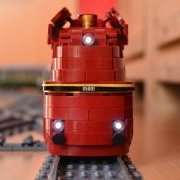 Hello together Who does not know it? The Swiss Crocodile. An icon for a long time and has been on my "want to have" list for quite some time. Then Lego made us happy last year with the set 10277 Crocodile. That was the starting signal for the realization of my dream crocodile. The Lego version has strengths and weaknesses. But it has made the locomotive better known in Lego circles and generally the praise for the set prevails. I also praise it, but the weaknesses had to be eliminated. Main criticisms from me were the wrong running gear and the huge gap between the stems. But I didn't want to hide only the weaknesses and so it became a complete redesign. A few ideas from the Lego Crocodile have certainly survived, also there are general similarities. It would be funny if there weren't, because then Lego or I would have done something completely wrong. SBB Ce 6/8 II "14253": This locomotive is the oldest surviving crocodile of the class. The "14253" was built in 1919 by the Schweizerische Lokomotiv- und Maschinenfabrik (SLM, mechanical part) and the Maschinenfabrik Oerlikon (MFO, electrical part). Thought and used the locomotive for freight train traffic among others on the Gotthard railroad (1920 - 1924, 1943 - 1976). Technical data: Length over buffers: 19.4 m Service weight: 126 t Friction weight: 103 t Driving wheel diameter: 1350 mm Power: 2688 kW / 3650 hp (rebuild Be 6/8 II) Speed: 65 km/h In 1943 it was rebuilt to Be 6/8 II "13253". The rebuild included more powerful engines, so that the top speed was increased to 75 km/h. This was followed by the change to the new engine. This was also followed by the change to the dark green paint scheme. After the rebuild, the locomotive was again stationed and in service at Erstfeld on the Gotthard. In 1976, the locomotive was handed over to SBB Historic for maintenance. It was refurbished as a ready-to-run museum locomotive "14253" and the original red-brown paint scheme was restored. The locomotive was also reclassified as a Ce 6/8 II, although the more powerful engines of the Be 6/8 II remained installed. To this day, the locomotive is in service and on display at Erstfeld as a museum locomotive ready to run. Main goals of my version: - correct running gear - all wheels equipped with flanges, because the "flying" flangeless wheels usually look unattractive. Consequence was, that the middle axle has to be mounted laterally shiftable (like in the prototype). - functioning linkage with counterweight - working lighting with correct light in both directions - usable power to be able to pull a nice train sometimes - prototypical details as far as possible and reasonable - prototypical lettering - a driver (ok, only 1/4 driver, there was only space for head and hair...) I invested a lot of time in the prototypical linkage. I couldn't realize my idea with Lego parts, nor with ready-made 3D parts off the shelf, so I designed a rather complex part for the triangular rod and a simpler one for the counterweight: I was able to find a small space for Urs: Lego version: - approx. 1830 Lego parts - 4 BigBenWheels S for the leading axle, because the wheels are free to see, I decided against the Lego train wheels for optical reasons - 8 3D-printed parts for the rods - 1x BuWizz 2.0 as battery and controller - Lighting brand "Self-Made" with PF connector - sticker brand "Self-Made" no other foreign parts and no machined or glued Lego parts. weight: ca 1050 gram length: approx 48 cm width from the model: 8 knobs with slight protrusions from individual details To switch on the transformer can be removed upwards and so you can get to the BuWizz. The BuWizz is charged in the same way. This is also an advantage of the BuWizz. SBB Ce 6/8 II "14253" in service with contemporary freight cars: All wagons have a concrete prototype with formerly existing numbers SBB J2D 22179: Vegetable and fruit wagon J2D with ventilation, color scheme 1950-1965. SBB K3 43105: Standard freight wagon of the SBB, color scheme period ca. 1913 - 1935 SBB J2D 22715 Express freight wagon of the SBB, period ca. 1912 - 1935 SBB K3 44738: modernized standard freight wagon K3 of the SBB, color scheme period ca. 1958 - 1968 this wagon has got the tail light attached The freight wagons are mostly identical, but always differ in details and in the color scheme. Differences are e.g. sometimes with brakeman's cab, sometimes without, number of windows on the brakeman's cab. In the case of the refrigerator car, there is also the ventilation. Each car weighs about 510-520 grams and requires just over 1100 Lego parts. The high number of parts comes from the elaborate sidewall structure with jumper plates (almost 200 per car) and the higher roof. To keep the rolling resistance low, I equipped the Lego metal axles with ball bearings again (analogous to the rest of my car fleet). SBB Ce 6/8 II "14253" in its current state as a museum train: SBB C4 5301: 3rd class coaches with 72 seats of the SBB, built in 1937 SBB AB4 3721: Built in 1951, 1st/2nd class coaches, 24 seats in 1st class, 32 seats in 2nd class. This car is equipped with the final signal and therefore runs at the end of the train. Details were hinted at on the underbody: detailed bogies were of course a "must" again: both cars have an interior with seats (most of them also suitable for figures) and toilets in the ends of the coaches. The middle roof part is removable for playing: Car crossover: The passenger coaches consist of about 1550 Lego parts each. The decals are again self-made and all metal axles were equipped with ball bearings. The weight of one of this coaches is almost 1Kg, the length 66 studs. I think the passenger coaches also cut a good figure behind the crocodile: Special thanks to Ronny. The freight cars are based on a design by Ronny, but built from scratch with many changes. For some details for the locomotive there was also good advice from Ronny. As bonus: Have fun watching. Thomas