

Ralph_S
-
Posts
1,418 -
Joined
-
Last visited
Content Type
Profiles
Forums
Gallery
Everything posted by Ralph_S
-
Thanks. These are great fun to build. You can expect to see a few more in the next few months. Zeros could carry bombs, but the thing under the plane's belly is an external fuel tank. It was a fairly common fit. Cheers, Ralph
-
Thanks guys. I always build fairly quickly, but I usually spend a fair bit of time researching what I want to build. I pretty much built this one on a whim. From start to finish, this aircraft took far less time than most things I've done recently. I started leafing through books to find a new plane to build on Friday after completing my M113. I decided on a Zero on Sunday and started collecting more pictures. I started putting bricks together on Monday. I finished it Tuesday evening. There are two things that made it possible build quickly. The things that I normally find difficult and that cost a fair bit of time to work out on minifig scale fighters are the cockpit and the undercarriage. When looking at Zeros I realised that even though it has a bubble canopy, only the central section slides aft when it opens. That meant I could basically copy the canopy from the Corsair. It also has a fairly straightforward undercarriage. What ended up taking most of the time was the SNOT work and the half-stud offsets on that tail boom. Cheers, Ralph
-
Thank you. I too like that policeman. He's still standing next to the car on one of the shelves where I store my LEGO models. I probably would have worked some more plates into the camouflage scheme if I'd had some. Unfortunately dark green plates seem to be rare. I've mainly got 1x6 plates in that colour and they are too long to be useful for something like this in most cases. I have use some of them on the top. Cheers, Ralph
-
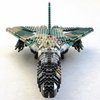
Back again with another military MOC! After building an American Avenger torpedo bomber and a Vought Corsair for my friend Lego Monster's Intrepid project, I now turned my attention to building something used by the Americans' adversaries. It just wouldn't be complete without a Japanese fighter ready to plunge onto its deck. So, here it is, my rendition of the famous Mitsubishi A6M 'Zero-sen' fighter. The model has an opening canopy, with room for a minifig inside, and a retractable undercarriage. Early models of the A6M had curved wing tips that could fold up for storage aboard aircraft carriers. On the A6M3 Type 32 these were deleted and the wings ended up with a squared-off look. It wasn't a success. The smaller wing area lowered the climb rate and increased the stall speed. Still, I was happy to avoid the complexity of folding wing tips and the relative scarcity of 3x3 plates with a round corner in light blueish grey, so it is the version I chose. The leading edges of the wing should be slightly swept back. However, the angle is so small, making the edges straight seemed acceptable. Most LEGO models of Zero fighters that I am aware of are either white or green. I considered green for mine, but regular LEGO green is far too bright and LEGO dark green is too rare. Many Zeros were painted in a very pale grey in real life, and using white makes some sense, but somehow the result tends to look too bland in my opinion. I am also running low on white plates, so I chose grey instead. It also gave me the option of having a nicely contrasting white band around the fuselage and a white outline for the rising sun symbol. The fuselage band is largely brick built with only a tiny part (just about visible in this picture) being made with tape. The Rising Sun symbol was also made with tape. I made two separate circles by sticking the tape to a Pound coin for the white and cutting around that, and doing the same using a Penny for the red. Cheers, Ralph
-
Definitely a big improvement. Version 21 is a nice rendition of a Sherman, although there is some room for improvement. It could do with a few more details. The commander's machine gun for instance. The jumper pate you've got sitting on the turret suggests that this is something you plan to add later. I'd like it better if it were one colour rather than a somewhat random mix. I also think you might want to fiddle around with the suspension. Many modern tanks have torsion bar suspension, whereas the Sherman had vertical volute spring suspension. It looks really different -in part because adjacent pairs of wheels are interconnected. It might be worthwhile to tinker with that a bit more and to perhaps look on flickr or brickshelf to see what other builders have done. The Sherman is a famous tank and there already are quite a few LEGO versions out there. All in all, nice tank. Kudos to you for sticking with it. If I'd have to keep rebuilding a MOC for two weeks in a row I'd have thrown it into a corner after a few days. Cheers, Ralph
-
Thanks. I know brick-built figures aren't to everyone's liking, but I'd rather have brick-built figures than no figures whatsoever. I agree that the white and orange looks a bit funny, but the colours are based on those used in the engine bay of the real vehicle. I had difficulty finding decent pictures of the engine bay of the M113A3 model (the details differ from one version of the vehicle to the next) but the few pictures that I do have (showing the engine seen through the front inspection hatch) show an orange hose/tube and a white box. Check out these. Cheers, Ralph
-
Thanks for all the comments guys. Thanks for your very fair comments. The turret (and the figure inside it) can turn a full 360 degrees. I'm not even sure it can do that on the real vehicle The colour scheme on this was problematic. At first I wanted to build a Bradley fighting vehicle, but I soon realised that I wouldn't have enough parts to build it in these colours; black, dark green and (old) brown. Small plates and tiles were a problem, in particular in dark green. I decided I had to go for something a bit smaller and an M113 seemed the way forward. It's also a fairly slab-sided little box that I felt might actually look decent in camouflage rather than in overall tan (which is the other colour that US Army versions come in). The latter seemed a but dull to em and I'd rather use the parts I have in that colour for a Bradley sometime in the future. I realise that the vehicle in some respects it might look a bit messy, but in real life (as opposed to in a picture) it looks decent. I normally don't bother to cover up studs and covering them up now wasn't really an option either in this colour scheme. Cheers, Ralph
-
Thanks to bricklink (and some other connections I have), I tend to be able to get sufficient quantities of most old parts I might be interested in. However, some old parts never appeared on some useful colours and since they are no longer in production, there doesn't seem to be much chance of them ever appearing, in particular if they've been replaced by alternative parts. That obviously applies to old style finger hinges. As an aircraft builder, I'm very happy with the wide variety of wedge plates LEGO make nowadays, but I also miss some old-style wing plates. wing 4x8 left and it's mirrored counterpart. I could really do with some of those in tan, for instance. Similarly wing 4x4 left and it's counterpart. The newer replacement doesn't have a cut-out in the corner, which means it's no longer possible to combine multiple to a nice straight line at 45 degrees. I'd love to have some in reddish brown, tan, sand blue or light bley. Cheers, Ralph
-
Eurobricks may be mainly town and pirate oriented, but that doesn't stop me from posting my military stuff here. Last week I've spent many enjoyable hours building a new military model. The M113 first entered service in the 'sixties. Over the years many different versions were produced for different roles. The final production version for the US Army was the M113A3 APC, which entered service in the 'eighties. Even though many M113s have been replaced in service by M2/M3 Bradley Fighting Vehicles, M113s are still in fairly widespread use in supporting units and heavy brigade combat teams. The M113 represented by my model has a few fairly common modifications made to M113s in service. On many M113s the side skirts have been removed, something that made construction of my model a lot easier. Because the vehicle commander's position is fairly exposed on top, many M113s have been fitted with a gun shield and added armour -modifications that were first made to the so-called ACAV version of the M113 used in the Vietnam War. A final modification is the addition of IR identification panels on both sides of the vehicle, common to vehicles serving in Iraq. The troop compartment in the M113 offers (very cramped) accommodation for 11 troops. It can be accessed through a large hydraulically controlled ramp, a hatch in the roof and a smaller door in the ramp. On my model, all of them can be opened. The M113A3 is powered by a six-cylinder Diesel engine mounted in the front next to the driver. It is accessible through an inspection hatch in the front (normally hidden by the vehicle's trim vane) or by opening a larger hatch. full photoset on flickr M113s might be little boxes on treads, but I had a lot of fun building this, especially adding all the working features. I hope you'll like it too. Cheers, Ralph
-
I completely agree that the large signatures are annoying. I've had my options set to not show signatures for months now and I haven't missed them for a second. I didn't realise quite how bad things had become in the meantime until I read a few things on Eurobricks without being logged in a few days ago (I wasn't on my own computer) and found I had a hard time finding the actual content of the messages between all the pictures, coloured text and things blinking at me. Cheers, Ralph
-
Nice little fighter. It will be fun to see a few more of them. Cheers, Ralph
-
As I wrote before on flickr, nice model. The ones currently in use are either tan or a camouflage scheme of olive green, flat black and brown. The latter in particular will be hard to pull off in LEGO. Cheers, Ralph
-
Indeed. The Jeep is nice and I like the bumper-mounted winch, but the gun stands out. Cheers, Ralph
-
Thank you. Until not too long ago I was far more into building contemporary jets, but these old clunkers are a lot of fun too. Thank you. The dark blue is actually not too bad. It's obviously more expensive than, say, regular blue, but I got a pretty stagering number of dark blue plates from the VW Beetle set. Wedge plates are available in fairly large numbers because of the Agents sets. Still, this project will probably dominate my spending on LEGO this year. Thank you. if I do make instructions, I probably will make them available. It seems like a shame about all the work otherwise. Cheers, Ralph
-
Thanks for your reply. I have to admit that it is slightly on the large side of minifig scale, with a scale of 1/40, but people were shorter in 1945 The cockpit canopy can be closed with the pilot inside. Obviously the use of trans clear plates means that he's not particularly visible once inside, but you can just about see the little guy sitting inside the cockpit in this picture . I also made two pictures showing the aircraft's lines a bit better (the pilot wasn't in the cockpit for these) I rarely keep track of how much anything I build takes in parts, but it's probably around 600 (a very rough guess). Since we want to make several of these for the aircraft carrier, I may be making instructions and I will certainly be making an inventory sometime in the next few months, so I should be able to tell you how many parts it uses then. Cheers, Ralph
-
Thanks for the review. I don't remember this set, but that's probably because it came out at a time when I wasn't buying LEGO. Lego had and still has a policy against contemporary military sets, and I think it shows from this set. Obviously the colour scheme makes it look like something flown at air shows, which is fine, but to me the jet looks awkward. It doesn't look like any real jet I can think of. It's clear they can do something that looks more like a proper jet if they want to (as shown by the newer set 4953 fast flyers ), so I'm guessing that this was probably somewhat deliberate. Nice parts pack though. Cheers, Ralph
-
Thank you. I am glad you like them. For a while, as a teenager, I built plastic model kits of aircraft. However, I wasn't particularly good at painting and turned to building them out of LEGO instead. In a sense I feel I am building proper models of the aircraft I built back then. Cheers, Ralph
-
That explains it. There's no need for you to take a picture as far as I am concerned. Cheers, Ralph
-
Very nice. I do have a question: with both axles hinged in the centre, what keeps the Bronco from tipping over? Cheers, Ralph
-
Thank you. I remember seeing that show when it was shown on German television when I was a child. It was far from authentic, but the planes were real Cheers, Ralph
-

[MOC WIP] SportsUtilityVehicle
Ralph_S replied to Perterz's topic in LEGO Technic, Mindstorms, Model Team and Scale Modeling
There are a few threads already Eurobricks about how to go about making a Power Functions RC chassis. Searching the boards for power functions steering or something similar ought to provide a few discussions. I don't think you ought to be too concerned with whether or not you can give your vehicle AWD. Whether you'll have the room for a lot of working functions inside is doubtful and just getting a working vehicle might be hard enough. I know it took me a lot of tinkering to get the two PF RC vehicles I've built so far to work. You'll need an IR reciever, IR remote, a battery box and at least two motors. I got all I needed from a monster Dino. Opinions differ a bit on what's the way forward. Power functions elements are fairly chunky, so it might indeed not be advisable to try to modify an existing chassis. Starting from scratch integrating the parts is probably the way forward. The biggest issue IMO is the steering. I prefer to have self centring steering which can be achieved using some sort of spring. It gives the best control for a reasonably fast-moving vehicle, although several people have mentioned that it can lead to the motor used for the steering overheating. It's not a problem I've experienced. Dutch builder Mahjqa has recently built a basic PF RC chassis that might be useful. He's a far more experienced technic builder than I am anyway, so he may have some more useful tips. Cheers, Ralph -
Why do people buy new sets and never open them?
Ralph_S replied to Ambo100's topic in General LEGO Discussion
I'm not much of a collector (I collect MOCs, I suppose), so I'm not really talking from personal experience here, but I think so. Cheers, Ralph -
Why do people buy new sets and never open them?
Ralph_S replied to Ambo100's topic in General LEGO Discussion
I've read a lot of reasons in this thread so far, but I think I am missing one. I do know a few people who have large collections of MISB sets, not because they never got around to opening them, don't have space to build the models or because they hope to one day sell them at a massive profit, but quite simply because they enjoy going to their attics (or wherever they store them) and look at them all resplendent in their rareness and shininess It's not my way of enjoying this hobby. It's a construction material and I buy sets to use the bits in my MOCs. I do have a few unopened boxes at the moment, but only because I haven't gotten around so parting them out yet. Cheers, Ralph -
Since a few months my friend Lego Monster has been working on a new ship, a minifig scale version of USS Intrepid, a WW-II Essex class aircraft carrier. He has asked me to design the aircraft for it. After completing my model of an Avenger about a month ago, I have turned my attention to another classic WW-II aircraft: a Vought F4U Corsiar fighter. The Corsair was already under development when the second world war started, but it had a fairly long gestation period. Although the aircraft was designed to fly from aircraft carriers, poor low speed handling and the view over the aircraft's long nose made the US Navy decide that the aircraft was not suitable. Most initial deliveries were to the US Marine Corps for use from land bases. Later in the war, experience with the Corsair in British Royal Navy service and the threat posed by Kamikaze made the US Navy reconsider this decision and towards the end of the war most Essex class carriers, including USS Intrepid, operated Corsairs. Many US Navy Corsairs were delivered in an all-over dark blue colour scheme. Sadly the variety of parts in that colour is very limited, so I decided to build the aircraft in the three-colour scheme that was in use from around 1943. The lower surfaces are white, the upper surfaces are dark blue and the tail and fuselage sides are largely grey. Because the wings on the aircraft fold up, their undersides are grey rather than white, as white would stand out too much against the carrier deck. One of the distinguishing features of the Corsair is its inverted 'gull wing'. One of the reasons for this unusual design is that it enabled the use of relatively short undercarriage struts, whilst making sure that the aircraft's huge propeller stayed well clear of the deck. The Corsair has a complicated undercarriage. The struts retract aft into the wing with main wheels rotating to lie flat inside the wing. I did manage to get that to work on my model, but unfortunately I couldn't find sufficient space to add the doors that cover the wheels. Since the aircraft is built to sit on top of an aircraft carrier anyway, I've decided it's a compromise I can live with. In early 1945, the Intrepid carried four different types of aircraft: the TBF/TBM Avenger, F4U Corsair, F6F Hellcat and the SB2C Helldiver. Two down, two more to go! more pictures Cheers, Ralph
-
I agree. It's a cute car, but cute and Lamborghini don't go very well together. That said, making any car look like anything in particular in four wide and making it big enough to fit a figure is pretty difficult. Cheers, Ralph