


Bruce Headley
-
Posts
3 -
Joined
-
Last visited
Content Type
Profiles
Forums
Gallery
Everything posted by Bruce Headley
-
Great work and detail! I understand why you'd want three differentials. The wheels on a real car DO NOT turn at the same speed in a turn. In a forward right turn for example, the front wheels turns faster than the rear wheels (because the wheels are travelling a greater distance), and the rear wheels track to the inside right of the front wheels (shown in green lines in image below). I see the problem with using three differentials : if one wheel loses contact with the ground, it spins at 4X the speed going nowhere. Inserting tensors between the mid to front and mid to rear differentials would help, but then the issue now becomes two wheels free (one from each axle) and the problem returns. Making all the differentials clutched, locker or limited-slip could be a cure .. at least in one direction. I wonder if there's a way to make a combination differential/tensor unit .. hmmm .. something to think about !
-
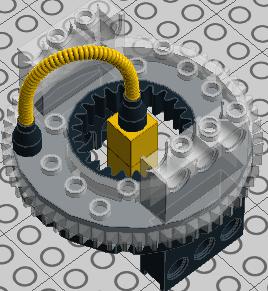
The implementation in the videos shown above will not work. The problem is that it must be a single wire or tube, it must be fixed where it enters the center of the rotating platform, must make a 180 degree bend, and attach to a fixed point on the outer edge of the rotating platform. Using multiple wires or tubes (like ribbon cable) will become twisted up! Sorry, I currently don't have the pieces needed to confirm this, but I'm pretty certain it will work. Imagine holding a piece of tubing in your hand, then swinging it around in a circle (there were some toys made from convoluted tubing that, when swung around in a circle, would make interesting sounds). Draw a black line down the length of the tubing, and notice the black mark aligns at the same place as it swings through the circle. As you swing the tube, the tube sheath rotates as it travels through a circular path - otherwise you'd need to spin your wrist! The wire or tube must be flexible enough to withstand full rotation and strong enough to do so repeatedly. If wire is used, it should be like test lead wire with a high count of very thin strands of wire. It may be possible to use a coaxial cable with a braided shield and a center conductor to pass DC power, then use an AC signal and capacitive coupling for controls.
-
I was playing around with construction of a 'radar', using Lego Mindstorms NXT bricks. It is simply a Tach Motor coupled to the Ultrasonic Sensor, that twists back and forth 180 degrees. The problem was with the supplied cables .. they are very stiff and kept getting hung up on everything and anything nearby, plus kept flopping in front of the sensors path. So, falling back on my years working in aerospace, I decided to make a rudimentary version of a 'twist capsule' to help with the problem. Basically, it's a fairly long length of flat ribbon cable (like a MindSensors 3m Flexi Cable), connectors crimped on both sides, then rolled up like a watch spring. The cable exits the center of the coil at a right angle and from the outer edge. A pancake coil. I cut out a couple of stiff cardboard discs and punched holes in the centers to act as retainers. To assemble: A long cross shaft is pressed into the Tach Motor hub, sticking upwards. One of the discs slides over the shaft. The cross shaft pokes through the center of the pancake coil, along with the center cable & connector. Enough cable needs to be pulled out to connect to the sensor. The other disc slides over the shaft. This helps with keeping the pancake coil in shape. The Ultrasonic Sensor (with a few additional brick pieces) attaches to the end of the cross shaft. The outer coil cable was loosely attached (tie wrap or bread tie) to one of the mounting holes on the Tach Motor. It worked! The pancake coil wound and unwound just like a watch spring. I also found out there was enough free 'twist' to allow for scanning in 360 degrees without any issues. Granted, this does not allow for continuous rotation, but for my purposes it works extremely well ! The other option in mind was to point the Ultrasonic Sensor (or the IR Sensor) upwards and construct a motor/reflector system, but ... Hope this idea helps !