DGI
-
Posts
8 -
Joined
-
Last visited
1 Follower

About DGI

- Birthday 01/03/1982
-
After I have read your post I thought a little about the RC models hardware adaptation to Lego. The implementation can be the following: The device has a connector for connection to a standard PF battery box (or a RC model accumulator). The device has two standard PF connectors for two motors or servomotors of Lego PF. The device has two standart RC connectors for connecting to the RC receiver (device will work with any RC receiver in standard mode). The device provides power to the RC receiver (as BEC does, so there is no need to have separate battery for the RC receiver). The device reads two channels from the RC receiver and converts them to the PWM control signal for two Lego PF motors or servomotors (device has two drivers for motors with PWM output). The device has no settings, all (invertion, limits) is adjusted in the RC transmitter. The main problem is to find where to buy PF connectors. I can use Lego extention cabels but they are expencive. I think I can design and make such a device. I think the cost will be about 60$ but it might be interesting for me if I can sale at least 20! Also it is posible to make a retranslator that will convert RC channels of RC receiver to IR PF commands and additionally power up the RC reciver from Lego PF battery box. The motors (or servomotors) of Lego PF then will be driven by a standart PF Receiver. Such a device is iven more simple as I dont need to add PWM motor drivers.
-
Exactly! The system can be customized for any transmitter design. Not necessary of a pistol type. And it provides proportional control instead of discrete control of standard transmitter. Four proportional channels, four additional functions (lighting effects, etc.).
-
I'v made a video in English, tried to show the basic functions of the system:
-
Thanks! The price difference is not so great. It may be 1.5$ for the first and 2$ for the second. And the cost of the microprocessor is not much stands out against the cost of the other components (especialy Step-Up DC-DC Converter and tantalum capacitors). I used the one that was at hand. But when I wrote all the code, found out that the resources of program memory and RAM are used by more than 80%, which I was surprised to see! So for exampe the ATmega88 is not suitable for that project.
-
Here are some videos were my friend rides his models with the help of my remote:
-
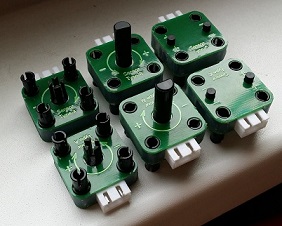
Thanks! I cant add more photo! Try the links: Shells and boards More Shells what is inside full scale photo of the sensors 4 holes are done in size of Lego black pins. Then i glued top and bottom plates whith thermal glue pistol and cut the unneeded glue.
-
I am sorry but there are still 7 speeds. It is build in the IR receiver. I have made a transmitter that allows to use these 7 speeds more comfortable than the train transmitter does.
-
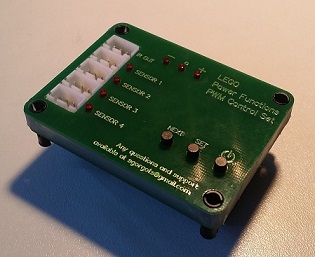
Hello everybody! It is no secret that the Power Functions system allows smooth control of motor power and regulation of the angle movement of servo motor. I have studied this issue and developed a proportional remote control system which was first designed for the management of wheeled and tracked models. But in fact it is a universal device, which can control any Lego models with PF IR Receivers. The system is not a control panel by itself. It represents a set of sensors, control unit and an infrared transmitter module which are made in the form factor compatible with Lego Technic. Here's how it looks Сontrol unit: Sensors of various types: IR transmitter: All this is connected together by wires and must be installed in the transmitter model made from Lego Technic. The device can be fully configured using the front panel buttons but a lot of functions and menu system are difficult to obtain. I wrote a manual, but did not translate it into English yet. Here is a short video showing the basic idea. I'm sorry, my comments are in Russian. At the beginning of the video I configure my system for a specific console design (the system remembers the maximum deviation of controls in this design). At the end of the video I run track model with the remote control, which is shown at the beginning of the video. To manage such a model i have made a special control mode, which converts the signals of throttle and steering into the power of left and right caterpillar motors. I want to find out, whether it can be interesting to someone?