62Bricks
-
Posts
344 -
Joined
-
Last visited
Content Type
Profiles
Forums
Gallery
Everything posted by 62Bricks
-
It's certainly a fake mock-up someone made featuring their own model. Aside from the fact that the model is not of LEGO quality, the image and logo are distorted.
-
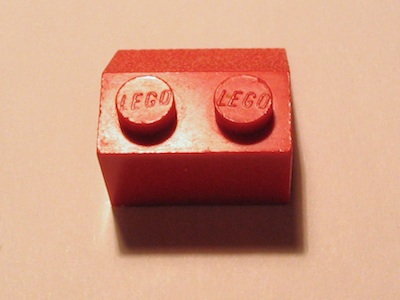
Modern slopes have the logo facing the long side with the L closest to the slope surface. However I have a few old slopes with the logo facing a different way - hollow 2x1 45-degree slopes, red, with the "modern" logo facing the short, square end. I also have a 2x2 45-degree slope with the old style logo facing the square end. In this case, the logos are rotated slightly off center. It's from a North American set, but I'm not sure which. This rotation is what makes me think the logo part of the mold was interchangeable and could possibly become misaligned during production. Or perhaps that part was drilled out and replaced with a round plug that had the logo imprint, and the plug could become misaligned? I'm sure all we can do is speculate at this point, but the quality control that LEGO has exercised over the product since the first days make little imperfections and variations like these fascinating.
-
That seems likely - but are rotated logos common on pre-1962 European bricks? I haven't seen enough of them to know.
-
This is fascinating stuff. I have noticed that it's not uncommon with the Samsonite bricks to find the script logo on the studs rotated from the standard alignment (or sometimes missing altogether), which makes me think the molds of this era were designed with an interchangeable portion that allowed for different marks on the tops of the studs. This would make sense given what you are showing us - it would seem the outer dimensions of the bricks and the studs stayed the same while the wall thickness and tube size were varied to test the clutch power. That would have been the most efficient way, because only one half of the mold would have to be tooled differently for each test run. Then different plugs could be inserted with different letters molded in them to mark each test run. I suppose the interchangeable stud tops served some larger purpose? Perhaps to allow LEGO to change its logo or produce pieces with other logos? I wonder if the logo portion wore out more quickly than the rest of the mold and had to be replaced separately?
-
I have quite a few red and yellow CA bricks from the Samsonite era. Hmm... In the first photo it is hard to tell for sure, but doesn't it look like the light pink brick near the center has the old LEGO logo on the studs? Edited to add: After zooming in I'm pretty sure the pink brick does have the LEGO script logo on the studs. So does the warped-looking white brick in the same bag (near the top of the picture)
-
Are the C bricks any more scarce or desirable to collectors for that reason? Did any of these "heavy metal" bricks make it into North American sets to your knowledge?
-
So, do we know which of these variations was the "winner" that LEGO actually chose?
-
I've always been a parts guy and never really cared about the themes. My son, though, got into Bionicle, then Ninjago, then Hero Factory and I ended up with a lot of those models being played with around the house. I had initially dismissed Bionicle, as the pieces were mostly too specialized for the kind of building I like to do. I changed my thinking slightly when I saw the enormous cool creatures my son made combining all his Bionicle pieces. When he got into Ninjago, he was a bit older and he just liked to build the models and play with the spinners. When he was a little older still and stopped playing with the models, he put them on a shelf for display. Now he's 14, and the other day I was talking to him about how I needed a few more tread links for something I wanted to build and he said, "there are some on one of my ninja cycle models - take any pieces you want from them." So maybe I've raised another "parts guy" after all...
-

Does Lego's emphasis on minifigures change the way kids play?
62Bricks replied to naf's topic in General LEGO Discussion
Again, it isn't Hasbro that owns the right to license Star Wars, it's Disney. If someone else started making Star Wars action figures without a license, it isn't Hasbro who would go after them, it would be Disney. Disney owns the characters and has the responsibility to protect them. -
Unofficial LEGO Sets/Parts Collectors Guide 1949-90s
62Bricks replied to LEGO Historian's topic in General LEGO Discussion
Judging from the warping and the difference in color shades, it looks like most of the 2x4 white plates, the 1x2 gray plates and whatever 2x plates those are alternating along the left edge of the roof are CA, while the more yellowed pieces are later - maybe the restoration on the roof was to the right side, not the left, replacing warped CA pieces? That side doesn't seem to have any CA in it, but all the pieces appear to have yellowed at the same rate, so maybe they're all original. Fascinating (to a select few, admittedly). Also fascinating is that this is made entirely of plates. Except for the windows I don't see a single brick-high piece anywhere. The lack of interlocking would probably make a modern model builder cringe, too. One wonders if this wasn't designed to use up the CA plates. -
Unofficial LEGO Sets/Parts Collectors Guide 1949-90s
62Bricks replied to LEGO Historian's topic in General LEGO Discussion
The different colors are normal discoloration, right? -
Does Lego's emphasis on minifigures change the way kids play?
62Bricks replied to naf's topic in General LEGO Discussion
The Star Wars license is "owned" by Disney and granted by them to Hasbro. These license deals usually include language about exclusivitiy - that Disney agrees not to allow anyone else to license Star Wars action figures while the license with Hasbro is in effect, for example. But license deals expire and are renegotiated, and if LEGO wanted to offer Disney more money for the license to action figures it would be Disney who made the decision, not Hasbro. The current license deal between Hasbro and Disney for the Star Wars and Marvel characters expires in 2020. -
Does Lego's emphasis on minifigures change the way kids play?
62Bricks replied to naf's topic in General LEGO Discussion
Thanks for looking that up - I was remembering it slightly differently. It does confirm what we thought about the Star Wars license. -
Does Lego's emphasis on minifigures change the way kids play?
62Bricks replied to naf's topic in General LEGO Discussion
In the case of licensed figures, in some cases TLG may not be allowed to sell only the minifigures. They must be included in a building set. I recall this from the Cuusoo project that proposed a bucket of only Star Wars troopers. A LEGO representative responded that it would require negotiating a new license, but that if it got enough votes it would be evaluated. This restriction is understandable because other toy companies have the license to sell Star Wars action figures as stand-alone items. I suppose the same is true of Marvel and DC characters. So TLG can only sell them in "battle packs" that include a small model. -
Does Lego's emphasis on minifigures change the way kids play?
62Bricks replied to naf's topic in General LEGO Discussion
The Friends sets are definitely designed to be played with as they are built. TLG explained this when they released the sets, saying that their observations showed girls more often started playing with the figures before the set was completely built. So they arrange the bags and instructions to promote this. It might be that this is not strictly a "girl" thing. It might be that the presence of minifigs overshadow the building aspects regardless of gender. -
How to store LEGO to avoid scratches on bricks
62Bricks replied to Adam87's topic in General LEGO Discussion
Here is an interesting graphic about the hardness of plastic types: The scale reads from left to right in order of ascending hardness. Plastic types are harder than the ones positioned to the left, and may scratch them if they come in contact. (A plastic's hardness is not the same as its resistance to scratching) Most LEGO pieces are made from ABS plastic, which is a polystyrene plastic. Plastic storage units like the one pictured at top in the original post have drawers that are usually also made from polystyrene. The drawers in the LEGO storage unit pictured above are made from polypropylene, which is softer than ABS plastic and will not scratch it. It is not the storage container itself that puts little scratches on LEGO parts, or even other LEGO parts (try scratching one brick with the corner of another - you may get a scuff, but it will wipe off). The scratches are caused by little bits of grit and dirt that are rubbed against the pieces as they are handled and played with. Keeping scratches off LEGO pieces is mostly a matter of keeping them clean. Nylons are higher on the scale than polystyrene. Nylon is a common fiber used in carpeting, and even though the individual fibers are small and flexible, they may be able to scratch ABS plastic. Carpets also contain lots of tiny bits of grit, of course. Keeping pieces off the floor will help keep them from getting scratched. Also note that polystyrenes are slightly less hard than bone in the chart above, which you can confirm by biting any LEGO brick. -
This has happened to me - a lot that was advertised as "maybe has a few non-LEGO pieces" turned out to be only about half LEGO. I sent the seller a picture of the two piles I sorted and he gave me a partial refund. I don't think most people are trying to be deceitful, they just can't tell / don't know about the difference.
-
A different way to classify LEGO elements
62Bricks replied to 62Bricks's topic in General LEGO Discussion
One reason I'm kind of obsessed with this question of classification right now is because of the news that Bricklink is asserting its control over its own method of naming, numbering and classifying parts. Its intention, of course, is to prevent commercial competitors from piggybacking on its database. I think most people can understand why they would want to do that, but the result is that other sites - even sites that do not compete directly with Bricklink, like Rebrickable - are severing all ties with Bricklink and using information from other sources. So I think over time we are going to see a wider divergence in how parts are classified and named. Bricklink has a lot of influence because it is the oldest and largest of the secondary market sites. It remains to be seen how tight a hold they will keep on the use of their classification system, or what other sites they might go after for using it. The example set by TLG is wonderful - essentially, as long as you do not create any confusion about whether you are actually representing TLG officially, you are free to share images, information, instruction scans, etc. It is this kind of openness that allowed Bricklink to even exist in the first place. I'm not going to condemn Bricklink for its decision, but I think it's an opportune moment for the LEGO community to be taking a look at the collective work that has already been done creating a system that describes the domain of LEGO elements. It needs improvement and greater consistency, and there are tools available now that were not available 15-20 years ago when we came online. If Bricklink wants to keep its system all for itself, I say let them have it. It's riddled with inconsistencies and illogical classifications. -
Another thing to look for in eBay lots are pieces and references to military-themed sets. With only a few exceptions, TLG has not made modern military-themed parts or sets, so bits of battleships, tanks, etc. are likely to be from non-LEGO sets. I looked up the auction and saw the full weight and what you paid for the lot, which is on the high end of what you would have paid in the US for a similar lot (even with non-LEGO mixed in), but not unreasonable.
-
You'll get good at spotting non-LEGO pieces if you continue to browse eBay auctions. I buy a lot of lots and rarely are they completely "clean". Looks like you have a pretty big lot there to sort through, which will give you plenty of practice!
-
A different way to classify LEGO elements
62Bricks replied to 62Bricks's topic in General LEGO Discussion
This is what I'm saying - rather than considering slopes as modified bricks and measuring them in the same way, Bricklink (and Peeron/Ldraw, for the most part, before it), uses the size of the slope to define the dimensions of the piece. But really there is no logic behind this, it's just an arbitrary convention. If you take a 2x4 brick and rotate it 90 degrees it does not become a 4x2 brick. Its dimensions are the same. A consistent system should categorize all pieces that have the same footprint - 2 studs in one direction and 4 studs in the other - as having the same width and length dimensions. The 45-degree 2x4 slope piece has the same dimensions as an 18-degree 4x2 slope piece. Information about the slope is already given in the naming convention (18-degree, 33-degree, 45-degree, etc.). There's no need to alter the WxLxH convention just for slopes. This oddity becomes especially apparent when using a parts database. Computers need consistency to put things in proper order. Ironically, it may be computers that led to this weirdness in the first place. I'm not sure, but I expect that measuring slopes this way came from LDraw, where the .dat files give pieces a default X,Y,Z orientation. [edited to add:] I see that TLG, although also inconsistent, uses the same method to measure slopes as it does to measure bricks. Thus is a "roof tile, 2x4x1, 18-degrees" -
A different way to classify LEGO elements
62Bricks replied to 62Bricks's topic in General LEGO Discussion
Another potentially confusing "standard" that Bricklink uses is in expressing the dimensions of pieces. For bricks and plates, the shorter dimension is given first - a 2x4 brick, for example. It is different for slopes, however, where the sloped dimension is given first - This is a 4x2 slope, for example: One the one hand, this convention might have been thought useful as it indicates the direction of the slope, but on the other hand it breaks the convention used for almost every other type of piece. Bricklink's general philosophy seems to assume a core type of piece, then call extended or variant versions of that piece "modified." Rather than consider slopes "modified" bricks, however, it has made them a core piece type with its own scheme for expressing dimensions. -
Does Lego still make non-minifig printed parts?
62Bricks replied to danth's topic in General LEGO Discussion
Of course many of us will remember stickered minifigs - I have several firefighters and a few classic space astronauts with stickered torsos rather than printed. I don't recall having to apply the stickers, though - were they applied at the factory? -
Where to purchase, and information about Modulex!
62Bricks replied to rollerbones's topic in General LEGO Discussion
Gary - Do you have any information on the amount of Modulex that was produced? It's obviously more scarce than LEGO, but there seems to be a fair bit available. Was it ever sold in the US/Canada? -
A different way to classify LEGO elements
62Bricks replied to 62Bricks's topic in General LEGO Discussion
You're right about the cheese slope, it has characteristics of both the Tile and Slope categories. But in the current system, these pieces that are halfway between categories get put in one or the other with no consistent criteria. Texture is an interesting characteristic. Many slopes are textured but not all. There are other textured pieces, too, like the log pieces, the grille tiles, the 1x2 bricks with the masonry pattern and the bricks with the grille texture. Bricklink calls these textured pieces "modified". Slopes with texture are not considered "modified" however. This is probably because almost all straight-angled slopes are textured. To a person unfamiliar with this external information this is potentially confusing - a texture is sometimes a modification and sometimes not.